
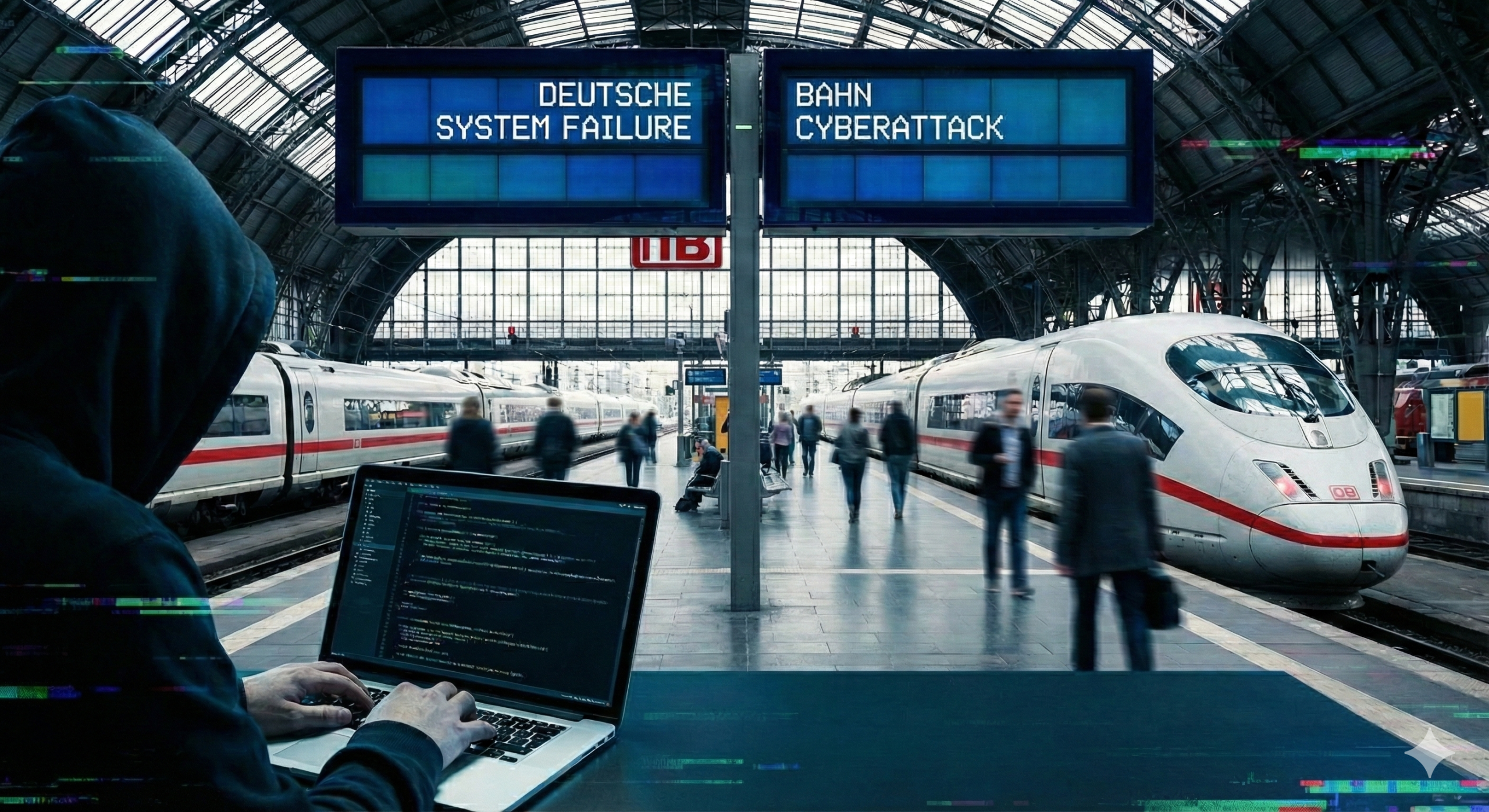

When a major national infrastructure provider like Deutsche Bahn experiences a large-scale digital disruption, the first reaction is often dramatic. Headlines quickly speak about “cyber attacks” and “hacked systems.”
According to public reporting, the disruption was likely caused by a DDoS attack. A DDoS attack does not necessarily mean that attackers have penetrated internal systems or stolen sensitive data. Instead, it overwhelms digital services with massive amounts of traffic, causing systems to slow down or become temporarily unavailable. In the DB case, ticket counters and digital services were affected, leading to significant operational disruption across Germany. At the same time, there is no confirmed evidence that attackers gained deep access to core infrastructure systems.
This distinction is important. It shows that not every cyber incident is a full system compromise. It also shows that even well-prepared organizations with strong IT infrastructure can experience temporary service failures under extreme external pressure. Interestingly, on the same day, other digital services such as Microsoft Teams reported increased technical problems. While not necessarily directly connected, this highlights another key reality: modern digital ecosystems are interconnected. When one element is under pressure, effects can spread quickly.
What makes this case relevant for businesses is not panic — it is perspective. Deutsche Bahn is known to have strong IT structures and significant security resources. The disruption was serious and affected large parts of the country, but it was also resolved relatively quickly. That is not a sign of weakness. It is a sign of operational resilience. The DB incident is not simply a story about one company being attacked. It is a practical example of how digital dependency creates operational risk — even for organizations that are well equipped.
For small and mid-sized businesses, this is especially relevant. You may not manage national transport systems, but you rely on digital tools, cloud services and online platforms every day. If those systems fail — whether through attack or overload — your operations can stop immediately. The question is no longer whether incidents can happen. The question is how prepared your organization is when they do. And in today’s connected business environment, that question concerns almost every company.
1. Size Does Not Mean Security
One of the most important lessons from the Deutsche Bahn incident is the difference between a disruption and a system compromise. In public discussions, the term “cyber attack” often creates the image of hackers breaking into internal databases, stealing confidential information or taking full control of critical infrastructure. However, not every incident follows this scenario.
In this case, reports suggest a Distributed Denial-of-Service (DDoS) attack. A DDoS attack works differently from a traditional intrusion. Instead of secretly entering internal systems, attackers flood public-facing services with massive amounts of traffic. The goal is not necessarily data theft. The goal is overload. When digital services are overwhelmed, they slow down or stop responding. For Deutsche Bahn, this meant that ticket counters and digital systems were temporarily unavailable. The operational impact was significant. Customers were affected across Germany. But there is currently no confirmed evidence that attackers gained deep access to core infrastructure systems. This distinction matters.
From a strategic perspective, a DDoS attack tests resilience, not necessarily confidentiality. It challenges availability. And availability is a critical pillar of cybersecurity. If customers cannot access services, operations are disrupted. Revenue can be affected. Reputation may suffer. But the internal structure of the organization may still remain intact.
For executives, this creates an important shift in thinking. Cybersecurity is not only about preventing data theft. It is also about ensuring service continuity under pressure. The DB case demonstrates something important: even organizations with strong IT infrastructure and security investment can experience temporary service disruption. No system is unlimited in capacity. Even well-prepared networks can be stressed. At the same time, the fact that services were restored relatively quickly shows operational maturity. Strong infrastructure does not mean zero incidents. It means the ability to respond, stabilize and recover.
For businesses, this leads to a practical question: If your public-facing systems were overloaded tomorrow, how long could you maintain operations? Would customers still be able to place orders, access support or complete transactions? Or would your business come to a standstill? Understanding this difference between breach and disruption helps leaders move away from emotional reactions and toward structured risk assessment. Not every incident means catastrophic failure. But every incident reveals how prepared an organization truly is.
2. One weak link is enough
Most cyber incidents do not happen because an entire system collapses at once. They happen because one small element fails. One overlooked weakness can create an entry point. And once attackers find that entry point, they do not need everything to be vulnerable. They only need one opportunity. In many cases, the initial trigger is simple. It may be a phishing email that looks convincing enough for an employee to click. It may be a weak or reused password that can be guessed or cracked. It may be an outdated server that has not received security updates. Sometimes it is not even the company itself, but a third-party provider with lower security standards.
Modern organizations are no longer isolated structures. They are connected ecosystems. Companies rely on cloud platforms, external software vendors, remote access systems and digital supply chains. Every integration increases efficiency. But every integration also increases dependency. If one supplier is compromised, the impact can spread. If one employee account is taken over, attackers may move laterally inside the network. If monitoring is not active, unusual activity may remain undetected for hours or days.
This is why cybersecurity cannot be reduced to a single tool. Installing a firewall or antivirus software is not enough. Technology alone does not close structural gaps. Security must be layered. It must include technical controls, clear internal processes, defined responsibilities and regular reviews. A company may believe it is secure because major systems are protected. But attackers do not usually attack the strongest point. They look for the weakest one.
The lesson for business leaders is clear: resilience depends on consistency. Every element matters. Password policies matter. Access rights matter. Update cycles matter. Vendor risk management matters. Cybersecurity is not a one-time investment. It is not a product that can be bought and forgotten. It is an ongoing system of controls, awareness and verification. And in complex digital environments, one weak link is often enough to test the strength of the entire chain.
Modern cyberattacks rarely start with dramatic system takeovers. In many cases, they begin quietly — with small vulnerabilities, social engineering or overlooked technical gaps. This is how modern cyberattacks really begin – a look behind the scenes.
In many organizations, the first six hours determine whether an incident remains manageable or turns into a crisis. As discussed in our analysis of what really goes wrong in the first 6 hours after a cyberattack, confusion, delayed decision-making and unclear responsibilities often cause more damage than the attack itself.
3. Incident Response Is as Important as Prevention
One of the most important lessons from the Deutsche Bahn incident is not only that a disruption occurred — but how it was handled. No organization can guarantee that incidents will never happen. Even strong infrastructure, experienced IT teams and advanced monitoring systems cannot create perfect protection. What truly defines maturity is not the absence of incidents. It is the quality and speed of the response.
In the DB case, the disruption was serious. Ticket systems and digital services were affected across Germany, operations were interrupted, and customers experienced delays and uncertainty. However, services were restored relatively quickly, which shows that internal response mechanisms were active and structured. For business leaders, this is a critical distinction: the financial and reputational damage of a cyber incident often depends less on the initial attack and more on how long systems remain unavailable.
The longer a disruption lasts, the greater the impact on customers, partners and internal operations. Orders may be delayed, communication may break down, trust may weaken and media attention may increase pressure. A prepared organization reacts differently. There is a clear chain of responsibility — decision-makers know who must act, technical teams follow predefined procedures, communication is coordinated and backup systems are activated if necessary. Without this preparation, response becomes chaotic. Teams waste time trying to understand what is happening, responsibilities are unclear, communication is inconsistent and recovery takes longer than necessary.
This is why incident response planning is not optional. It is a strategic requirement. Every organization should be able to answer a set of simple but essential questions: Who detects the incident? Who makes the first decision? Who informs customers or partners? How fast can systems be restored? If these answers are unclear, the risk increases significantly.
The DB case shows that even a large-scale disruption does not automatically lead to long-term collapse — if response structures are strong. Resilience is not about avoiding pressure. It is about functioning under pressure. For small and mid-sized businesses, this lesson is even more important. Recovery resources are often limited, there may be no 24/7 security team, and external support may take time. Therefore, preparation must happen before an incident occurs. Cyber resilience is measured in hours, not in intentions. And when systems are under attack or overload, response speed becomes the difference between disruption and crisis.
Companies that want to prepare systematically should develop a structured Cyberattack Emergency Response Plan, defining roles, communication channels and recovery priorities before an incident
4. Reputation and Trust Are Fragile
When a cyber incident affects a large organization like Deutsche Bahn, the technical disruption is only one part of the story. The second and often more sensitive dimension is public perception. Customers do not analyze technical details. They do not differentiate between a DDoS overload and a deep system breach. What they experience is simple: services are unavailable, systems do not work, communication is delayed. From the outside, disruption looks like instability. In industries connected to infrastructure, transport or public services, reliability is expected. People assume that systems will function. When that expectation is interrupted, trust can weaken — even if the technical damage is limited. This is an important lesson for businesses of every size.
Cybersecurity is not only about preventing attackers from entering systems. It is also about protecting reputation. A short disruption may be technically manageable, but if communication is unclear or inconsistent, the reputational impact can increase significantly. Transparency plays a central role here. Organizations that communicate clearly during incidents often protect trust better than those that remain silent. Customers understand that technical problems can occur. What damages trust is uncertainty and the absence of information.
The DB case shows that large-scale disruption does not automatically lead to long-term reputational damage — especially when systems are restored quickly and communication remains controlled. However, it also demonstrates how visible digital dependency has become. When digital systems fail, the impact is immediate and public.
For small and mid-sized businesses, this dimension is often underestimated. Many assume that media attention only affects large corporations. But reputation risk exists at every level. In local markets, trust is even more personal — a serious incident can quickly spread through word-of-mouth, online reviews or social media. Leadership must therefore understand cybersecurity as both a business continuity issue and a reputation management issue, not only as a technical IT topic. In today’s digital economy, operational stability is part of your brand identity. Customers expect reliability. Partners expect resilience. Investors expect preparedness. Technology enables your business. Trust sustains it. And every cyber incident tests both.
The idea that “we are too small to be attacked” remains one of the most costly misconceptions in modern business cybersecurity.
5. Visibility Is More Important Than Tools
One of the most underestimated factors in cybersecurity is visibility. Many organizations believe they are secure because they have invested in tools — antivirus software, firewalls, cloud security features. But investment alone does not automatically create control. Real security begins with understanding.
Do you know which systems are publicly exposed? Do you know which employees have administrative access, or which external providers can reach your internal data? Do you know when your backups were last tested successfully? Without clear answers to these questions, there is no true visibility. And without visibility, risk cannot be managed effectively.
The Deutsche Bahn incident illustrates this principle in a broader way. Even if internal systems were not deeply compromised, the disruption showed how dependent operations are on digital availability. When systems are stressed, leaders must quickly understand what is affected, what is still functioning and what must be prioritized. This requires structured oversight, documentation, regular testing — and most importantly, executive awareness.
Cybersecurity is often delegated entirely to IT departments. While technical teams play a critical role, risk ownership cannot be outsourced. Business leaders are responsible for continuity, reputation and operational stability, and therefore they must also understand their organization’s digital exposure. Visibility does not mean knowing every technical detail. It means understanding the risk landscape at a strategic level: Where are the critical dependencies? Which systems would stop operations if they failed? Which processes have manual fallbacks? How long can the business function without core digital services?
In many companies, these questions are not regularly reviewed. Risk assessments become outdated. Vendor reviews remain incomplete. Access rights accumulate over time without systematic cleanup. Incidents like the DB disruption serve as reminders that digital environments are dynamic — new tools are added, new integrations are created, remote access increases. Each change slightly modifies the risk profile. If leadership does not actively review this landscape, blind spots grow.
The goal is not perfection. No company can eliminate all risk. The goal is awareness, prioritization and continuous adjustment. Cybersecurity becomes effective when it is treated as part of strategic governance, not as a background technical function. Visibility creates control. Control enables resilience. And resilience protects the business when disruption occurs.

Conclusion: What businesses can learn from the DB DDoS attack
The DB DDoS attack was not a story about total system collapse. It was a story about disruption under pressure. Services were temporarily unavailable, operations were affected nationwide — but systems were restored and core infrastructure remained stable. This is exactly why the incident is valuable as a case study. What businesses can learn from it is not fear, but perspective.
Even well-prepared companies can experience disruption. Digital environments are complex and interconnected, and no company is completely immune to overload or external pressure. But resilience matters more than perfection. The speed of detection, response and recovery determines the real impact of an incident. Strong structures reduce chaos, and clear responsibilities reduce downtime. At the same time, visibility and leadership awareness are essential. Cybersecurity is not only a technical issue — it is part of operational stability, reputation management and long-term business continuity.
The incident also reminds us that availability itself is critical. A DDoS attack does not need to steal data to cause damage. If customers cannot access services, trust is tested immediately. The DB case shows that disruption can happen even in highly structured environments. The difference lies in preparation. For every organization, the essential question remains: if your systems were under pressure tomorrow, would your business continue to function? Cyber resilience is not built during a crisis. It is built before one. And that is the real business lesson.
Stay informed about real-world cyber incidents and practical business resilience strategies.
Follow my Facebook page for structured insights and executive-level cybersecurity analysis.