
What happens in the first hours after a cyberattack? Let’s get find out in this Article. When people think about a cyberattack, they often imagine one dramatic moment: a warning message, locked files, or systems that suddenly stop working. In reality, this moment is rarely the real problem. What causes the most damage usually happens after the attack is noticed.
The first six hours are the most critical phase of a cyber incident. Not because of complex technology, but because people are under pressure. Decisions are made quickly, often without enough information or structure. Uncertainty, fear of making mistakes, and unclear communication shape this phase.
Attackers understand this very well. They know that organizations hesitate, argue, or act without a clear plan during the early hours. While teams try to understand what is happening, attackers often continue their work in the background. By the time the situation feels “official” or external help is involved, important damage is already done. Many early decisions cannot be reversed.
This article looks at what really goes wrong in the first six hours after a cyberattack. Not in theory, but in reality. Because cybersecurity rarely fails because of missing tools. It fails when pressure, confusion, and human reactions take over.
Before the 1 hour: Shock, Confusion, and Silence
The first hour after an attack is rarely about technology. It is about human reaction. When something goes wrong, many people do not act immediately. They hesitate. They try to understand the situation before they respond. Employees may notice that systems behave strangely. Files are suddenly missing. Login attempts fail. Applications react slowly or not at all. At this point, no one is sure whether this is a serious security incident or just a temporary technical problem.
Instead of reacting, people often wait. They hope the issue will resolve itself. They avoid escalation because they do not want to cause unnecessary panic or make a wrong decision. This leads to silence, especially in organizations without clear incident procedures.
This silence creates a critical window of time. While internal discussions are delayed, attackers are usually still active. They continue to move through the network, access additional systems, and collect more data. In many cases, they also prepare the environment by weakening backups or security controls.
During this first hour, the damage often grows quietly. Nothing looks dramatic yet, but the situation becomes more complex with every minute. By the time the organization agrees that this is a real incident, important opportunities for containment may already be lost.
Hour 1–2: Improvised Decisions Without a Plan
After the initial shock fades, pressure quickly increases. People realize that the problem will not disappear on its own, and the need to act becomes stronger. This is usually the moment when activity starts—but not always in a coordinated way.
Decisions are often made without a clear plan. Systems are restarted, accounts are reset, and network connections are changed. These actions feel necessary, but they are rarely documented or aligned. Different teams may act at the same time without knowing what the others are doing.
The intention is to stop the damage as fast as possible. However, this rush can create new problems. Important logs may be overwritten, temporary evidence can be lost, and the real entry point of the attack becomes harder to identify. In some cases, attackers notice these changes and adapt their behavior.
During this phase, organizations often act on assumptions instead of facts. There is little verified information, but strong pressure to show progress. This combination leads to actions that look decisive but reduce visibility and control.
The second hour is therefore critical. It often defines whether the incident response will stay structured or become chaotic. Once important information is lost, later analysis becomes slower, more expensive, and less reliable.
Hour 2–3: Communication Breaks Down
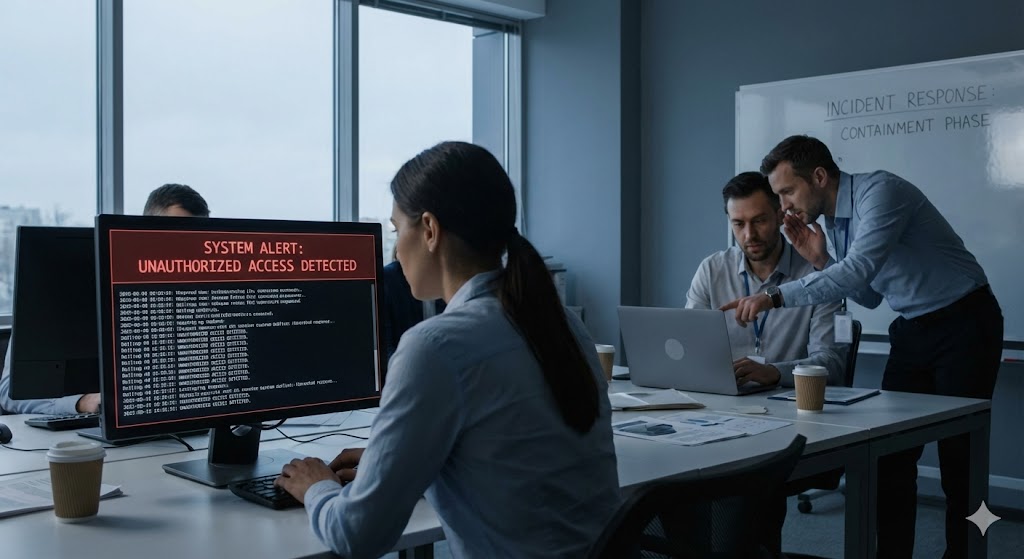
By the third hour, the incident is no longer limited to technical teams. Management becomes involved, external service providers may be contacted, and internal questions increase. At this point, communication becomes a central issue.
Information is incomplete and often inconsistent. Different people have different interpretations of what is happening. Some believe the situation is under control, while others suspect a much larger problem. Without a central coordination point, these views exist side by side.
Instructions begin to conflict. Employees are unsure whether they should continue working, disconnect systems, or stop using certain tools. Messages are passed on informally, sometimes through private channels, without clear confirmation.
This confusion creates risk. Well-intended actions can interfere with containment efforts or unintentionally spread the problem further. At the same time, attackers may still have access and observe internal reactions.
The longer this phase lasts, the harder it becomes to regain control. When communication lacks clarity, trust inside the organization starts to weaken. And once trust is damaged, effective response becomes much more difficult.
Hour 3–4: The Search for Someone to Blame
Around the third or fourth hour, a subtle but dangerous change often happens. The focus slowly moves away from understanding and containing the attack and toward internal questions and concerns. People start asking how this could have happened and who might be responsible. Attention shifts to individual actions, past decisions, or possible mistakes. This is rarely spoken openly, but it strongly influences behavior. Employees become more careful about what they say or share.
As a result, important details may be delayed or softened. Small observations that could help the investigation are not mentioned immediately. Cooperation becomes slower, even if everyone is acting with good intentions. At the same time, decision-making becomes more cautious. Leaders worry about consequences, visibility, and long-term impact. Technical response loses momentum while discussions grow longer and more complex.
This phase weakens the response without anyone noticing it directly. The incident is still active, but energy is divided. Attackers benefit from this loss of focus, because containment and clarity are no longer the only priorities. Once attention drifts away from the incident itself, regaining a clear and structured response becomes much harder.
Hour 4–5: Legal and Business Risks
By the fourth or fifth hour, the technical incident begins to feel like a business problem. Questions about legal responsibility, data protection, and public image move into the foreground.
Management starts to consider whether personal or customer data could be affected. There is uncertainty about reporting duties, regulatory deadlines, and possible consequences. Without preparation, these questions slow down decisions instead of guiding them.
At this stage, many organizations become extremely cautious. Statements are delayed, information is limited, and actions are postponed to avoid saying or doing something wrong. This often creates a false sense of safety. Internally, people wait for approval before moving forward. Externally, nothing is communicated yet. Meanwhile, the attackers may already have clear proof of access or stolen data and are preparing the next step.
The problem is not legal awareness itself. The problem is timing. When legal and reputational concerns take control too early, technical containment loses priority. This delay can increase damage and extend recovery time. What feels like protection in this phase often turns into risk.
Hour 5–6: Long-Term Impact
By the sixth hour, the situation feels more stable on the surface. Initial chaos has slowed down, and some form of structure may finally be in place. However, many of the most important outcomes are already decided.
Data that was taken during the early hours is gone. Systems that were changed without documentation are difficult to reconstruct. Missed evidence cannot be recovered. What happened during the first hours now defines how complex recovery will be.
At this point, response efforts often shift toward cleanup and damage control. Teams focus on restoring systems and explaining the situation internally. But containment is no longer as effective as it could have been earlier. The real issue is not that mistakes were made. Under pressure, mistakes are normal. The problem is that early decisions, hesitation, and unclear coordination have long-term effects.
By the end of the sixth hour, the attack itself may no longer be the biggest threat. The lasting impact is shaped by how the company reacted when clarity was missing and pressure was high. This is why the first six hours matter more than any later response step.
The Real Lesson
Cybersecurity is often described as a technical challenge. Firewalls, tools, updates, and prevention measures receive most of the attention. While these elements are important, they do not define how an organization survives an incident. What truly matters is what happens immediately after prevention fails.
The first six hours are not a test of technical perfection. They are a test of clarity under pressure. During this time, success depends on whether people know their responsibilities, whether communication follows a clear structure, and whether actions are taken in a controlled and traceable way.
Organizations that prepare for this phase do not react faster because they panic less. They react better because decisions are not made in isolation. Information flows in the right direction, actions are documented, and priorities remain clear even when the situation is uncertain.
As a result, these Companies recover more quickly and with less disruption. Downtime is shorter, data loss is limited, and trust can be rebuilt more easily. Organizations that ignore this reality often discover it too late. Without preparation for the early hours, even a manageable incident can turn into a long and expensive crisis. Cybersecurity does not fail when an attack happens. It fails when response replaces structure with improvisation.
The 5 Executive Mistakes in the First 60 Minutes
When a cyberattack hits, the technical breach is only one part of the damage.
What often escalates the situation is not the malware itself —
but executive reactions made under pressure.
These five mistakes repeatedly turn a manageable incident into a business crisis.
1️⃣ Pulling the Power Plug in Panic
The instinct to immediately shut down compromised systems is understandable.
It is also frequently destructive.
Modern ransomware variants store encryption keys and volatile traces in RAM.
A hard shutdown can permanently eliminate the possibility of forensic recovery.
What feels like “taking control” may irreversibly destroy evidence.
2️⃣ Deleting “Suspicious Files” Too Early
The urge to clean up servers quickly is strong.
But deleting files, restoring backups prematurely, or “tidying up” logs destroys the attack timeline.
Without forensic clarity, you cannot determine:
-
How the attacker entered
-
How long they were present
-
Whether persistence mechanisms remain active
Premature cleanup often guarantees repeat attacks.
3️⃣ Changing Passwords Without System Verification
Mass password resets may create a false sense of security.
If attackers still maintain administrative access (e.g., through a rootkit or compromised domain controller), they may capture new credentials in real time.
Without verifying system integrity first, password changes become cosmetic.
4️⃣ Looking for a Scapegoat
Blame culture is a silent multiplier of damage.
If employees fear consequences, they withhold observations:
-
Suspicious emails
-
System anomalies
-
Timeline details
In a crisis, information flow is more valuable than accountability.
Stability requires coordination — not accusation.
5️⃣ Installing Random “Recovery Tools” from the Internet
In desperation, many organisations download unverified “decryption tools.”
These tools often:
-
Permanently corrupt encrypted files
-
Introduce additional malware
-
Destroy forensic admissibility
Well-intentioned shortcuts frequently eliminate professional recovery options.
Executive Takeaway
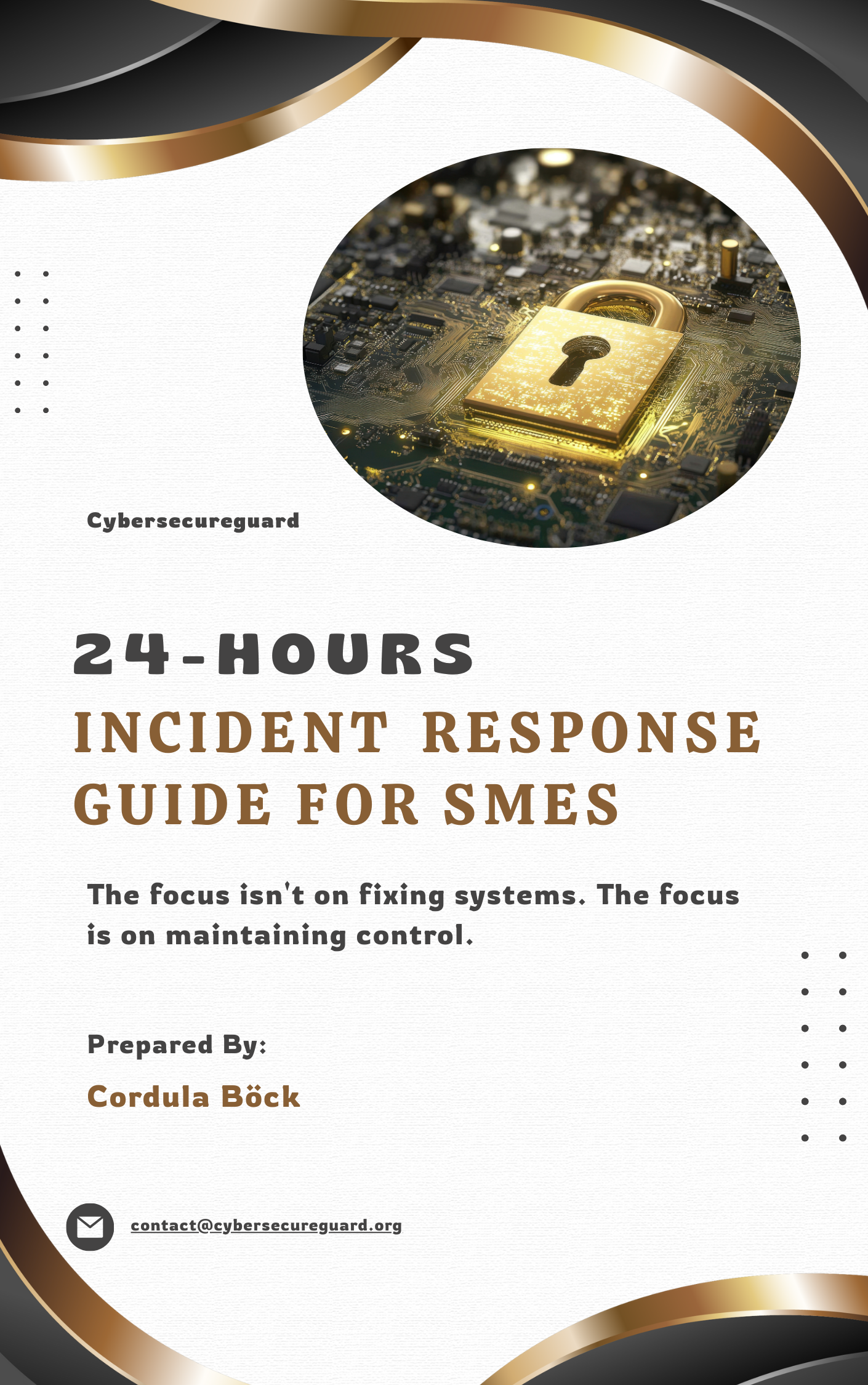
Cyber incidents are rarely lost in the first minute. They are lost through unstructured reaction in the first hour. If your organisation does not have predefined response logic, you are relying on adrenaline instead of structure. For a detailed 24-hour executive response framework — including role assignment, escalation logic and documentation structure — the full Incident Response Plan outlines the process step by step.
If you recognise these early pitfalls, you are already ahead of most organisations.
But knowing what goes wrong is only half the story — the more important part is knowing what to do next, step by step.
For a structured, executive-oriented response framework covering the first 24 hours, including role assignments, escalation logic, documentation strategy, and operational checkpoints, you can explore the Incident Response Plan for Small Businesses here:
This is not another generic checklist — it is a pragmatic framework for real business scenarios.
Conclusion: What Happens in the First Hours After a Cyberattack
The first hours after a cyberattack are rarely defined by technology alone. They are defined by human behavior under pressure. Confusion, hesitation, and unclear communication often shape this phase more than the attack itself. What happens in the first hours after a cyberattack determines how much control an organization keeps. Early silence, uncoordinated actions, and delayed decisions allow damage to grow quietly. By the time the situation feels stable, many outcomes are already fixed.
Companies that prepare for these first hours respond with more clarity and less panic. They know who is responsible, how information flows, and which actions must be taken first. This preparation does not prevent attacks, but it limits their impact. Those who ignore this phase often focus too much on recovery and too little on response. As a result, incidents become more expensive, more disruptive, and harder to explain. Cybersecurity does not fail when systems are breached. It fails when the first hours are left to chance. Understanding this reality is one of the most effective steps toward real cyber resilience.
I recommend you read the following articles
How to Build a Simple and Effective Cybersecurity Plan for Your Team
I’m Too Small to Be a Hacker” – The Most Expensive Mistake in the Middle Class
The Role of Firewalls in Modern Business Cybersecurity
Why cyberattacks are successful: Understanding the real causes (Part 1 of 4)