

The Silent Beginning of a Digital Disaster
Hacking attacks never start with a bang or a spectacular explosion. They begin quietly, inconspicuously, almost mundanely. With a single thoughtless click on a seemingly harmless link. With a password consisting of a birth date and the company name. With a USB stick apparently lost in the company parking lot and “found” by a helpful employee. With an IT team that is chronically understaffed, juggling a hundred urgent tickets, and barely has time to think about basic security measures.
The truth about modern cyberattacks is frighteningly simple: They don’t primarily exploit technical vulnerabilities—they exploit human habits, time pressure, and the fatal assumption that “it won’t happen to us.”
The Dangerous Misconception: “We’re Not Interesting Enough”
Many companies—especially small and medium-sized businesses—rest in deceptive security. “We’re far too small for hackers,” you hear again and again. “We don’t have sensitive data.” “There’s nothing worth stealing from us.” But reality paints a completely different picture: Small and medium-sized enterprises (SMEs) are precisely in the crosshairs of professional attackers.
Not because these companies are doing something fundamentally wrong. But because attackers know exactly how easily human routines, trust, and everyday normalcy can be exploited. SMEs often have:
- limited IT budgets and small, overworked IT departments
- less sophisticated security infrastructures than corporations
- employees without regular security training
- a higher willingness to find “pragmatic solutions”—even when these open security gaps
- business relationships with larger firms—and thus become backdoors into more valuable networks
For cybercriminals, SMEs are the perfect target: easy to compromise, often willing to pay, and rarely able to detect or fend off attacks quickly.
A Documentary Journey into the Minutes Before Collapse
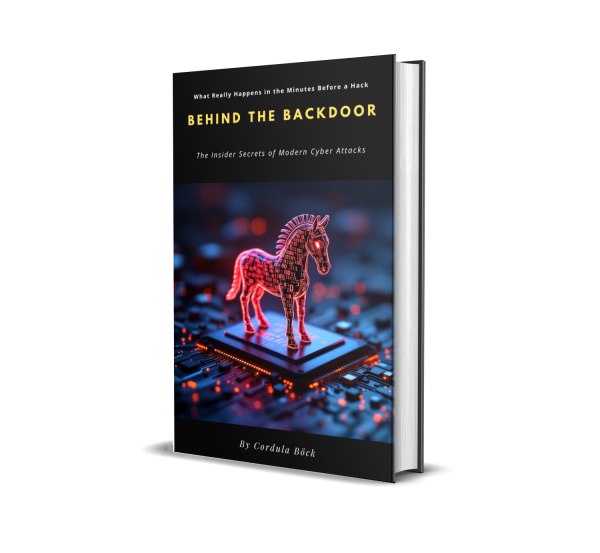
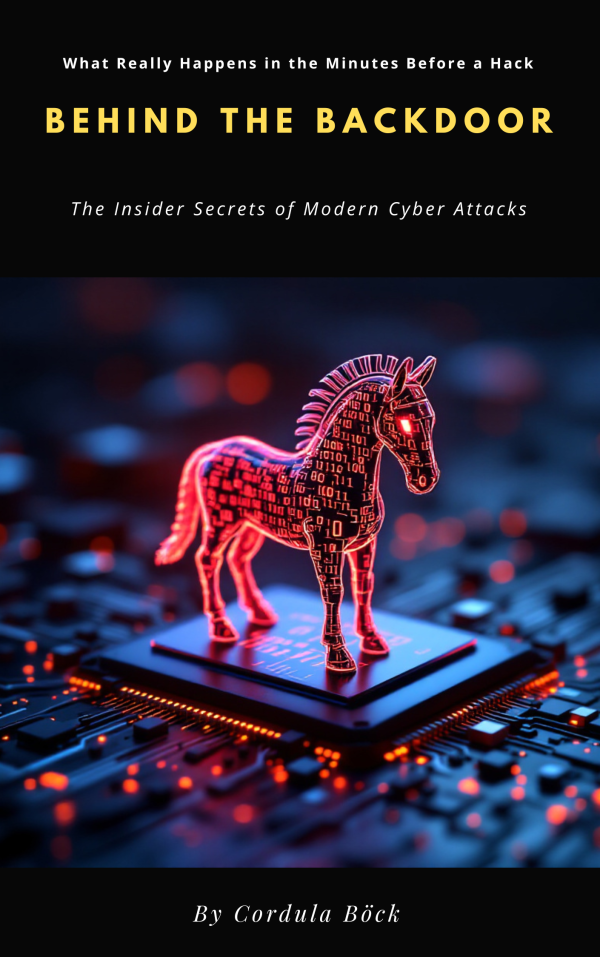
“Behind the Backdoor” takes you on an intense journey into the critical minutes and hours before a cyberattack. That moment when everything still appears normal—but the catastrophe has already begun its course.
The book is based on real cases, including well-known German ransomware incidents such as the devastating attacks on companies like Malibu and Pilz in 2018, both of which were crippled by encryption trojans and were inoperable for days. It reveals with brutal clarity:
The True Entry Points of Modern Cyberattacks
Weak Passwords as Company Killers Why a single password like “Summer2024!” is enough to bring an entire company to its knees. How attackers systematically search for reused, simple, or standardized credentials—and crack them within minutes. What happens when an admin account is compromised and no one notices until data is encrypted and ransom demands in the six-figure range appear on screens.
Social Engineering: The Art of Human Manipulation What does social engineering really look like in practice? Not like in Hollywood movies, but in everyday German office life. It’s the supposed call from the IT service provider who “urgently needs your credentials for maintenance.” The polite email from the “new business partner” who just quickly needs an invoice. The CEO allegedly requesting an urgent transfer from vacation. The book shows through concrete scenarios how skillfully attackers build trust, fake authority, and create pressure.
Fake Portals and Insidious Deceptions The role of deceptively authentic-looking loan portals, IT hotlines with familiar voices, fake cloud login pages, and perfectly replicated company websites. How attackers purchase domain names that differ from the original by just a single letter. How phishing sites are set up within hours and disappear again—after they’ve found their victims.
The Browser Pop-up That Becomes a Nightmare Why a single, harmless-looking browser window is enough to open a backdoor into the company network. How supposed “security warnings” trick users into installing malware themselves. What happens when an employee clicks “Allow” because the warning looks so urgent and official.
IT Service Providers as Unwitting Vulnerabilities A particularly insidious reality: Many IT service providers themselves become security gaps without knowing it. Because they have remote maintenance access to dozens of clients. Because their own systems aren’t adequately protected. Because a single compromised technician’s laptop becomes a master key to all managed companies. The book illuminates why your IT partner’s security directly affects your own security.
USB Baiting, Fake Wi-Fi Networks, and Hasty Decisions The tactic of “USB baiting”: Prepared USB sticks are deliberately placed in company parking lots, entrance areas, or conference rooms. Curiosity or helpfulness leads to them being plugged in—and the malware runs automatically. Fake Wi-Fi hotspots with names like “Company_Guest” or “Conference_WiFi” that intercept all data traffic. Decisions under time pressure: The boss needs immediate access, the colleague forgot their password, the customer is waiting—and suddenly security rules are “exceptionally” ignored.
The Frightening Silence of Modern Cyberattacks Perhaps most terrifying: Modern cyberattacks are so quiet, so inconspicuous, that no one notices them—until it’s too late. Attackers often spend weeks or even months in the network, observing, collecting data, spreading. They operate outside business hours, delete log files, disguise their activities as normal IT processes. Until the moment when suddenly all screens display a ransom demand and the entire IT infrastructure is encrypted.
A Book Like a exciting documentary
Each chapter of “Behind the Backdoor” reads like an episode of a gripping documentary: intensively researched, shockingly realistic, compellingly told—and often disturbingly down-to-earth. No exaggerated Hollywood scenarios, but the sober, almost banal reality of German offices, medium-sized production facilities, trades businesses, and service providers.
You experience how an accountant responds to an email that appears to be from her boss. How an IT technician takes what seems like a routine support call. How a managing director hastily opens a file without looking twice. And how these everyday moments develop into a chain reaction that culminates in a corporate crisis.
No Technical Jargon. No Dry Theory. Pure Reality
This book deliberately isn’t a technical treatise on firewalls, encryption protocols, or network segmentation. There’s no glossary of IT terminology, no page-long code examples, no abstract security models.
Instead, “Behind the Backdoor” is a documentary journey through the world of modern cyberattacks—told from the perspective of those who experience them. From the viewpoint of employees, executives, IT managers. But also from the attackers’ perspective: How do they think? How do they plan? What are they looking for? How easy is it for them to compromise companies even in 2025?
It’s a clear, urgent warning to anyone who believes IT security is “just an IT issue” or “too technical for me.” Because the truth is: Most successful cyberattacks have nothing to do with sophisticated hacking techniques—but with human decisions, everyday routines, and the fatal underestimation of the threat.
A New Perspective on Your Digital Daily Life
After reading this book, you’ll see your professional daily life with different eyes:
- Your Passwords: Suddenly it becomes clear why “Password123” or “Company2024!” aren’t acceptable options—and what a truly secure password looks like.
- Your Emails: Every unexpected message, every link, every attachment becomes a conscious decision instead of an automatic click.
- Your IT Infrastructure: You understand what vulnerabilities might lurk in your network—and why investing in security isn’t an optional expense.
- Seemingly Harmless Requests: The friendly call from “IT support,” the urgent email from a “business partner,” the “important security warning” in the browser—all of this will make you pause in the future.
- USB Sticks and External Devices: What was previously taken for granted becomes a potential danger requiring careful consideration.
- Wi-Fi Connections: Public networks, even in company buildings, lose their taken-for-granted status.
Who Is This Book For?
“Behind the Backdoor” addresses a broad readership:
Entrepreneurs and Executives who want to understand what real risks threaten their company—beyond abstract IT reports. Who need to recognize that cybersecurity is a leadership issue and cannot be completely delegated to the IT department.
Freelancers and Self-Employed Professionals who often work without dedicated IT support and whose entire livelihood depends on their digital systems. A single successful attack can mean professional ruin here.
Teams and Employees from All Departments, because security isn’t an IT task alone. Every employee is a potential vulnerability—or the first line of defense. The book conveys necessary awareness without lecturing with a raised finger.
IT Managers and Administrators who need to sensitize their colleagues and superiors to security issues. The book provides a tangible, comprehensible foundation for conversations about necessary security measures.
Anyone who wants to understand how hackers really think—and how shockingly easy it still is to compromise companies in 2025 when the fundamentals aren’t right.
The Central Message: real-world hacker attack stories and security lessons
This book has a clear, unmistakable message: Cyberattacks aren’t an abstract threat from a distant digital world. They’re real, they happen daily, and they don’t just hit major corporations and government agencies.
They hit the trades business with 15 employees. The tax consulting office around the corner. The up-and-coming startup. The freelance consultant. And they don’t begin with sophisticated zero-day exploits or military hacking tools—but with the everyday vulnerabilities that exist in every company.
The good news: If you understand how attackers think and work, you can protect yourself. Not just through expensive high-end security solutions, but through awareness, through smart processes, through questioning routines.
“Behind the Backdoor” shows you where the backdoors into your company are—so you can close them before someone else finds them.