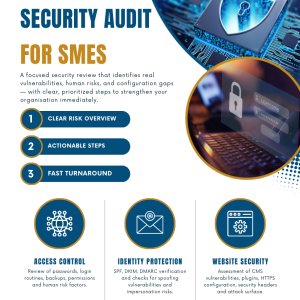
The secure WordPress site for small businesses helps you reduce common attack vectors and protect your website from preventable security risks.
The uncomfortable truth about cyberattacks on business websites is this: The vast majority of successful attacks are not based on spectacular, previously unknown zero-day exploits or highly complex hacking techniques. Instead, attackers systematically exploit fundamental security vulnerabilities that arise from simple oversights and could have been prevented with manageable effort:
- Outdated plugins and themes – Often not updated for months or years, with publicly documented vulnerabilities
- Incorrect server or CMS configuration – Default settings that were never intended for production environments
- Unnecessarily open access points and write permissions – Doors left wide open without anyone noticing
- Missing elementary protection mechanisms – Basics that were simply overlooked in the hectic pace of daily business
This is exactly where the Secure Website Hardening Package comes in. We ensure that your existing website is no longer an exposed flank – but becomes a hardened, resilient digital presence.
What is Website Hardening?
Website Hardening refers to the targeted securing of an existing website through systematic reduction of attack surfaces and professional closing of typical, known security vulnerabilities.
Our approach is deliberately pragmatic:
- No overkill – We don’t implement oversized security solutions that create more problems than they solve
- No security theater – No superficial measures that only look good but provide no real protection
- But rather: Clean, professional implementation of proven security fundamentals – Tested best practices that demonstrably work
We don’t rebuild your site – we make it safer. The focus is on achievable, effective improvements that measurably and sustainably improve your security posture.
What is Specifically Reviewed & Optimized?
We systematically examine the most critical areas of your website and optimize them according to current best practices. Each checkpoint is based on real attack scenarios and years of practical experience:
1. HTTPS & HSTS Configuration – The Foundation of Secure Data Transmission
A clean HTTPS implementation is mandatory today, not optional. Yet faulty configurations are alarmingly common:
- Review for clean HTTPS configuration – We ensure your entire website is consistently delivered encrypted
- Prevention of “Mixed Content” – No insecure content (images, scripts, stylesheets) on supposedly secure pages
- Correct setup of HSTS status (HTTP Strict Transport Security) – Prevents Man-in-the-Middle attacks by forcing browsers to use only encrypted connections
- Optimization of SSL/TLS certificates – Review of correct certificate chains and modern encryption standards
Your benefit: Protection of sensitive data (login credentials, customer data, payment information) from interception and manipulation during transmission.
2. Plugins & Update Strategy – Closing the Most Common Gateways
Outdated or poorly maintained plugins and themes are by far the most common cause of successful website compromises. This is where we intervene:
- Comprehensive review of all installed plugins and themes – Complete audit of your WordPress installation or comparable CMS systems
- Identification and removal of outdated, unnecessary, or known vulnerable components – We actively research vulnerability databases (CVE, WPScan, etc.)
- Trustworthiness assessment – Review for abandoned projects, questionable developers, or missing updates
- Recommendation for a secure update strategy – Balancing automatic versus manual updates based on your specific situation
- Documentation of dependencies – Clear overview of which components are critical and require special attention
Your benefit: By far the most common gateway for attacks is closed. You receive a cleaned-up, maintainable installation with a clear update plan.
3. Essential Security Headers – Invisible Protection with Major Impact
Security headers are special HTTP instructions that tell your visitors’ browsers how to behave from a security perspective. Properly implemented, they provide a robust shield against common attack vectors:
- Content Security Policy (CSP) – Realistic, incremental implementation to control which content is allowed to load. Prevents loading of malicious scripts (XSS attacks)
- X-Frame-Options – Protection against clickjacking attacks where your website is embedded in invisible frames
- X-Content-Type-Options – Prevents MIME-type sniffing and associated security vulnerabilities
- Referrer-Policy – Controlled handling of referrer information to protect user privacy
- Permissions-Policy – Control over browser features like camera, microphone, or geolocation
- Strict-Transport-Security (HSTS) – Already mentioned under point 1, but technically implemented here
Your benefit: Multi-layered protection that operates directly in your visitors’ browsers – even before potential attacks reach your servers.
4. File & Server Permissions – The Often-Overlooked Vulnerability
Incorrectly set permissions are like open doors in an otherwise secured building. We systematically close these:
- Setting correct file and folder permissions – According to the principle of least privilege
- Protection of sensitive directories – Configuration files, backup folders, and system directories are shielded from unauthorized access
- Removal of unnecessary write permissions – Write permissions are granted only where actually needed
- Avoiding typical CMS pitfalls – Especially with WordPress, there are classic misconfigurations that we systematically identify
- Securing .htaccess and wp-config.php – These critical files receive special protection
Your benefit: Even if an attacker manages to gain initial access, correct permissions drastically limit the potential damage. Lateral movement (spreading through the system) is hindered or prevented.
5. Backup Routines – Your Survival Insurance in an Emergency
A backup is only valuable if it actually works when you need it. We don’t just check whether backups exist, but whether they can actually save you in an emergency:
- Review of existing backup solutions – Analysis of backup frequency, retention period, and versioning
- Assessment of storage locations – Are backups physically separated from the live system? (Ransomware protection)
- The critical point: Verification of recoverability – We test on a sample basis whether backups can actually be restored
- Review of automation – Do backups run reliably without manual intervention?
- Clear recommendation for a secure and redundant backup setup – Tailored to your requirements and budget
- Documentation of the restore process – In an emergency, you know exactly what to do
Your benefit: The confidence that in a worst-case scenario (ransomware, hardware failure, catastrophic error) you can restore your website. Backups transform from a theoretical safety net into a reliable insurance policy.
6. Admin Access & User Roles – Order in the Permission Chaos
Many successful hacks begin with a forgotten admin account or excessively broad permissions. We create clarity and security here:
- Review of all admin accounts – Complete inventory of all users with elevated privileges
- Removal of unnecessary accounts – Ex-employees, old developer access, forgotten test accounts
- Secure role distribution – Implementation of the principle of least privilege
- Securing login paths – Renaming or additional protection of the admin area
- Enforcement of strong passwords – Where possible, implementation of password policies
- Review for compromised credentials – Cross-reference with leak databases (Have I Been Pwned)
Your benefit: Many hacks start with a forgotten or poorly secured admin account. Through consistent cleanup, this attack vector is eliminated.
7. Brute-Force & Login Protection – Defense Against Automated Mass Attacks
Every day, automated bots attempt to log in with stolen or guessed credentials. We effectively stop these attack waves:
- Implementation of effective rate limiting – Protection against automated login attempts through intelligent request throttling
- Detection and blocking of malicious bots – Distinguishing between legitimate users and attackers
- Setup of sensible Captcha or alternative login procedures – User-friendly solutions that still provide effective protection
- IP-based blocking after repeated failed attempts – Temporary or permanent blocking of known attacker IPs
- Monitoring of suspicious login activities – Setup of notifications for unusual access patterns
- Implementation of Two-Factor Authentication (2FA) – Where sensible and desired
Your benefit: Massive reduction of continuous attacks on your website. Server resources are conserved, and the risk of successful brute-force attacks drops to near zero.
Your Result: Clear, Traceable Security
After completion of the hardening process, you will receive comprehensive, understandable documentation. You will know exactly:
- Where your website was vulnerable – Detailed list of all identified vulnerabilities with risk assessment
- What specifically has been improved and optimized – Step-by-step documentation of all measures implemented
- What the security status looks like now – Before-and-after comparison with measurable metrics
- Which measures remain important going forward – Concrete recommendations for ongoing maintenance and updates
- Emergency contacts and restore procedures – For worst-case scenarios
No sensationalism. No technical overwhelm. Just clear, measurable security.
The documentation is written so that both technically savvy individuals and non-technical users can understand the measures and assess their value.
Ideal for:
This package is aimed at anyone who takes their online presence seriously but does not have their own security department:
Typical Target Groups:
- Coaches & Consultants – Whose reputation is directly linked to the security of their digital presence
- Freelancers & Solo Entrepreneurs – Who need professional security without being able to employ their own IT staff
- Agencies – Who need to demonstrate security compliance to their clients
- Creators & Bloggers – Whose entire business model is based on the availability and integrity of their website
- Small Online Shops (e.g., WooCommerce) – Who process sensitive customer data and payment information
Especially Suitable for:
- WordPress websites – The world’s most popular CMS, but also a popular attack target
- Organically grown projects with unclear history – Websites maintained by various people over years without a clear security concept
- Websites whose operators want to establish a solid foundation – Independent of external IT service providers, with clear understanding of their own security status
- Migrated or inherited websites – Where the current security state is unclear
- Websites after security incidents – Professional recovery and hardening after attacks have occurred
Why This Package is the Right Choice:
Proactive protection instead of reactive damage control: The costs and effort of remediating a successful hack far exceed the investment in preventive hardening – not to mention reputational damage.
Measurable improvements: You don’t receive vague security promises, but concrete, traceable improvements to your security posture.
Sustainable expertise: You not only become more secure, but also understand why – and can apply these principles yourself in the future.
Independence: After project completion, you’re not dependent on continuous external support. You have control over your own security.
Make your website a hard target. Let us professionally secure your digital presence together.