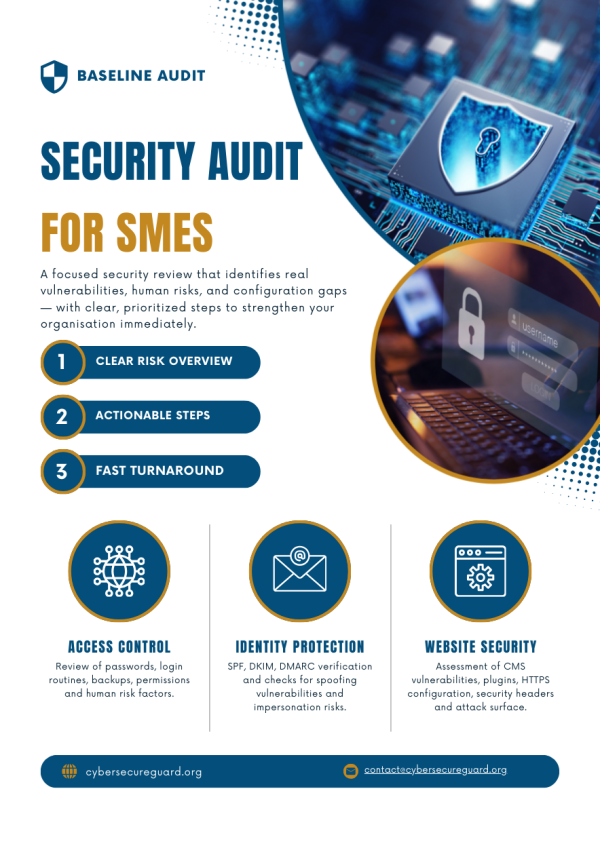
Most cyberattacks don’t begin with advanced hacking techniques. They start with simple, avoidable weaknesses such as outdated website components, missing email authentication, weak passwords or everyday habits that unintentionally expose your organisation to risk. This audit focuses precisely on these real entry points. It identifies the vulnerabilities attackers would target first and provides a clear, prioritised improvement plan you can act on immediately — without needing any technical background.
What’s Included in the Audit
1. Website Security Review
Your website is often the first system attackers test. I examine your encryption setup, your security headers, your CMS version and configuration, installed plugins and themes, external scripts and potential information leaks. You receive a clear understanding of where your website currently exposes attack paths and how to close them effectively.
2. Basic Vulnerability Check (Digital Footprint)
This non-invasive scan shows what attackers can instantly learn about your organisation. I look at visible server information, outdated components, open ports, DNS configurations and misconfigurations that could make your organisation appear as an “easy target”. You learn how to strengthen your external presence and reduce unnecessary exposure.
3. Email Security Assessment
Email remains the number one attack vector worldwide. I verify whether your domain is properly protected against spoofing and phishing by checking your SPF, DKIM and DMARC setups. Proper email authentication is one of the fastest ways to reduce cyber risk — and many organisations still leave dangerous gaps here.
4. Internal Processes & Workflows
Strong technology means little if everyday routines are weak. I review password practices, access control, multi-factor authentication, backup routines, onboarding and offboarding, and overall operational discipline. Often, small adjustments in these areas produce major security gains without additional cost.
5. Human Risk Assessment
Most breaches begin with human behaviour, not technical flaws. I evaluate phishing awareness, email habits, file-sharing behaviour, password strength and general social engineering awareness. You receive practical guidance on how to reduce human-related risks through simple improvements and targeted training.
6. Compact System Map
Many organisations lack a clear picture of their own IT landscape. You receive a simple visual overview of your systems, access routes, sensitive data flows and critical components. This map brings clarity to decision-makers and helps align future IT and security planning.
7. Prioritised Action Plan (24h / 7 Days / 30 Days)
The most valuable part of the audit is the prioritised roadmap. Instead of a long, overwhelming list, you get a clean structure of what needs immediate attention, what should be fixed within a week and what can be improved over the next month. Each recommendation includes the risk, the reasoning and the exact steps required to resolve it.
Your Deliverable: A Clear and Actionable Report
You receive a structured PDF report (8–12 pages) that includes an executive summary for management, a risk overview, impact evaluations, your prioritised action plan, quick wins you can implement immediately, tool recommendations and your system map. All technical terms are explained in a brief glossary to keep everything accessible. This report becomes the foundation for better decisions, safer processes and future audits.
Who This Audit Is For
This audit is ideal for small and medium-sized organisations without a dedicated security team, for freelancers and consultants who rely on a trustworthy digital presence, for agencies handling client data, for service providers and trades with growing digital infrastructure and for startups that want to build securely from the beginning. It is also highly useful for organisations preparing for certifications such as ISO 27001 or handling GDPR/NIS2 compliance duties.
Your Key Benefits
This is not a penetration test.
It is a practical, business-focused security review that helps you understand:
-
where attackers would strike first — and how to block those paths
-
which vulnerabilities truly matter — not every warning is critical
-
how to reduce risk immediately, even without a large IT budget
-
how to strengthen your organisation step by step with clear priorities
-
how to operate more securely without a large IT department
The focus is always on clarity, practicality and measurable improvements — not on technical jargon.
Why This Audit Is the Right First Step
You gain a realistic understanding of your true security posture.
You receive clear, actionable guidance instead of theoretical recommendations.
You save time and resources by focusing on what matters most.
You build a strong base for future IT projects and compliance efforts.
And you gain credibility with clients, partners and investors who value robust security.
Investing in Security
A successful cyberattack can result in €50,000 to €500,000 in direct costs, significant downtime, loss of customer trust and potential legal consequences such as GDPR fines. This audit costs only a fraction of that — and can help you prevent exactly these scenarios.
The question is not whether you can afford security, but whether you can afford insecurity.
Frequently Asked Questions
How long does the audit take?
Typically 3–5 business days after receiving all necessary information.
You will receive the final report within 7–10 days.
Do I need technical knowledge?
No. The report is designed for decision-makers without technical background.
Is this a penetration test?
No. This is a non-invasive review. No active attacks are performed.
What do you need from me?
Primarily your domain/website URL and optional information about internal processes (via questionnaire). Deep system access is not required.
Can I implement everything myself?
Many measures can be implemented internally or with your IT provider.
I can support implementation if needed.
Does this replace ISO 27001 certification?
No — but it is an excellent first step and helps identify gaps before entering a formal certification process.
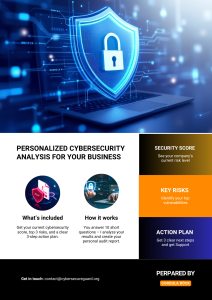
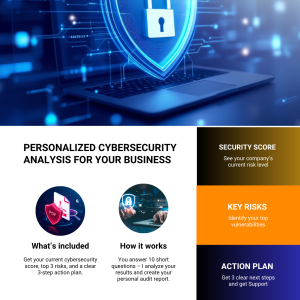
This report provides a clearly defined and actionable overview of your company’s current cybersecurity posture. Based on your answers to the CybersecureGuard Mini Security Audit (10 key questions), it immediately identifies critical vulnerabilities, prioritizes necessary improvements, and provides a blueprint for immediate action toward demonstrably stronger cyber resilience. It’s not about theory, but about immediate risk reduction.