

Cyberattacks have evolved enormously over the past decades, yet the core truth behind them has never changed: the biggest breaches do not happen because attackers are extraordinarily talented, but because organisations overlook small weaknesses for just a little too long. A single outdated laptop, an uninstalled Windows update or one rushed click on the wrong email can be enough to bring global companies to a standstill.
The most destructive computer viruses in history caused enormous financial damage, disrupted supply chains, shut down hospitals and factories, and exposed just how fragile modern IT environments can be. And although many of these outbreaks happened years ago, their lessons are more relevant today than ever before. Modern malware is no longer handcrafted by individual hackers; it is automated, fast, AI-supported and constantly scanning the internet for vulnerable systems. Many companies still believe they are too small to be noticed or assume that having an IT provider automatically guarantees safety. Yet the biggest outbreaks in history did not discriminate. They targeted anyone who happened to be unprotected in that moment.
By understanding how these historic viruses worked, you gain a powerful advantage: you see clearly that cybersecurity is not about fear, but about awareness and consistent prevention. Once Sie understand why past attacks succeeded, Sie can strengthen your own defences long before a modern threat reaches your network. In this article, we look at the most devastating malware incidents ever recorded — including WannaCry, NotPetya, Conficker and Stuxnet — and explore what they still teach Sie today about protecting your organisation.
1. WannaCry (2017) — When Outdated Systems Became a Global Emergency
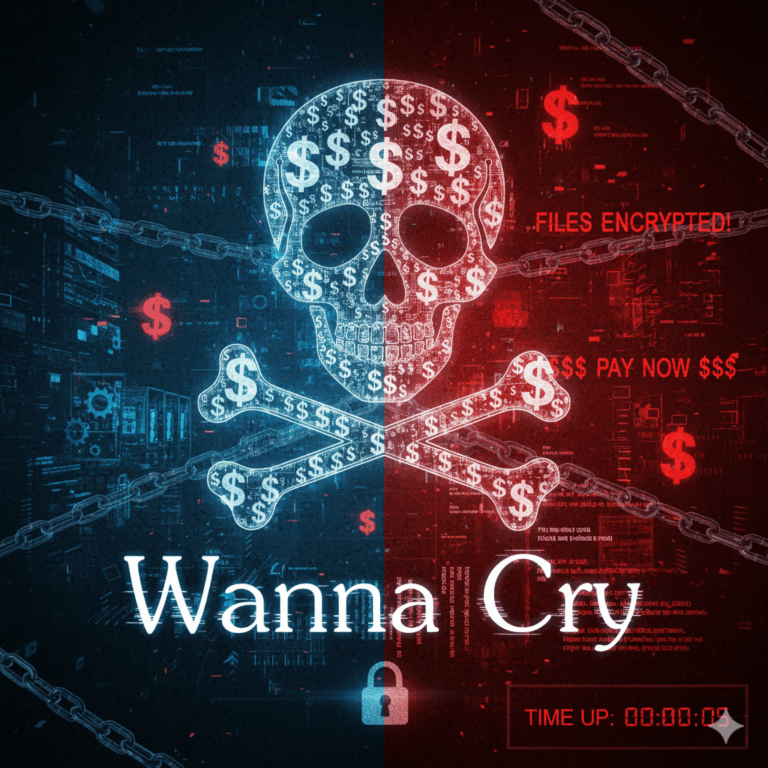
When WannaCry struck in May 2017, it spread at a speed the world had never seen before. Within a single afternoon, the ransomware had jumped across continents and reached hundreds of thousands of systems. Entire organisations suddenly found themselves locked out of their computers as a red ransom message appeared on screen, demanding payment in Bitcoin. Hospitals were forced to cancel surgeries. Logistics companies halted deliveries because their tracking systems went dark. Even large corporations with well-funded IT departments could only watch as operations collapsed within minutes.
What made WannaCry so devastating was not the ransomware itself, but the way it entered networks. The malware exploited a vulnerability in Windows known as EternalBlue — a flaw that had been publicly disclosed weeks before the attack. Microsoft had already released a security patch. Yet countless companies had not installed it, either because they underestimated the risk, delayed maintenance to avoid downtime or simply assumed they were too small to be affected. That single oversight created a perfect opportunity for the ransomware to sweep through networks without resistance.
For modern organisations, the true lesson from WannaCry is uncomfortable but essential: even the strongest security tools mean little if basic hygiene is neglected. A single unpatched device — an old laptop in a storage room, a workstation that has not rebooted in months, a forgotten server running outdated software — can act as the weak link that compromises an entire infrastructure. The attack reminded the world that cybersecurity does not fail because systems are too complex, but because small tasks are postponed until it is too late.
WannaCry’s impact continues to be studied today because it demonstrates just how much damage an attacker can cause with a vulnerability that was already fixed. It showed that cyber risk is not only about what hackers are capable of, but also about how consistently organisations maintain their systems. If updates are delayed, if devices are unmanaged, or if older operating systems remain in use, the next WannaCry-level catastrophe is not a question of “if”, but “when”. Strengthening update culture and ensuring every device in the organisation is monitored, maintained and patched is one of the most powerful ways to prevent a similar disaster.
2. NotPetya (2017) — The Most Expensive Cyberattack in History
NotPetya remains one of the clearest reminders that a cyberattack does not need to steal data or demand money to cause catastrophic damage. When the malware first appeared in June 2017, it masqueraded as a piece of ransomware, showing a payment message similar to what companies had seen with previous attacks. But this was only a distraction. Behind the surface, NotPetya had a very different purpose. It was engineered not to extort, but to destroy. Once activated, it overwrote critical parts of the system, making recovery nearly impossible. Even companies willing to pay the ransom quickly realised there was nothing to decrypt — the data was gone.
What made NotPetya particularly alarming was the way it spread. Unlike traditional ransomware, it did not rely on victims clicking malicious attachments or being tricked by fake emails. Instead, the attackers compromised a legitimate software supplier in Ukraine and inserted the malware into an official update of a common accounting program. Companies who trusted this vendor and regularly installed updates received the infection directly from a source they believed to be safe. Once inside, NotPetya moved laterally at extreme speed. It used stolen administrative credentials, exploited multiple Windows vulnerabilities and spread aggressively across internal networks. Businesses that had strong perimeter firewalls still collapsed because the attack arrived via a trusted channel they never questioned.
The consequences were unprecedented. Global shipping giant Maersk had to shut down entire terminals because its systems were wiped. Pharmaceutical company Merck lost access to production facilities. FedEx suffered major disruptions. The financial impact on these and many other organisations climbed into the billions, making NotPetya the most expensive cyberattack in recorded history. Many companies needed weeks to rebuild their systems from scratch, manually reinstalling servers and restoring operations under enormous pressure. Some organisations with insufficient backups never fully recovered.
The deeper lesson for modern businesses is unsettling but essential: your security is only as strong as the weakest point in your supply chain. Even if Sie maintain excellent internal security practices, a compromised software provider can bypass every defence you have built. NotPetya demonstrated that trust is not enough. Every supplier, especially smaller regional ones, must be evaluated for update processes, transparency and their own cybersecurity posture. Companies that relied blindly on vendor updates became the easiest targets in this attack.
NotPetya also revealed how fragile IT environments become when privileged access is not properly controlled. The malware did not need sophisticated hacking techniques; it simply used the credentials it found on infected machines to elevate itself. One poorly protected admin account, one workstation without multifactor authentication or one shared password across systems was enough to accelerate the infection dramatically. Strengthening identity security, restricting access rights and protecting admin credentials are no longer optional steps — they are essential for preventing large-scale compromise.
Ultimately, NotPetya changed the way the world views cyber risk. It showed that destructive malware can disguise itself as legitimate software, that trust in vendors can be exploited and that the financial impact of a single attack can reach levels once unimaginable. For organisations today, the message is clear: supply-chain security, strict access controls and resilient backups are not luxuries. They are fundamental requirements in an era where one compromised update can bring global operations to a halt.
3. Melissa (1999) — The First Email Virus That Showed How Powerful Social Engineering Can Be
When the Melissa virus appeared in 1999, the world had not yet experienced large-scale email-based attacks. Most organisations still believed that malware spread mainly through infected floppy disks or poorly secured networks. Email was seen as convenient, fast and relatively harmless. Melissa changed that perception in a single weekend. The virus arrived disguised as a simple Word document attached to an email that looked personal, friendly and completely unthreatening. Many employees opened it without hesitation, not because they were careless, but because the digital culture of that time had not yet developed the instinct to question every message.
As soon as the infected document was opened, Melissa embedded itself into Microsoft Word and Outlook. Within seconds it began sending itself to the first fifty contacts in the victim’s address book. This created an explosive chain reaction. Inboxes around the world filled up faster than IT teams could react. Mail servers crashed under the sudden load, internal communication systems stalled, and entire companies had to temporarily shut down email access to stop the spread. At a time when the internet was rapidly becoming part of everyday business, Melissa demonstrated how easily a single infected file could disrupt global communication.
The real power of the attack did not lie in complex technical mechanisms, but in psychology. Melissa succeeded because the message looked familiar, personal and harmless. Employees trusted it. They reacted quickly, without questioning the sender or the purpose of the file. This was one of the first major lessons in modern cybersecurity: technology alone cannot compensate for human behaviour. Even the best antivirus software of that time could not keep up with the speed of the outbreak, because the infection relied on people acting exactly as expected — opening an email that seemed safe.
For organisations today, Melissa still holds an important message. Social engineering remains one of the most effective attack methods, even more than two decades later. Cybercriminals no longer rely solely on technical exploits to penetrate networks. Instead, they exploit emotions such as curiosity, stress, urgency or the desire to be helpful. A convincing email, a well-crafted fake invoice or a seemingly routine message from a colleague can trigger a mistake before an employee even realises something is wrong. The Melissa outbreak showed how quickly trust can be weaponised and how important it is to build a culture of awareness — especially among non-technical staff.
Although Melissa did not steal data or encrypt files, its impact was profound because it highlighted a vulnerability that still exists today: people tend to trust digital communication too easily when it feels familiar. This single insight forms the foundation of modern phishing campaigns. The virus became one of the earliest examples of how social engineering can bypass technical security entirely, and it pushed organisations worldwide to rethink training, email filtering and internal security policies.
Even in today’s world of AI-driven threats and advanced ransomware, the core lesson from Melissa remains unchanged: a well-informed employee is one of the strongest defences an organisation can have. Teaching people to pause, question and verify — even when a message appears harmless — prevents more incidents than any single technical tool ever could.
4. ILOVEYOU (2000) — The Email Virus That Broke the Internet
When the ILOVEYOU virus emerged in May 2000, the world was not prepared for what would become one of the fastest and most destructive email outbreaks in history. At first glance, the message seemed harmless — even flattering. An email with the subject line “I love you” appeared in inboxes across the globe, often sent from the address of a friend, colleague or family member. In a time when digital communication still carried a sense of novelty and innocence, very few people questioned the authenticity of such a message. Opening the attachment felt natural, even exciting. Within minutes, millions of users clicked without hesitation.
The moment the attached script was executed, it unleashed a wave of damage that rapidly spiralled beyond control. The virus overwrote image, music and system files, disabled key functions, stole passwords and replicated itself across every reachable mailbox. Because the message came from familiar contacts, each new victim unintentionally reinforced the illusion of trust, causing the infection rate to accelerate at a speed no one had ever witnessed before. Within a single day, mail servers around the world collapsed under the weight of outgoing messages. Entire organisations disconnected their email infrastructure just to regain control, effectively shutting down parts of the internet to contain the outbreak.
What made ILOVEYOU so impactful was not sophisticated code — in fact, by today’s standards, the malware was shockingly simple. Its true strength lay in its emotional design. It manipulated the most basic human instinct: curiosity mixed with a desire for connection. People clicked because the message felt personal, unexpected and meaningful. This was one of the earliest and clearest examples of how cyberattacks succeed not by defeating technology, but by exploiting the human mind. ILOVEYOU demonstrated that emotional triggers can bypass even the most cautious behaviour, especially when the threat feels impossible or too absurd to be real.
For modern organisations, the legacy of ILOVEYOU remains highly relevant. Even today, emotional manipulation is at the heart of most phishing campaigns. Attackers use urgency, affection, fear, authority or routine to trigger quick reactions. A fake delivery notice, a sudden request from “IT support,” a changed bank account number from a vendor — all of these work because people trust familiar patterns. The ILOVEYOU outbreak proved that when emotions take over, critical thinking pauses, and in that pause, an entire network can fall.
Another lasting lesson from the attack is the importance of limiting what email attachments and scripts are allowed to do. In 2000, many organisations had minimal restrictions on scripting languages, macros or executable files. The virus used this freedom to spread unhindered. Today, robust email filtering, attachment controls, macro restrictions and endpoint protection exist because of outbreaks like ILOVEYOU. Yet even with modern tools, the human factor remains decisive. Technology can block dangerous files, but it cannot prevent someone from reacting emotionally to a convincing message.
In the end, ILOVEYOU became more than just a historic cyberattack. It marked a turning point in the evolution of phishing, social engineering and email security. It reminded the world that trust is both necessary and dangerous in digital communication, and that a single impulsive click — even with the best intentions — can disrupt global operations. For organisations today, the most valuable lesson is timeless: awareness and emotional resilience are key. Teaching employees to slow down, question unexpected messages and protect their own curiosity is one of the most powerful cybersecurity strategies available.
5. Conficker (2008) — The Silent Worm That Built One of the Largest Botnets in History
When Conficker first appeared in late 2008, it did not make headlines immediately. There was no dramatic ransom message, no sudden data loss and no obvious symptoms that would alert ordinary users. Instead, the worm spread quietly, methodically and with an efficiency that shocked security researchers once they realised what had happened. By the time the full extent of the infection became visible, millions of Windows systems worldwide — including government agencies, militaries, hospitals and small businesses — were already under the worm’s control. Conficker had silently created one of the largest botnets ever recorded, a massive network of compromised machines that attackers could manipulate for whatever purpose they chose.
The worm exploited a vulnerability in Windows that allowed it to spread automatically across networks without any user interaction. Systems that were slightly outdated, poorly monitored or not regularly patched became easy targets. From there, Conficker moved aggressively, scanning nearby devices and breaking into those that still used weak or default passwords. Organisations that assumed internal networks were “safe” discovered that the worm had no difficulty jumping from one neglected device to the next. Even computers that were rarely used — old workstations in storage rooms, legacy systems running outdated software or machines without proper access controls — acted as stepping stones for the infection.
What made Conficker especially dangerous was the way it combined technical precision with an understanding of human tendencies. Many companies delayed installing the critical Windows patch because they feared operational interruptions. Others believed their antivirus software was sufficient protection. Some simply assumed they were not high-value targets and therefore not at risk. Conficker took advantage of every one of these assumptions. It became a global reminder that cybersecurity vulnerabilities rarely look dramatic in the beginning. They often grow quietly, feeding on small oversights that accumulate over time.
As security experts worked to understand the worm, they discovered that Conficker had multiple mechanisms to maintain control over infected systems. It blocked access to security websites, disabled updates and prevented antivirus installations. This meant that removing the worm required coordinated, large-scale effort. Many organisations had no choice but to isolate entire network segments, rebuild machines manually and introduce stricter security policies. The global cleanup lasted years — not months — because so many devices had been compromised without their owners ever noticing.
For modern organisations, Conficker offers a lesson that is still painfully relevant: threats do not always arrive with obvious signs of danger. Some of the most damaging infections spread silently in the background, exploiting overlooked systems, weak passwords and outdated machines that have fallen behind regular maintenance schedules. Even today, many businesses underestimate how attractive they are to attackers simply because they assume their operations are too small, too local or too unimportant. Conficker proved that attackers do not choose victims — vulnerabilities do.
The worm also underscored the value of strong basic security practices. Regular patching, enforced password policies, restricted administrator rights, centrally managed devices and reliable monitoring would have prevented the vast majority of Conficker infections. These are not advanced techniques; they are foundational habits. Yet when they are neglected, even simple malware can cause global-scale disruption.
In the end, Conficker became a turning point in how governments, enterprises and security professionals view basic hygiene. Its impact continues to influence cybersecurity standards today, reminding organisations that small oversights can create large vulnerabilities — and that consistent, disciplined maintenance remains one of the most powerful defences against modern threats.
6. Stuxnet (2010) — The Cyberweapon That Changed the Definition of Warfare
When Stuxnet came to light in 2010, it immediately rewrote the rules of what cybersecurity meant. Until then, most malware had targeted data, money or corporate disruption. Stuxnet was entirely different. It was the first widely known cyberweapon designed to cause physical destruction in the real world. This single piece of malware proved that digital attacks could manipulate machinery, sabotage industrial processes and damage infrastructure — all without a single gunshot, explosion or traditional act of war.
The sophistication of Stuxnet stunned security researchers. It did not spread through careless clicks or phishing emails. Instead, it used multiple zero-day vulnerabilities — rare weaknesses unknown even to Microsoft — and a highly coordinated strategy to infiltrate isolated industrial networks. Many of the targeted systems were not connected to the internet at all, which led investigators to believe the malware was introduced through infected USB drives, possibly carried into the facilities by employees or contractors who never realised they were serving as a delivery mechanism. This showed the world that “air-gapped” systems, long considered safe by design, could still be penetrated if attackers were determined enough.
Once inside, Stuxnet behaved with remarkable intelligence. It did not immediately reveal itself or cause visible errors. Instead, it lay dormant, studying the environment, identifying industrial control systems and determining whether the facility matched its intended target. Only when all conditions aligned did the malware begin subtly altering the behaviour of centrifuges inside Iran’s Natanz nuclear facility. It manipulated their rotation speeds while simultaneously feeding operators falsified readings to make everything appear normal. This deception allowed the sabotage to continue for months, gradually damaging equipment until it failed. By the time engineers realised something was wrong, the malware had already achieved its purpose.
The discovery of Stuxnet had profound implications for global cybersecurity. It demonstrated that malware could be as precise and strategic as a human special-operations team. It also revealed that attackers with enough resources could reach deeply into systems once thought untouchable. Stuxnet functioned as a proof of concept for a new era: one in which digital tools could quietly alter the functioning of industrial machinery, energy systems, transportation networks or manufacturing lines. Suddenly, cybersecurity was no longer only an IT issue — it became a matter of national security, infrastructure protection and geopolitical stability.
For modern organisations, the lessons from Stuxnet reach far beyond the nuclear sector. It highlighted the vulnerabilities in industrial control systems that many facilities had ignored for years. Production lines, power stations, water treatment plants, medical equipment, building automation and manufacturing robots often rely on older software, weak authentication or poorly segmented networks. These environments were historically designed for reliability, not security. Stuxnet exposed how dangerous that assumption can be.
The attack also underscored the importance of monitoring not just digital activity but physical behaviour. If centrifuges, valves, conveyor belts or other machines behave inconsistently, the cause may not be mechanical — it could be cyber manipulation designed to remain invisible. Organisations with operational technology (OT) must therefore adopt the same security mindset used in IT environments, including strict access controls, regular patching, intrusion detection and continuous monitoring.
In many ways, Stuxnet was a wake-up call that still echoes today. It forced companies, governments and security professionals to understand that cyberattacks can shape real-world events, damage infrastructure and disrupt entire industries without any traditional warning signs. It remains one of the clearest examples of how powerful digital threats have become — and why protecting industrial systems is just as critical as securing office computers.
Conclusion: 6 worst computer viruses and how to protect your business
Looking back at the worst computer viruses in history reveals something essential: every major outbreak, no matter how destructive, followed a predictable pattern of overlooked updates, weak access controls and human error. Understanding the 6 worst computer viruses and how to protect your business is not about revisiting old events — it is about recognising that the same weaknesses still exist today. Modern attackers may use faster tools and automated scanning, but they rely on the exact same gaps that WannaCry, NotPetya, Conficker and others exploited years ago.
What truly protects an organisation is not fear, but clarity. When Sie treat updates as non-negotiable, when Sie strengthen identity security, when Sie verify your vendors and when Sie invest in awareness for your team, Sie close the doors these historic viruses once used to spread. Cybersecurity becomes manageable the moment Sie turn these lessons into consistent habits.
The past has already shown where the risks lie. The decision to use that knowledge to protect your business today lies entirely in your hands — and with the right strategy, Sie are far better prepared than any attacker expects.
I also recommend the following articles
AI-Phishing Emails: Why They’re Harder to Detect Than Ever
Inside Germany’s Ransomware Struggle: Lessons from Real Incidents
Social Engineering: How Hackers Trick You in Daily Life
The WannaCry Hack: How a Virus Could Spread Worldwide in Hours
Connect with me on LinkedIn
This is what collaboration looks like
Take a look at my cybersecurity email coaching
And for even more valuable tips, sign up for my newsletter