
1. What is Ransomware — Quick Overview
Ransomware is a form of malicious software designed to disrupt business operations by encrypting files or locking entire systems until a ransom is paid. Unlike traditional malware, which might spy on users or steal information quietly in the background, ransomware is loud, visible, and disruptive on purpose. Its goal is simple: force victims to pay money, usually in cryptocurrency, in exchange for a decryption key or a promise not to release stolen data.
Ransomware usually gets into a system through a few common paths. Phishing emails with dangerous attachments or links are one way in. Unsecured remote access points, such as VPN gateways or exposed RDP services, are another. Outdated software and unpatched operating systems with known weaknesses offer a third route. Once the malware is inside, it spreads through the network, looking for servers, shared drives, and backups. In the end, it encrypts files or locks down whole systems, effectively holding the company hostage.
Modern ransomware rarely stops at simple encryption. Many attacker groups now use what is called double extortion. First, they quietly steal sensitive data, such as customer information, contracts, or financial records. Then they encrypt the local systems. Finally, they threaten to publish or sell the stolen data if the ransom is not paid. This means that even companies with solid backup systems are still at risk, because restoring files does nothing to remove the threat of a public data leak.
Cybercrime today has become highly organized, almost like a business. Instead of lone hackers working alone, many ransomware attacks are run through a model called Ransomware-as-a-Service, or RaaS. Developers build the ransomware tools and then rent them out to affiliates, who carry out the actual attacks and share the profits. This setup has lowered the barrier to entry enormously, so that even criminals with little technical skill can launch serious attacks on companies anywhere in the world.
For victims, the hardest question is always whether to pay. At first glance, paying might look like the quickest way to get back to normal operations. But there are several serious problems with this approach. There is no guarantee that attackers will actually hand over a working decryption key. There is also no guarantee that stolen data will really be deleted rather than sold on the dark web. Paying can even make a company a target again in the future, since attackers may assume a company that paid once will pay again. On top of that, in some countries, paying a ransom can break sanctions laws or create legal problems for the company.
The damage caused by ransomware goes far beyond the ransom payment itself. Operations can shut down completely, with production stopping, services interrupted, and customers turned away. The financial losses go well beyond the ransom demand, including the cost of downtime, incident response, legal fees, and possible fines. Data can be lost or leaked, putting intellectual property, personal information, and confidential business details at risk. Trust can suffer too, as clients and partners lose confidence in the company. And in the EU, if personal data is exposed, this can lead to GDPR violations and heavy financial penalties.
In short, the consequences of ransomware go far beyond a single ransom demand. They threaten the very core of a company’s operations, its reputation, and its long-term survival.
2. Case Study 1: Pilz GmbH (Germany)
The ransomware attack on Pilz GmbH & Co. KG is one of the most well-known German examples of this kind of attack. The attack happened on October 13, 2019, and experts linked it to the BitPaymer ransomware strain. The company faced global disruption for more than a week, and production had to stop for a while. Reports say that Pilz refused to pay the ransom and chose instead to restore its systems and keep the business running manually. During this time, employees used paper, whiteboards, and phone calls to communicate and keep operations going. The case shows clearly that even a high-tech, automation-focused company can become a victim, which proves that no company is truly safe from this kind of attack.
There are some important lessons to take from this case. Ransomware does not only target small and medium-sized businesses; it also hits large industrial companies. Refusing to pay a ransom is only possible if a company has strong backup and recovery systems in place. Being prepared for a crisis, with emergency plans, tested communication channels, and reliable backup processes, can make the difference between surviving an attack and collapsing under it.
Overall, the Pilz case shows clearly that even technologically advanced companies can be vulnerable. With strong backups, good crisis preparation, and open communication, a company can turn a serious ransomware attack into a challenge it survives, and sometimes even come out of it with a stronger reputation.
May interessting the Articel about the Ransomeware Attack from Bitefender:
https://www.bitdefender.com/en-us/blog/hotforsecurity/automation-giant-pilz-halts-operations-for-a-week-after-ransomware-infection?utm_source=chatgpt.com
3. Case Study 2: The “Malibu” Scenario (Documentary)
Unlike the Pilz case, the “Malibu” scenario does not come from an official press release or an incident report. Instead, it comes from a German documentary. Even so, it gives a strong picture of how ransomware attacks usually happen in medium-sized businesses, which form the backbone of the German economy. Because these companies often have smaller security budgets than large corporations, they are especially attractive targets for ransomware attackers.
The story begins in a way that sounds almost too simple: with a phishing email. An employee gets a message that looks like it comes from a trusted supplier. The attached PDF invoice looks completely normal, but as soon as it is opened, it runs malicious code in the background. Within minutes, the attackers already have a foothold inside the company’s network.
After getting in, the attackers do not strike right away. Instead, they move quietly through the network, taking advantage of weak passwords, reused login details, and badly configured systems. Step by step, they gain more access rights and spread across servers, computers, and shared network drives.
Once the attackers control the key systems, they launch a two-part attack. First, they steal data: confidential customer information, internal contracts, and sensitive financial records are copied and sent outside the company. At the same time, they encrypt local files and databases, so employees suddenly lose access to important tools, from their ERP system to their email.
After this, the attackers reveal themselves through a ransom note. The message is clear: pay a large amount in Bitcoin or Monero, or risk losing the data forever and having it published publicly. A countdown timer adds extra pressure, reminding managers that every hour without payment makes a data leak more likely.
At this point, the management faces a very difficult decision. They can either pay the ransom and hope the attackers keep their promise, or refuse to pay and risk a complete operational breakdown along with serious damage to their reputation. Meanwhile, employees cannot do their normal work, customers start calling with questions, and the company’s reputation is at serious risk.
This is usually the moment when external IT forensic experts and crisis teams get involved. Their first jobs are to isolate the infected systems, stop the attack from spreading further, and find out how the attackers got in. The backups are checked, and fortunately, some clean versions still exist. However, restoring them is slow and difficult, and it can take days or even weeks.
Even once the systems are working again, the damage does not simply disappear. The company has lost income during the downtime, its reputation with customers has been shaken, and the legal team has to check whether any GDPR rules were broken because personal data was leaked. Employees also need extra training to help prevent something similar from happening again. In the end, the company survives, but the total cost of recovery ends up being higher than the ransom itself, which turns out to be a hard but useful lesson.
This example matters for several reasons. At its center is human error: one single phishing email was enough to let the attackers in, which shows how important staff awareness training and email security really are. The attack also shows how fast and quiet the escalation can be, since attackers usually prepare and expand their access before showing themselves, in order to cause as much damage as possible. It also shows how important good preparation is, because working backups, a clear incident response plan, and support from external security experts can be the difference between recovery and total collapse. Finally, this story feels familiar to many SMEs, because it is not an unusual case. Something similar could happen to almost any mid-sized business in Germany tomorrow.
In short, the Malibu scenario shows how quickly one single phishing email can turn into a full-blown crisis. It makes clear that human error, weak security, and missing response plans can easily turn an avoidable incident into a costly lesson for any business.
4. Case Study 3: Düsseldorf University Hospital
One of the most tragic ransomware incidents in Germany took place in September 2020, when Düsseldorf University Hospital, a major medical center with more than 1,000 beds, became the victim of a cyberattack. Unlike most ransomware cases, which “only” disrupt business operations, this attack showed how ransomware can directly put human lives at risk when it hits critical infrastructure.
On September 10, 2020, the hospital’s IT systems suddenly went offline because of a ransomware infection. The malware was actually meant to target a university system, but it spread into the hospital’s network by mistake. As a result, key medical IT services, including patient admission systems, diagnostic platforms, and email, stopped working. The hospital had no choice but to suspend emergency care. Emergency patients had to be sent to other hospitals in the region, and one critically ill patient was transferred to a facility almost 30 kilometers away, which caused a delay in treatment. Sadly, this patient later died.
This case led to a serious legal and ethical debate. German authorities opened a criminal investigation, marking the first time worldwide that a death was possibly linked to a ransomware attack, and prosecutors looked into whether the attackers could be charged with negligent homicide. In the end, though, investigators concluded that the patient’s death could not be legally blamed directly on the ransomware attack, since the underlying illness was already severe and could have been fatal on its own. Because of this, the case was closed without any charges. Still, even though a direct legal link could not be proven, the incident started a global discussion about whether ransomware groups that attack hospitals during a pandemic should be seen as committing crimes against humanity.
In the aftermath, IT specialists worked non-stop to restore the critical systems, and the hospital was able to slowly resume emergency care after about two weeks. The incident also pushed the German government and the Federal Office for Information Security, known as the BSI, to call for stricter cybersecurity rules in healthcare institutions. International media picked up the story too, describing it as a wake-up call for healthcare providers everywhere, since it showed clearly that ransomware is not only about money, but can also cost human lives.
There are several important lessons from this case. First, critical infrastructure like hospitals is especially vulnerable, because such institutions often depend on outdated IT systems, old medical devices, and networks that are all connected to each other, which makes them attractive targets. Second, in a hospital, unlike in a factory or an office, a shutdown has immediate and very human consequences, since every minute of downtime can affect patient care. Third, attackers do not always plan to cause this kind of damage. In this case, reports suggest that the attackers were actually aiming at a university partner, not the hospital itself, yet the results were still devastating, which shows that collateral damage is almost unavoidable in ransomware attacks. Finally, this case shows how complex legal responsibility can be. Even though the moral picture is clear, it is very difficult to legally connect a death to a cyberattack, and this reveals real gaps in current laws and international efforts to prosecute cybercrime.
Overall, the Düsseldorf hospital attack shows the devastating risks that ransomware poses to critical infrastructure. Beyond the financial losses, such incidents can put human lives in danger, which makes cybersecurity in healthcare not just an option, but an urgent necessity.
Read here the complette story about the Maleware Attack:
https://www.wired.com/story/ransomware-hospital-death-germany/?utm_source=chatgpt.com
5. Comparing the Cases
| Aspect | Pilz (Industry) | Malibu (SME Scenario) | Düsseldorf Hospital |
|---|---|---|---|
| Sector | Industrial automation | Medium-sized services/agency | Healthcare / critical infrastructure |
| Entry Point | Likely network/service vulnerability | Phishing email (social engineering) | Software/system vulnerability |
| Impact | Production shutdown, manual fallback | Data theft, reputational risk, financial loss | Patient care disruption, possible fatality |
| Strategy | Refused ransom, restored via backups | Incident response, forensic cleanup | Government/legal involvement |
| Lesson | Even high-tech firms need resilience | Phishing awareness + backups are critical | Critical sectors face highest stakes |
6. Key Takeaways for international Businesses
The three case studies — Pilz, the “Malibu” scenario, and Düsseldorf University Hospital — show that ransomware is not a distant or theoretical risk, but an immediate danger across industries all over the world. From industrial production to healthcare, attackers keep exploiting the very same weaknesses. The following points highlight what businesses of any size, in any country, should focus on to reduce their risk and build stronger resilience.
One of the most important steps is early detection and monitoring. The longer attackers stay undetected inside a system, the more time they have to spread further, steal data, and cause maximum damage. Setting up systems for security monitoring, anomaly detection, and round-the-clock log analysis can make a real difference. Many German SMEs still lack this kind of continuous monitoring, so outsourcing it to a managed security provider can be a practical and affordable solution.
Closely related to this is network segmentation and the principle of least privilege. A flat, fully connected network is exactly what attackers hope for, since it lets them move freely once they get in. By using separate network zones, firewalls, and access controls, companies can isolate their most sensitive systems, while also making sure that employees only have access to what they actually need for their work. In industrial settings, keeping production systems separate from office IT is especially important, as the Pilz case clearly showed.
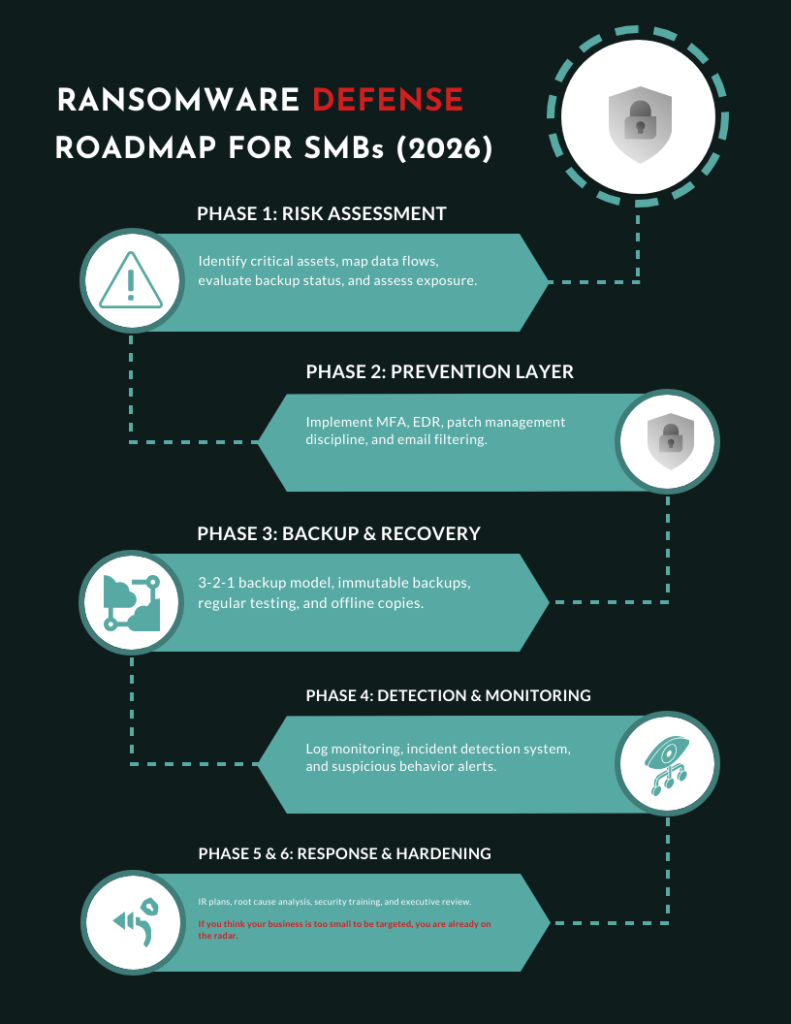
Backups are another essential pillar, but only if they are tested regularly. A backup that is outdated, damaged, or encrypted along with everything else is worthless. Following the well-known 3-2-1 rule, which means keeping three copies of data on two different types of storage with at least one copy offline, is a good starting point. Regular recovery drills are just as important, since they make sure staff can actually restore systems under real pressure, not just in theory.
Having a clear incident response plan in place before an attack happens can prevent a lot of chaos and confusion. Such a plan should define who does what, how the situation should be escalated, and how communication should be handled internally and externally, ideally with external experts like forensic specialists, legal advisors, and PR professionals already included. In Germany, operators of critical infrastructure are required to have such plans under BSI rules, and it makes sense for SMEs to follow similar standards voluntarily.
Employee awareness remains one of the most important defenses of all, since human error is still the number one way ransomware gets into a company. Regular phishing simulations, short training sessions, and ongoing awareness campaigns can help employees recognize suspicious emails and avoid risky clicks. In Germany, works councils are often supportive of this kind of training, since it strengthens both company security and employee confidence at the same time.
Patch and vulnerability management is another area that attackers rely on heavily, since many well-known security gaps stay open for months simply because systems are not updated. A structured patching process with clear timelines, supported by automated vulnerability scanning, can close many of these gaps. Since many SMEs still run older ERP or production systems that are difficult to patch, extra safeguards like firewalls and monitoring become even more important as a backup layer of protection.
Legal and regulatory compliance also plays a major role, especially in the EU, where data breaches can lead to serious GDPR fines on top of the damage to a company’s reputation. Clear procedures for reporting incidents to data protection authorities and affected customers are essential, and in Germany, regulators tend to be strict, meaning that how transparently and quickly a company handles an incident can directly influence the size of any penalty.
Cyber insurance and supplier contracts offer another layer of protection, but only when they are set up correctly. It’s important to check insurance policies carefully to make sure ransomware and business interruption are actually covered, and to include clear cybersecurity requirements in contracts with suppliers so that responsibility is shared. German insurers have been tightening their ransomware coverage recently, so businesses need to check exclusions carefully and make sure they meet the minimum security requirements.
Finally, regular penetration testing and continuous security assessment help companies find their weaknesses before attackers do. Regular penetration tests, red team exercises, and vulnerability scans, combined with a clear focus on fixing the most serious issues first, are all part of a strong prevention strategy. The BSI recommends this kind of continuous testing, and for SMEs, regional IT security initiatives or shared audits can offer a more affordable way to get started.
Taken together, these lessons show that ransomware resilience is about much more than firewalls and antivirus software. It requires a combination of the right technology, such as monitoring, backups, and network segmentation, together with well-trained people who are aware of the risks, and solid processes covering incident response, compliance, and contracts. The three case studies make it clear that ransomware is not a distant or isolated problem, but a global challenge that touches every industry, from manufacturing to healthcare. Only by bringing technology, people, and processes together into one complete security strategy can organizations truly reduce their risk and be ready, not for if ransomware strikes, but for when it does.
Conclusion – real examples of ransomware attacks on companies
Cybercriminals don’t need advanced skills to cause serious damage — they just need one small business owner to make one small mistake. The truth is, most successful attacks could have been prevented with a few simple changes, and that’s exactly what this guide gives you: clear, practical steps you can put into action today, no technical background required. Every day without basic protection is another day your business, your data, and your customers’ trust remain exposed. Take a few minutes now to close the gaps that cybercriminals are actively looking for. Download your free guide today and give your business the protection it deserves.
I also recommend to read the following articel
All computers locked – what to do in the event of a ransomware attack?
Can Ransomware Encrypt Cloud Backups? How Small Businesses Can Actually Protect Themselves
Cybersecurity Is Not Dead: Why Small Businesses Need Security Expertise More Than Ever
Ransomware Attacks Explained: How They Spread and How to Protect Your Business
Ransomware in Small Businesses: 5 Steps You Can Take Right Away
The WannaCry Hack: How a Virus Could Spread Worldwide in Hours