
Find out in this article How WannaCry ransomware spread so fast in 2017. In the digital age, we often imagine hackers as shadowy figures working quietly in the background, targeting one company or stealing a few credit card numbers at a time. But in May 2017, the world witnessed something very different – a cyberattack that spread like wildfire, crossing borders faster than any human pandemic ever could.
Within hours, hospitals in the UK were cancelling operations, factories in Europe shut down production lines, telecom providers in Spain struggled to stay online, and government institutions from Russia to China reported massive outages. Screens everywhere lit up with the same chilling message: “Oops, your files have been encrypted.”
The attack, later known as WannaCry, wasn’t just another computer virus. It was a global crisis that exposed how vulnerable our digital infrastructure really is – and how quickly chaos can unfold when millions of machines are connected but unprotected.
What made WannaCry truly terrifying was its speed. Unlike most cyberattacks that require someone to click on a malicious link or open a dangerous attachment, this ransomware spread on its own, leaping from one vulnerable computer to the next. By the time IT teams realized what was happening, the infection had already swept across entire networks, locking up critical data and demanding ransom payments in Bitcoin.
How could one virus do so much damage, so fast? And why were so many organizations – from small businesses to national healthcare systems – caught completely off guard? To answer that, we need to look at the hidden ingredients that made WannaCry one of the most infamous hacks in history.
What was WannaCry?
At its core, WannaCry was a piece of ransomware – but not just any ransomware. Ransomware is a type of malicious software designed to take control of a computer by encrypting its files, making them completely inaccessible to the user. Once the files are locked, victims receive a message demanding a ransom payment in exchange for the decryption key.
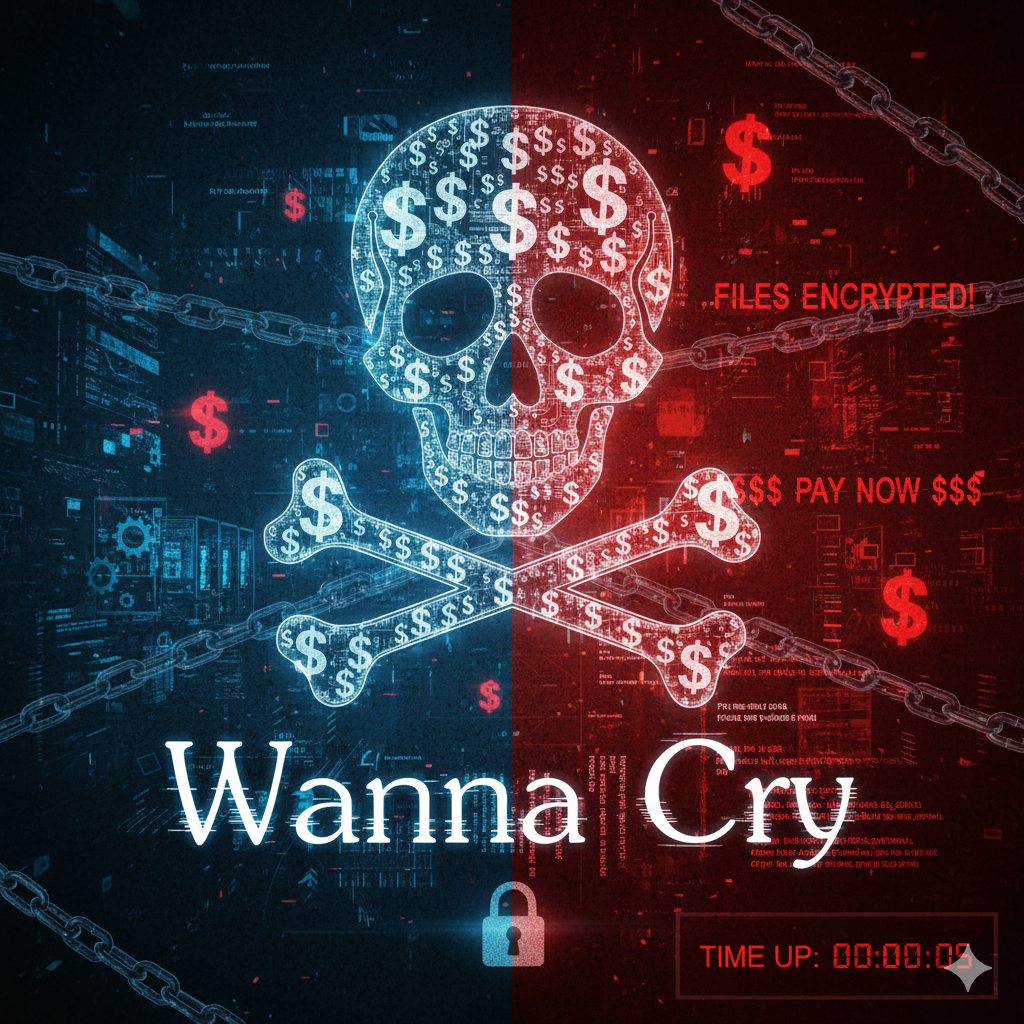
WannaCry followed this classic formula, but with a more polished – and more frightening – approach. After infection, the victim’s screen would suddenly display a red-and-black message box with the words:
“Oops, your files have been encrypted!”
The message wasn’t just a warning; it was a digital ransom note. Victims were told that if they wanted to see their data again – whether family photos, business documents, or entire hospital databases – they would need to pay a fee in Bitcoin, the cryptocurrency often favored by criminals for its relative anonymity.
The initial ransom demand was about $300 worth of Bitcoin, but the malware added psychological pressure with a built-in countdown timer. Victims had only a few days to make the payment. If the deadline passed, the ransom would double to $600, and after a week the attackers threatened to delete the files forever.
This combination of encryption, fear tactics, and urgency created a sense of panic. For individuals, it meant possibly losing personal memories or critical work. For organizations, it meant paralyzed systems, halted operations, and financial losses mounting by the minute.
But what truly made WannaCry different from earlier ransomware attacks was not just its ransom note or payment method – it was its ability to spread automatically, turning a typical cybercrime scheme into a global digital epidemic.
The WannaCry ransomware attack was a worldwide cyberattack in May 2017 by the WannaCry ransomware cryptoworm, which targeted computers running the Microsoft Windows operating system by encrypting data and demanding ransom payments in the form of bitcoin cryptocurrency.[4] It was propagated using EternalBlue, an exploit developed by the United States National Security Agency (NSA) for Microsoft Windows systems.
The Key to its Speed: EternalBlue
What turned WannaCry from “just another ransomware” into a global catastrophe was not only its ransom scheme, but the weapon it used to spread: a powerful exploit called EternalBlue. EternalBlue targeted a flaw in Microsoft’s Server Message Block (SMB) protocol – a core Windows feature that allows computers to share files and printers across networks. Under normal circumstances, SMB is essential for office environments, letting hundreds of machines connect and exchange information. But in this case, a hidden vulnerability made SMB the perfect gateway for attackers.
Here’s where the story gets even more alarming: EternalBlue wasn’t invented by cybercriminals at all. It was originally developed by the U.S. National Security Agency (NSA) as part of a secret stockpile of cyber weapons. These tools were designed for offensive operations, giving intelligence agencies the ability to penetrate foreign networks. But in 2017, hackers known as the Shadow Brokers leaked a collection of these NSA tools to the public. Among them was EternalBlue – soon to become the fuel for WannaCry’s global firestorm.
Why was EternalBlue so dangerous?
-
No user interaction required – Unlike most malware that needs someone to click a link or open an attachment, EternalBlue allowed WannaCry to break in silently.
-
Automatic propagation – Once a single vulnerable computer was infected, WannaCry could scan for other machines on the same network and spread instantly, without human help.
-
Lateral movement – Inside corporate networks, it jumped from one workstation to another, infecting entire organizations in minutes.
-
Worm-like behavior – This turned WannaCry into more than just ransomware. It became a self-spreading worm, able to replicate itself endlessly as long as it found unpatched systems.
The result was explosive speed. A hospital network, for example, didn’t just lose one PC – it could see hundreds of machines locked simultaneously, crippling everything from patient records to diagnostic equipment. Factories, shipping companies, and telecom providers faced the same nightmare: once WannaCry entered the front door, it swept through the building like a digital hurricane. In other words, EternalBlue gave WannaCry the power to scale like a pandemic – a cyber virus capable of circling the world in just a few hours.
Why So Many Computers Were Vulnerable
Here’s the most shocking part of the WannaCry story: the vulnerability that made the attack possible had already been fixed before the global outbreak even began. In March 2017, two months prior to the ransomware wave, Microsoft released a critical security patch known as MS17-010. This update closed the SMB vulnerability that the leaked exploit “EternalBlue” would later abuse at massive scale.
Technically speaking, the door had already been locked. Yet millions of systems around the world were still standing wide open.
So why did WannaCry spread so aggressively?
The uncomfortable answer is this: the problem was not the absence of a solution — it was the failure to implement it.
In many organizations, outdated Windows systems were still deeply embedded in daily operations. Hospitals, public institutions, and manufacturing plants were running legacy environments such as Windows XP or other unsupported versions of Windows. These systems often controlled diagnostic devices, industrial machines, or internal administration platforms that were never modernized. Once vendor support ended, security updates stopped. That meant every newly discovered vulnerability became permanent technical debt.
Another critical factor was what you might call the “too critical to touch” mindset. In healthcare environments, for example, IT teams were understandably cautious. Rebooting a system connected to medical equipment or updating a server that supports emergency workflows can feel risky. Downtime might delay patient care. Production stoppages can cost factories thousands per hour. As a result, updates were frequently postponed — not out of ignorance, but out of operational fear. Ironically, this attempt to avoid disruption created a far larger one when ransomware eventually hit.
Patch management itself was often fragmented or weak. In larger enterprises, updates had to pass through testing, approval chains, and scheduled maintenance windows that sometimes occurred only quarterly. In smaller organizations, there was often no structured process at all. Systems were updated manually, inconsistently, or only when someone remembered. Without centralized visibility, leadership had no clear overview of which machines were protected and which were not.
There was also a psychological dimension. For many administrators, the vulnerability addressed by MS17-010 sounded highly technical and abstract. It was “just another patch.” Without immediate signs of exploitation in their own network, the perceived urgency remained low. Cyber risk that has not yet materialized tends to feel theoretical — until it suddenly becomes operational reality.
These combined factors created a perfect storm. Millions of internet-facing machines remained exposed. Critical infrastructure relied on unsupported systems. Update cycles were slow. Risk was underestimated. When WannaCry was finally unleashed, it did not need sophisticated social engineering or targeted intrusion. It simply scanned the internet for vulnerable systems and propagated automatically. The attack moved at machine speed, exploiting organizations that had already been given the opportunity to protect themselves. The lesson is not merely technical. It is strategic. Cybersecurity failures are rarely caused by missing tools. More often, they stem from governance gaps, risk misjudgment, and operational hesitation. And that is precisely why patch management is not an IT detail — it is an executive responsibility.
The Impact
When WannaCry erupted in May 2017, the consequences were immediate and highly visible. Within hours, screens displaying the same red ransom note appeared across continents. What began as a technical exploit quickly escalated into a global operational crisis. One of the most alarming examples was the National Health Service (NHS) in the United Kingdom. Hospitals and clinics across England and Scotland were severely affected. Thousands of appointments and surgeries had to be cancelled. Doctors and nurses suddenly lost access to digital patient records. Ambulances were diverted to unaffected facilities. In some locations, staff were forced to revert to pen and paper. The disruption was not merely inconvenient — it directly interfered with medical care and placed vulnerable patients at risk.
The corporate sector was hit just as hard. FedEx reported major operational disruptions, particularly through its European subsidiary TNT Express. Deliveries were delayed, logistics chains were interrupted, and recovery efforts required extensive system rebuilds. For a company whose core value proposition is reliability and speed, even temporary paralysis had enormous financial and reputational consequences.
In the manufacturing industry, Renault temporarily halted production at several plants. Assembly lines were stopped as a precaution to prevent further spread within industrial networks. In modern manufacturing, downtime is measured in thousands — sometimes millions — of dollars per hour. The ransomware had effectively crossed from IT systems into operational technology environments.
Telecommunications providers were not spared. Telefónica, one of Spain’s largest telecom operators, instructed thousands of employees to power down their computers immediately. The aim was simple: contain the infection before it propagated further across internal networks. Even the act of turning off machines at scale demonstrated how urgent and uncontrolled the situation had become. Beyond these high-profile cases, critical infrastructure in multiple countries experienced temporary shutdowns. Reports emerged of disruptions affecting government agencies, railway systems, and energy providers in nations such as Russia, India, and China. While not all outages were publicly detailed, the message was clear: essential national systems were vulnerable.
The damage was not limited to financial loss. Lives were potentially endangered. Patients missed critical treatments. Companies suffered halted production and broken supply chains. IT and security teams worked around the clock, isolating networks, disconnecting machines, and attempting emergency patch deployments under extreme pressure. In the aftermath, global financial damage estimates ranged between 4 and 8 billion US dollars. And the most sobering reality remains this: the catastrophe was not triggered by an unknown zero-day vulnerability without a fix. The protective patch had already been available for weeks. The impact of WannaCry was therefore not just a lesson in malware propagation. It was a stark demonstration of what happens when governance, patch management, and executive risk awareness fail simultaneously. Similar operational disruptions have also occurred in Germany in recent years. For a deeper look at how ransomware has affected German municipalities, hospitals, and mid-sized companies, see Inside Germany’s Ransomware Struggle: Lessons from Real Incidents.
How the Attack Was Stopped
After hours of escalating chaos — hospitals shutting down systems, factories halting production, and IT teams around the world scrambling to contain the spread — something unexpected happened. The explosive growth of WannaCry began to slow. It was not an immediate government intervention. It was not a coordinated multinational response. And it was not an emergency patch from Microsoft that stopped the first wave. Instead, the turning point came from a young independent security researcher working from home.
That researcher was Marcus Hutchins, known online as MalwareTech. While analyzing the ransomware sample in a controlled environment, he noticed something unusual in the code. Each time WannaCry infected a system, it attempted to connect to a long, seemingly random domain name ending in “.com.” The domain was unregistered — essentially dormant. Out of curiosity and as part of his investigation, Hutchins decided to register the domain for a small fee, reportedly around ten dollars. At that moment, he did not fully realize what he had just triggered.
Almost immediately, the global infection rate began to drop. The reason was both simple and remarkable. The domain functioned as a built-in “kill switch.” Before encrypting files, the malware attempted to contact that specific web address. If the domain was unreachable, the ransomware continued executing — encrypting data and spreading laterally across networks. But if the domain responded, the malware interpreted that as a sign it was running inside a security sandbox or analysis environment and shut itself down to avoid detection.
By registering the domain and making it active, Hutchins unintentionally caused infected instances of WannaCry to stop executing on newly compromised machines. The ransomware, in effect, began disabling itself. This did not magically solve the crisis. Systems that were already encrypted remained encrypted. The kill switch did not decrypt files, restore backups, or remove the malware from affected networks. Victims still faced operational disruption and difficult recovery decisions.
Moreover, cybercriminals quickly adapted. Variants of WannaCry appeared that removed the kill switch mechanism entirely, eliminating that particular weakness. Unpatched systems were still vulnerable. A second wave remained entirely possible. Yet the impact of that discovery was enormous. The slowdown bought organizations critical time — time to apply the MS17-010 patch, time to isolate infected machines, time to disconnect exposed servers from the internet, and time to coordinate incident response efforts. Without that accidental discovery, the worm-like propagation could have continued at machine speed for far longer. The consequences for healthcare systems, manufacturing plants, and national infrastructure might have been significantly worse.
The episode is a powerful reminder of two realities in cybersecurity. First, even highly destructive malware can contain flaws. Second, resilience often depends on a combination of preparation, rapid analysis, and sometimes a small stroke of luck. But luck is not a strategy. The real lesson remains unchanged: patch management, network segmentation, and executive-level risk awareness must be in place before the next outbreak begins.
WannaCry hit so many companies because they were still running outdated systems like Windows XP and Windows 7, had missed critical security patches, and continued using legacy software such as Internet Explorer. Many machines lacked up-to-date antivirus protection, and poor network segmentation allowed the ransomware to spread rapidly inside corporate networks. In short: a mix of obsolete IT, weak patch management, and poor cyber hygiene opened the door for WannaCry.
Lessons Learned
The WannaCry incident wasn’t just a temporary disruption — it became a historic wake-up call for the entire cybersecurity community. In a matter of hours, the attack revealed just how fragile the digital backbone of our world can be. The lessons it left behind are still highly relevant today.
1. Patch Management is Critical Microsoft had already released the patch (MS17-010) two months before the outbreak, yet countless organizations failed to install it in time. This showed that having patches available is not enough — what matters is how quickly and consistently they are applied. For businesses, that means establishing automated patch management systems, testing updates rapidly, and enforcing strict timelines for critical fixes. For individuals, it’s a reminder to never ignore Windows Updates or software prompts — delays can be the difference between safety and disaster. Lesson: Updates aren’t optional “later tasks” — they are frontline defenses.
2. Legacy Systems are High-Risk Many of the worst-hit organizations were still running Windows XP or Windows 7, long past their official support period. Healthcare systems, industrial plants, and government agencies often depend on outdated machines connected to vital equipment, but these older systems are prime targets for hackers. The attack forced governments and companies to rethink their reliance on legacy infrastructure. Some organizations even paid millions afterward to upgrade to supported platforms. Lesson: Old systems equal open doors — if replacement isn’t possible, they must be isolated and monitored.
3. Cyber Weapons Can Escape Control EternalBlue was never meant to be in criminal hands. It was a tool created by the NSA, leaked by a hacking group called the Shadow Brokers. Once released into the wild, it became a weapon anyone could use — from lone hackers to organized crime groups. This raised ethical and political questions about whether intelligence agencies should keep zero-day exploits secret for their own use or disclose them to software companies to protect the public. Lesson: When powerful exploits leak, the whole world pays the price.
4. Prevention is Cheaper than Damage Control WannaCry caused $4–8 billion in damages worldwide — costs that could have been avoided by simply applying a free security patch. Companies lost not only money, but also customer trust, operational continuity, and in some cases human lives were put at risk due to medical delays. The contrast is striking: a 15-minute system update versus billions in global economic impact. Lesson: Proactive defense always costs less than reactive recovery.
5. Cybersecurity is Everyone’s Responsibility WannaCry showed that a single weak point can have global ripple effects. Hospitals in the UK, car factories in France, shipping companies in the U.S. — all fell victim, proving that cybersecurity is no longer just an IT problem. Executives, employees, and even home users all have a role: staying aware, following safe practices, and treating digital hygiene like physical hygiene. Lesson: Security is not just about firewalls — it’s about culture, habits, and awareness.
The Big Picture Ultimately, WannaCry demonstrated that in today’s hyperconnected world, a single vulnerability can trigger a global crisis. The attack may be years in the past, but the principles remain timeless: keep systems updated, retire or isolate legacy software, and treat cybersecurity as a strategic priority, not an afterthought. Because if WannaCry taught us anything, it’s that the next digital epidemic could spread even faster — and the cost of unpreparedness will be even higher.
Preparedness is not optional. It is foundational. For a complete strategic implementation roadmap, see The Ultimate Ransomware Protection Guide for your Business.
Conclusion: How WannaCry ransomware spread so fast in 2017
The WannaCry ransomware attack was more than just a headline in 2017 — it was a global wake-up call that exposed the fragility of our interconnected digital world. It demonstrated how a single vulnerability, once weaponized, can cripple hospitals, factories, and governments within hours. The answer to how WannaCry spread worldwide so rapidly lies in a deadly combination of outdated systems, ignored security updates, and a powerful cyber weapon that was never meant to fall into criminal hands.
The lessons this attack left behind are as clear as they are urgent: timely patching, the phasing out of legacy infrastructure, and a culture of shared cybersecurity responsibility are not optional — they are essential. Yet while the lessons are clear, the threat landscape has only grown more dangerous. Cybercriminals have become more sophisticated, more organized, and more relentless since 2017.
The world cannot afford to forget what happened in May 2017. The next digital epidemic may spread even faster, strike even harder, and — unlike WannaCry — may not come with a accidental kill switch to stop it. Preparedness is no longer a choice. It is a necessity.
Airports and transportation hubs are equally vulnerable. A recent case illustrates how quickly operational paralysis can occur when core systems fail — as explored in Airport offline: How vulnerable our systems really are.