

For more than 75 years, this Swiss company stood for stability and continuity. Founded in 1947 by the founder’s grandfather in the aftermath of World War II, it had weathered economic crises, technological revolutions, and generational transitions. What began as a small family operation had grown into a mid-sized business with over 200 employees, many of whom had worked together for decades. Colleagues knew each other’s families, celebrated milestones together, and shared a deep sense of loyalty to the company. It was not just a company – it was a community built on trust, tradition, and personal relationships. Then one phone call changed everything.
On an otherwise ordinary morning, the CEO was confronted with a demand no business ever expects to hear: pay the equivalent of two million Swiss francs in Bitcoin – or permanently lose access to critical company data. The attackers had infiltrated the company’s systems, encrypted essential files, and now held the digital keys to the company’s operations. If the ransom was not paid within 72 hours, they threatened not only to destroy the data but to publish sensitive information – client records, financial details, internal communications – on the dark web. What followed was not only a technical crisis, but an emotional one that would test the very foundation of this family business.
Don’t be the next company to be targeted by a ransomware attack! Use the Insights and Strategies from Cyber secureGuard practically for your company.
A company in shock
Inside the company, the impact of the attack was immediate and overwhelming. Within hours of the breach being discovered, uncertainty spread like wildfire through offices, workshops, and production areas. Employees huddled in small groups, voices lowered, exchanging rumors and worst-case scenarios. The usual rhythm of work – the hum of machinery, the flow of daily routines – was replaced by an unsettling silence punctuated by anxious conversations. People began to ask questions no one could answer yet. Would operations continue? Would salaries still be paid? Would clients lose confidence? Would the company survive this?
For many, the fear was deeply personal. This was not just a job at risk, but long-term stability, routines, and livelihoods built over years – sometimes decades. Employees who had planned their retirements around the company’s pension scheme suddenly faced uncertainty. Younger workers with mortgages and young families wondered if they should start looking for other positions. In a company where people knew each other well – where they had attended each other’s weddings and watched colleagues’ children grow up – anxiety was not hidden behind professional facades. It was shared openly, in break rooms and hallways, creating a collective sense of vulnerability.
Management faced a different kind of pressure entirely. The leadership team found themselves in crisis mode, holding emergency meetings that stretched late into the night. Decisions had to be made quickly, under incomplete information, and with enormous consequences. Should they pay the ransom or refuse on principle? Should they inform clients immediately or wait until they had more clarity? How transparent should they be with employees? Every option seemed to carry risk. Every hour without clarity increased the tension. The weight of responsibility for 200 families rested heavily on their shoulders.
The IT team, however, carried the heaviest emotional burden. These were professionals who took pride in their work, who had dedicated years to building and maintaining the company’s digital infrastructure. Now they worked around the clock, surviving on coffee and adrenaline, trying to assess the full extent of the breach while fielding constant questions from anxious colleagues. The exhaustion was physical, but the psychological toll was worse. Again and again, the same question surfaced internally: How could this happen? We were well protected. We did everything right. This was not denial. It was disbelief – genuine, painful disbelief.
The company had invested seriously in cybersecurity, treating it as a priority rather than an afterthought. Modern security infrastructure was in place, updated regularly and monitored consistently. A high-end firewall protected the network perimeter. Multi-factor authentication had been implemented across critical systems. Established IT processes had been followed meticulously. Regular backups were performed. Software patches were applied promptly. Security awareness training had been conducted with employees. Measures had been taken to reduce risk at every level the team could think of.
From an external perspective, this was exactly the kind of organization that should not become a ransomware victim. They had done their homework. They had been diligent. They had taken cybersecurity seriously in an industry where many competitors still treated it as a checkbox exercise. And yet, it did happen.
That contradiction would haunt everyone involved – not just in the immediate aftermath, but for months to come. Not because obvious mistakes had been ignored or warnings had gone unheeded, but because the attack challenged a dangerous assumption many well-prepared companies share: that good security automatically means complete security. That being better than average provides immunity. That professionalism and investment create an impenetrable shield. The breach shattered that illusion completely.
The decision that defines everything: pay or resist
Ransomware attacks are not only technical incidents. They are psychological operations, carefully orchestrated campaigns designed to break down resistance and extract maximum payment through fear, pressure, and manipulation. From the moment contact was established, pressure became constant and relentless. The attackers did not rely on a single message or threat and then wait passively for a response. They maintained communication through encrypted channels, repeated their demands with escalating urgency, and made sure their presence was felt at every moment. Messages arrived at irregular intervals – sometimes in the middle of the night, sometimes during business hours – creating a sense that the company was under constant surveillance.
They demonstrated detailed knowledge about the CEO, the company’s organizational structure, recent business developments, and even internal projects – information that could only have come from weeks or months of reconnaissance within the company’s systems. This was a deliberate tactic designed to unsettle and intimidate, to show that the attackers were not opportunistic amateurs but sophisticated operators who had studied their target thoroughly. The message was clear: we know who you are, we know what matters to you, and we are in control.
For hours that stretched into days, the central question remained unresolved, debated in tense boardroom meetings and late-night conference calls. Should the company pay the ransom and hope to regain control quickly – buying back their own data and resuming operations within days – or refuse on principle and risk prolonged disruption, potential permanent data loss, leaked confidential information, and the reputational damage that could follow?
Two million Swiss francs in Bitcoin is not an abstract sum. It is not a line in a budget report or a hypothetical scenario discussed in a risk management workshop. It is real money – money that could fund salaries for months, finance critical investments, or sustain the company through difficult times. It is a decision that can determine whether a company continues to exist in its current form, whether employees keep their jobs, whether client relationships survive the crisis.
For the CEO, this decision carried a heavy personal weight that went far beyond the financial calculation. As the leader of a family business built over three generations, every choice felt like a betrayal of some fundamental principle. Paying the ransom might seem like the fastest, most pragmatic way out – a business decision prioritizing operational continuity and employee welfare. But it would also mean directly funding criminal organizations, potentially encouraging future attacks not just against this company but against others, and setting a dangerous precedent that might make the company a target again. The moral dimension was impossible to ignore.
Refusing, on the other hand, meant embracing uncertainty. It meant accepting weeks or even months of operational disruption. It meant the very real possibility that some data might be lost forever or published online for competitors and the public to see. It meant shouldering responsibility for whatever consequences followed – lost revenue, strained client relationships, employee anxiety, and the immense effort required to rebuild systems from scratch. There was no easy choice. Every path forward came with costs, both tangible and intangible.
After careful consideration, intense internal debate, and consultation with cybersecurity experts and legal advisors, negotiations were deliberately stopped. The company made the decision: they would not pay. This decision was not based on optimism, bravado, or naive courage alone. It was not an emotional reaction or a defiant gesture made in the heat of the moment. It was based on cold, practical preparation that had been put in place years before this crisis ever materialized.
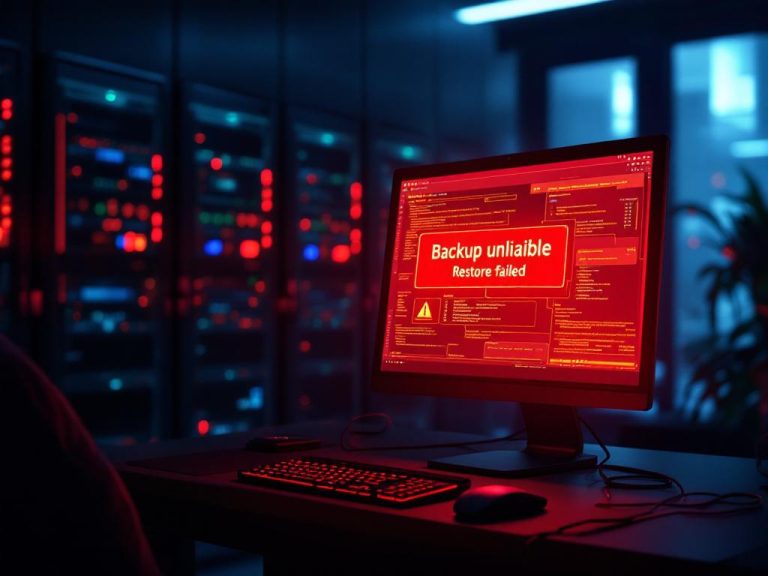
The company had functional, regularly tested, and geographically distributed backups stored offline and in separate systems that the attackers could not reach. These backups were comprehensive, covering critical business data, customer information, financial records, and operational systems. They were not perfect – some recent data would inevitably be lost – but they were sufficient. Systems could be restored. Operations could, with considerable effort, significant time investment, and temporary workarounds, be resumed without relying on the attackers’ decryption keys or their promises of cooperation. This changed everything. It transformed the negotiation dynamics completely.
In ransomware incidents, backups do not merely support recovery as a technical convenience. They define the entire strategic position. They determine whether a company negotiates from a position of desperation and fear – willing to pay almost any price to avoid catastrophe – or from a position of relative control and leverage, able to walk away from demands they consider unreasonable or unethical. Without backups, companies are hostages. With them, they have options. This company had options. And they chose to use them.
“We were secure” – and still vulnerable
For years, the company had invested heavily in its defenses. They had the firewalls, the encrypted servers, and the high-end security protocols one would expect from a Swiss industry leader. The internal mantra was clear: “We are secure.” But as the forensic investigators began to peel back the layers of the breach, a much more uncomfortable and humbling truth began to emerge.
The analysis revealed that this wasn’t a “Hollywood-style” heist. There were no elite hackers bypassing biometric scanners or using “zero-day” exploits worth millions. In fact, the attackers had spent days knocking on the front door, repeatedly trying to brute-force their way in with common passwords. They failed. The core systems held firm.
But a fortress is only as strong as its most forgotten window.
The real entry point was something far more mundane, yet far more dangerous: a piece of “Shadow IT” that had slipped through the cracks of time. Tucked away in a dusty corner of a paint warehouse stood several outdated display systems. These screens, originally installed years ago to show inventory levels, were still physically connected to the main network but had long since been forgotten by the IT department.
Because they weren’t considered “critical,” they were:
-
Unmonitored: No one was watching their traffic.
-
Unpatched: They were running ancient software riddled with known vulnerabilities.
-
Invisible: They didn’t appear on the modern security dashboard.
To the attackers, these neglected screens were the perfect backdoor. Once they gained a foothold in the warehouse display system, they were able to pivot through the internal network, bypassing the formidable front-line defenses from the inside.
This is the most vital chapter of the story. It serves as a haunting reminder that a company’s greatest risk isn’t usually the “unsolveable” high-tech threat—it’s the simple, outdated device that everyone assumed was harmless. It is a vulnerability that exists in almost every company today.
This pattern is not unique to this case. Similar risks have surfaced in other industries as well. In one simulated cyber attack, even a modern bakery production facility discovered that overlooked systems and assumptions about “non-critical” environments created real and measurable security gaps. What a Simulated Cyber Attack Revealed About a Bakery Production Facility’s Real Risks
Ransomware is not chaos – it is an industry
The documentary goes far beyond the description of a single ransomware incident. It exposes a reality that many organizations – from small businesses to multinational corporations – still fundamentally underestimate: modern ransomware operations are not chaotic, improvised attacks carried out by lone hackers in darkened rooms. They are structured, organized, and deliberately professional enterprises operating at a scale and sophistication that rivals legitimate businesses.
These groups do not consist of isolated individuals working randomly, opportunistically targeting whatever systems they happen to stumble upon. They function much more like multinational corporations with hierarchies, specializations, and strategic planning.
Roles are clearly defined and separated for both efficiency and operational security. Some members specialize exclusively in initial access – identifying vulnerabilities, purchasing stolen credentials on underground markets, or deploying phishing campaigns designed to establish that critical first foothold in a target network. Others focus on lateral movement within compromised systems, methodically exploring networks, escalating privileges, and mapping out the digital infrastructure to identify the most valuable assets.
Dedicated teams selecting and evaluate sensitive information that can be used as additional leverage – financial records, client databases, proprietary research, internal communications that could prove embarrassing if leaked. Professional negotiators, often fluent in multiple languages and trained in psychological manipulation tactics, handle all victim communications, calibrating pressure and adjusting demands based on the target’s responses and perceived ability to pay.
Payments are tracked precisely through cryptocurrency wallets. Profits are shared according to predetermined agreements between operators, affiliates, and initial access brokers – often following a “Ransomware-as-a-Service” (RaaS) model where the ransomware developers take a percentage cut while affiliates who execute the attacks keep the majority. Operations follow repeatable processes documented in internal manuals, with quality control measures and performance reviews not unlike those found in legitimate sales organizations.
In many cases, ransomware groups operate with fixed schedules – working hours that align with business days in their target regions to maximize pressure during negotiations. They maintain internal rules governing acceptable targets (some groups claim to avoid hospitals or critical infrastructure, though these claims are often violated), standards for customer service (providing decryption support to victims who pay), and even dispute resolution mechanisms when conflicts arise between affiliates. Performance expectations are set and monitored. Groups compete for reputation in underground forums, advertising their reliability in decrypting data and their professionalism in negotiations.
This level of organization is not accidental or superficial. It explains why attacks are often so persistent, so well-coordinated across multiple time zones and technical layers, and so psychologically precise in their timing and messaging.
The attackers in this Swiss case study knew exactly who they were dealing with – and that knowledge was no accident. They had gathered detailed information about the CEO and the company long before launching the encryption attack. Personal details about the CEO’s background and family, the company’s seventy-five-year history and generational transitions, corporate organizational structures showing reporting lines and decision-making authority, operational dependencies revealing which systems were most critical to daily business, recent financial performance that indicated ability to pay, and even internal projects that suggested areas of vulnerability – none of this was discovered by chance during the attack itself. It was researched methodically, compiled systematically, and weaponized strategically.
This knowledge was deployed at precisely calculated moments throughout the negotiations to increase pressure and establish credibility. When attackers referenced specific internal projects by name, quoted from confidential emails, or demonstrated awareness of the CEO’s personal schedule, the message was unmistakable: they had been inside the network for weeks or months, observing silently, and they understood the business intimately. The goal was not only to encrypt data and demand payment, but to create a profound psychological sense of violation and inevitability: we know you, we know your business, we know your weaknesses, and we know where it hurts most. Resistance is futile.
The journalist who documented this case and produced the documentary initially maintained regular contact with several active ransomware groups, including affiliates associated with LockBit – one of the most prolific and sophisticated ransomware operations globally. Through these interactions, conducted through encrypted channels on dark web forums and messaging platforms, he gained unprecedented insider perspective into how professionalized and disturbingly normalized these criminal structures had become. He observed their marketing materials, their customer service protocols, their technical support systems for victims who paid ransoms, and their casual discussions about targeting strategies – all conducted with the businesslike professionalism of a legitimate software company.
However, this perspective changed dramatically and personally after he learned about ransomware attacks deliberately targeting hospitals, emergency medical services, and critical healthcare infrastructure – attacks that resulted in delayed treatments, diverted ambulances, and in some documented cases, contributed to patient deaths. The human cost of what he had been observing as a fascinating criminal ecosystem became impossible to ignore or rationalize as mere documentation.
At that point, he made a deliberate and consequential decision: he broke off all contact with ransomware groups entirely and later began actively cooperating with government institutions, law enforcement agencies, and cybersecurity organizations. Rather than continuing to document these operations from the outside as a neutral observer, he chose to use his knowledge, his sources, and his understanding of these groups’ methods to help prevent future attacks, assist in investigations, and educate potential victims about the true nature of the threat they faced. This personal shift in his work highlights an important and uncomfortable truth that the documentary makes explicit.
The image of ransomware attackers as unskilled criminals acting impulsively out of garages or internet cafés – script kiddies running automated tools they barely understand – is not just outdated. It is dangerously misleading. Today’s ransomware ecosystem is closer to a sophisticated underground service industry than to random, opportunistic cybercrime. It has supply chains, market dynamics, competitive pressures, customer reviews, professional standards, and continuous innovation in both technical capabilities and business models.
Groups invest in research and development. They test their malware against the latest security tools. They study victim industries to understand which data is most valuable and which disruptions are most painful. They analyze negotiation patterns to optimize their ransom demands. They provide technical support and maintain reputations for reliability because repeat business and referrals matter even in criminal markets.
Ignoring this reality – continuing to treat ransomware as a technical nuisance rather than a strategic, organized threat – leads directly and predictably to underestimating both the persistence of attackers and the strategic intent behind modern campaigns. And that underestimation is itself a critical vulnerability, one that sophisticated ransomware groups actively exploit when selecting and researching their targets. Understanding that you are facing not a chaotic threat but an organized adversary fundamentally changes how you must prepare, respond, and recover.
This case is not an isolated incident. Similar patterns can be observed across Europe, where ransomware groups repeatedly exploit overlooked systems, supply chain dependencies, and human assumptions rather than purely technical weaknesses. Inside Germany’s Ransomware Struggle: Lessons from Real Incidents
Why backups changed everything
Despite the immense pressure created by the ransom demand and the constant threat of data exposure, the company achieved something many ransomware victims never do: it regained full control without paying the attackers. Recovery was neither quick nor effortless. Systems did not simply return to normal overnight. The process required careful coordination, forensic cleanup, and a structured rebuild of critical infrastructure. But the decisive factor was simple: recovery was possible at all.
This outcome was not the result of luck or an improvised technical workaround. It was the result of a deliberate decision made long before the attack ever happened. Backups existed – and more importantly, they worked.
That distinction is often underestimated. Many organizations believe they are prepared because backup systems exist somewhere in their environment. In real ransomware incidents, this assumption frequently collapses. Backups that remain permanently connected to the production network are often encrypted alongside live systems. Others turn out to be outdated, corrupted, or practically unusable when time pressure is at its highest. In some cases, restoration procedures exist only in theory, undocumented and untested, leaving teams to improvise during a total system blackout.
In this case, backups met a much higher standard. They were isolated from production systems, protected against manipulation, and regularly tested under realistic recovery conditions. When systems went offline, the IT team did not have to experiment or guess. They followed a defined recovery process that had already been proven to work.
This technical readiness fundamentally changed the dynamics of the crisis. The attackers’ power depended entirely on one thing: control over the company’s data. The moment restoration began without the need for decryption keys, that leverage disappeared. The negotiation pressure lost its force. What had started as an extortion scenario turned into an internal recovery operation.
Backups did not merely enable technical restoration. They enabled a strategic decision. Without them, refusing to pay would have meant risking irreversible damage to a company built over generations. With them, independence remained intact. In ransomware incidents, backups are never just an IT detail or a routine maintenance task. They are the dividing line between forced compliance and control – between collapse and survival.
This case highlights a reality many organizations underestimate: ransomware rarely starts with sophisticated exploits, but with overlooked details. For companies that want to reduce their risk without panic-driven decisions, it’s worth focusing on practical, immediately actionable measures. Ransomware in Small Businesses: 5 Steps You Can Take Right Away
A second case: even IT companies are not immune
The documentary does not end with a single incident. It introduces a second case that reinforces an uncomfortable reality: even highly specialized IT companies are not automatically protected from ransomware. In this instance, the affected organization was technically advanced, professionally secured, and well aware of modern cybersecurity threats. Its internal infrastructure was not the weak point.
The breach occurred elsewhere. Attackers gained access through a mistake made by a customer. An external system, connected through trust and operational necessity, became the entry point. Once inside that environment, the attackers were able to move laterally and reach systems that were never intended to be exposed.
This detail matters because it highlights a growing risk in modern business environments: security is no longer limited to what a company controls directly. Even when internal defenses are strong, dependencies on customers, partners, and service providers can introduce vulnerabilities that are difficult to detect and even harder to control. Access relationships, integrations, and shared environments expand the attack surface far beyond a single organization.
In this second case, backups reportedly existed. However, unlike the first company, a ransom payment was allegedly made. Whether this decision was driven by time pressure, operational constraints, or contractual obligations remains unclear. What is clear is the implication. Strong internal security is necessary – but not sufficient. Supply chains, customer environments, and third-party access paths can undermine even the most well-designed defenses. Responsibility becomes fragmented, while attackers exploit exactly that fragmentation. Cybersecurity does not stop at the firewall. It extends into every connection a company depends on – whether technical, contractual, or operational.
Incidents like this rarely start with sophisticated exploits. They often begin with systems that were never designed to be exposed for this long. Outdated IT components, once considered harmless, quietly expand the attack surface over time. When Outdated IT Becomes a Security Risk – What Your Company Needs to Know
The Hard Truth: Lessons Beyond the Breach
This ransomware attack was not the result of corporate negligence or a lack of effort. It succeeded because of a fundamental law of the digital age: Security is only as strong as its most invisible link. The breach occurred in a space where responsibility had quietly faded and assumptions had taken over. That distinction is the difference between a secure network and a resilient one.
The company had done what most “good” organizations do—they invested in high-end tools, followed established protocols, and built a defense they believed in. Yet, a single unmanaged component was enough to undermine years of preparation. The warehouse display wasn’t ignored out of malice; it simply no longer registered as a risk. It had become part of the furniture, a digital ghost in the machine.
The Illusion of “Safety”
This is the trap that many organizations fall into. They believe that their size, their industry, or their 75-year reputation provides a layer of protection. They believe they are “too small” or “too traditional” to be a target. But the reality is that attackers don’t target reputations—they target visibility. They look for:
-
Systems that exist but are unmanaged.
-
Connections that are active but unmonitored.
-
Hardware that is quietly aging in the background, far from the IT dashboard.
This company survived not through luck, and certainly not because the attackers were incompetent. They survived because their preparation extended beyond the “front door” of prevention. They understood that while you cannot stop every attack, you can decide how much power that attack has over your future.
Resilience is not the ability to remain untouched by an invisible enemy. It is the guarantee that no single overlooked detail can ever decide the fate of the entire organization.
Conclusion – How outdated hardware becomes a backdoor for ransomware
This case illustrates clearly how outdated hardware becomes a backdoor for ransomware, even in companies that take cybersecurity seriously. The attack did not succeed because of missing firewalls, poor policies, or a lack of awareness at the strategic level. It succeeded because legacy hardware remained connected to the network long after it had fallen outside the active security mindset. These systems were still trusted, still operational – and therefore invisible.
Outdated hardware rarely attracts attention. It is assumed to be harmless, stable, or simply necessary for daily operations. Yet this assumption creates exactly the conditions attackers look for: devices that are connected, unmanaged, and rarely questioned.
What ultimately determined the outcome of this incident was not the presence of outdated systems, but the company’s ability to recover without surrendering control. Functional backups, tested recovery procedures, and a clear refusal to negotiate under pressure shifted the balance of power away from the attackers.
This is the central lesson: ransomware resilience is not built on perfect Preparation. It is built on understanding where trust persists without verification – and on preparing for failure before it happens. Outdated hardware does not announce itself as a risk. But in modern networks, it often becomes one.
Want to make sure outdated systems aren’t silently putting your business at risk?
If this case felt uncomfortably familiar, it’s worth taking a closer look at your own environment. Many ransomware incidents don’t start with sophisticated attacks, but with overlooked details that no one is actively checking anymore.
In a Cybersecurity Call, we review your current setup together, identify hidden risk areas such as legacy hardware, backup strategies – and discuss concrete, realistic next steps tailored to your companie.
👉 Book your Cybersecurity Call (Teams or Zoom):
https://cybersecureguard.org/produkt/premium-cybersecurity-call-via-teams-or-zoom