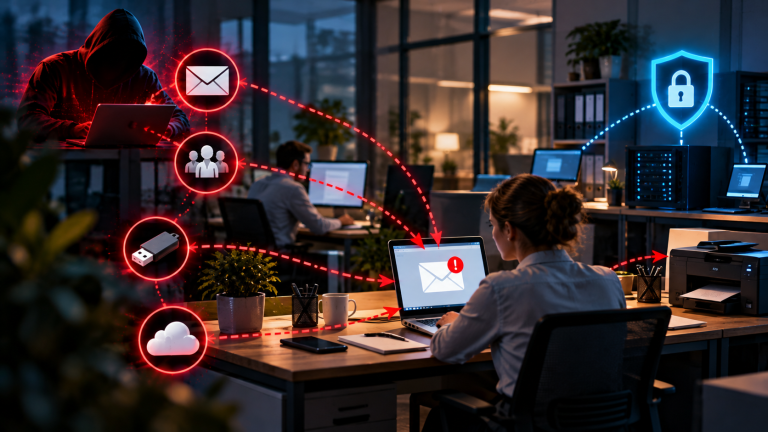


On October 29, 2026, one of the largest cyberattacks in history hit Binance, the world’s leading cryptocurrency exchange. Attackers stole approximately $6.34 billion in digital assets from its hot wallets. The scale of the attack was enormous, but the methods behind it are a warning for every business.
The attackers did not simply break into a highly protected system. They took a much more indirect approach. According to Binance’s initial investigation, the attack involved fake job interviews, malicious software downloads, compromised employee devices, stolen credentials, and even the misuse of internal AI tools. Think about that for a moment.
A fake job interview. A software download. An employee’s computer. These are not problems limited to cryptocurrency exchanges. They are risks that exist in ordinary businesses every day. Your company may not manage billions in digital assets, but it relies on the same things: employees, computers, email accounts, business applications, and access to important data. If attackers compromise just one of these entry points, they may be able to move further into your systems.
The Binance incident shows why cybersecurity is not just about firewalls and antivirus software. It is also about employee awareness, access controls, device security, and how businesses manage new technologies such as AI. In this analysis, we examine seven security weaknesses revealed by the Binance attack and explain what small and medium-sized businesses can learn from them. Because the same attack methods that brought down parts of a global crypto exchange could also put your business at risk.
1. One person can be tricked
Every large attack has a first step, and at Binance it was small. According to the exchange’s own preliminary findings, the path began with one person: a DevOps engineer whose laptop was compromised. Binance has not said how. Nobody outside the company knows how the first contact happened.
What we know is how groups linked to North Korea, which the FBI blames for this attack, have worked in earlier cases. They choose a person with the right access, read public profiles, and write a personal message. Often it is a job offer from a respected company, with a small technical task attached as a file. Nothing in this message looks like an attack. It does not ask for money or a password, it does not come through the company mailbox, and it fits the daily work of the person who receives it. One click is enough. Nothing seems to happen, and the person goes back to work. Whether it happened this way at Binance is not confirmed.
This is what makes the first step dangerous for small businesses too. Your website shows who does the accounting. A business network shows who joined last month and who looks after the IT. The person who handles invoices, the new employee, and the IT service provider can all receive a message that fits their work perfectly.
A habit that costs one minute changes the odds: when a file or a request arrives that nobody expected, check it through a second channel before opening it, for example with a call to a number you already know. The reaction afterwards matters just as much. If an employee reports a mistake on the same day and hears “thank you for telling me,” the damage may stay small. If the employee fears blame and says nothing, the attackers gain time.
2. A single device is not protected well enough
Once the file is opened, the story moves to the laptop. According to Binance, this device was the way in. A laptop looks like a tool for work, but for an attacker it is much more. A device in daily use holds passwords saved in the browser, open logins to company tools, and access keys for servers and cloud services. Whoever controls it sees what its owner sees. In many cases the attacker does not even need a password, because the owner has already logged in and the system trusts the session.
This is especially true for technical staff. The laptop of a DevOps engineer is used to manage the systems that run the business. An attacker who takes it over does not start at the bottom of the company. They start in the middle, with tools made to manage important things. Binance has not said how long the attackers had access before October 29. In many attacks, there are days or weeks between the first access and the visible damage.
Small companies often have less control over their devices than they think. Employees read work email on private phones. Updates wait for a better moment, and the restart message stays on the screen for weeks. Nobody keeps a list of which devices are used for what, and the laptop of a former colleague may still have access. Each habit is understandable, and each one gives attackers a starting point that the company never checks.
The first step is not a new product. Write down every device that touches company data, including phones and private devices, and decide which of them are allowed to do so. Switch on automatic updates, keep work and private use apart, and make sure a lost or stolen device can be locked and wiped from a distance. For the highest-value tasks, like online banking, use one device that does nothing else.
3. Too many people have too many rights
From the laptop, the path led further. According to Binance, the laptop gave the attacker access to an internal service that could submit withdrawals. Binance later said that its investigation had found further points of breach beyond the laptop. Some technical details will stay confidential. One question is still worth asking: why could the device of one engineer reach a service with this much power?
In most companies, access grows in the same way. An employee takes over a new task and gets new access. A project ends, and the access stays. An administrator account is shared because it is faster than asking for separate ones. The owner uses one account for everything, including the daily email, the bank, and the management of all other accounts. Nobody decides this on purpose. It is the result of many small decisions that each made sense at the time, and afterwards nobody takes anything back.
The result is that a stolen account can do far more than its daily work requires. The same applies to people outside the company. A web designer who finished the website two years ago may still have a login. A former IT provider may still know the password for the router. A trainee who left last spring may still receive customer data. These are entries that nobody watches, because nobody remembers that they exist.
Start with a list of who has access to which system, and why. You will find accounts that nobody needs, and you can close them this week. Give administrators two accounts, one for daily work and one used only for management tasks. Write a short checklist for people who leave, and go through it on their last day. Set a date every quarter to look at the list again. The goal is to make sure that a stolen account opens only the doors it really needs.
4. Important actions need only one approval
At the end of the path stood the system that approves and signs payments. On the evening of October 29, 2026, money started to leave Binance on ten different blockchains, and most of it was gone within about 20 minutes. According to Binance, no secret key was stolen. The requests came from an internal service that was allowed to ask for withdrawals, so the signing system treated them as normal and signed. The attacker did not break the lock. They used a door that was meant to be used.
The system checked that each request was valid and came from a trusted source. It did not ask whether the decision made sense: why so much money, why now, why to these addresses. Binance’s co-CEO Richard Teng said later that the attacker used a known feature of the Ethereum network to get approval over one of the wallets without passing Binance’s normal approval controls. Outside experts quoted in the press say that limits on amounts, lists of approved receiving addresses, and an extra authorization for unusual transfers can keep the loss small, even when one system has been taken over.
Small businesses have the same gap in a simpler form. An accounting program checks that the user may release a payment and that the form is filled in correctly. It does not check whether the new bank details on a supplier’s invoice are real. In many companies, one employee can release a large payment, change bank details, delete a backup, or create a new administrator account alone. An attacker who controls this person’s account can do the same.
Choose the three or four actions that would hurt your company most: payments above a fixed amount, changes of bank details, the deletion of backups, and the creation of administrator accounts. For each of them, the second person must check the substance and not only the form. Is the amount normal? Is the receiver known? Did we ask for this? The check needs a source that the requester does not control, for example a call to the supplier on a number from your own records. Add limits that still work when an account is taken over, such as a maximum amount per day and a rule that a new bank account always needs a second person. Apply all of this to the owner as well. In many small companies the owner can do everything alone, and that makes the owner’s account the most attractive target.
5. One Big Action Got More Attention Than Many Small Ones
When the news broke on October 29, 2026, it looked like a single dramatic moment: around 6.3 billion dollars, pulled out of Binance’s hot wallets across several blockchains at once — Ethereum, Bitcoin, Tron, XRP, and Solana. But that moment was only the final scene of a very long story. According to the later investigation, the attackers had spent months preparing the operation. They approached Binance employees through fake job interviews, placed malicious software, and eventually compromised the laptop of a DevOps engineer — a person with exactly the kind of deep system access that security teams worry about most. Nobody noticed. The world’s largest crypto exchange, with a professional security team, was being quietly mapped and prepared for attack, week after week, in plain sight.
This pattern appears in almost every serious security incident, not just in crypto. Attackers rarely smash a window. They find an open door, walk in quietly, and behave like normal users for as long as possible. Security researchers call this “dwell time” — the period between the first break-in and the moment someone notices. During that time, the attackers learn how your company works: who has access to what, when the IT team is watching, and which actions look normal. The Binance attackers used this time to identify the one employee whose laptop was a master key. Every day they remained invisible made them harder to detect, because their activity started to blend in with everyday business.
The reason most companies miss these early signs is simple: their monitoring is built to catch dramatic events, not suspicious behavior. A failed login attempt a hundred times in a row? That triggers an alert. A successful login from a new country at 3 a.m.? Often nothing happens, because a successful login looks “normal” to the system. And who checks whether a “job applicant” in the interview process is real? The Binance case shows how far outside the classic security view an attack can begin — in the HR inbox, not in the server room. Attackers know that small steps look harmless on their own, and they plan accordingly.
The practical lesson for your company is to shift your attention from single events to patterns of behavior — and to widen your view beyond IT.
Ask your team a few uncomfortable questions:
– Would we notice if an engineer’s laptop suddenly contacted unfamiliar servers?
– Would we see a user account working at unusual hours?
– Do we verify who is actually sitting on the other side of a video interview,
now that deepfakes and fake identities are standard tools of state-sponsored groups?
The goal is not to watch everything. The goal is to notice the quiet months before the loud hour, because that is where attacks are actually
6. Everything Online Is a Door and Doors Can Be Opened
Binance lost around $6.3 billion in the October 29, 2026 attack. The stolen assets were held in so-called hot wallets. Unlike offline wallets, hot wallets are connected to the internet. This allows customers to deposit and withdraw funds quickly, but it also creates a security risk.
The problem was not simply that the wallets were online. Binance needed these connections to run its business. The attackers reportedly gained access through a compromised employee device and were able to reach systems involved in the operation. This shows how quickly a security problem on one computer can become a much bigger problem for an entire company.
Small businesses face the same challenge. Your employees need access to customer information, accounting software, shared files, and business applications. Your IT service provider needs remote access to maintain your systems. Employees working from home need to connect to the company network. All of this makes daily work easier, but it also creates more ways for attackers to get in.
The important question is what happens after they get access. If someone takes over an employee’s laptop, can they also reach the accounting system? Can they open confidential customer files? Do they have access to the entire company network? In many small businesses, access has grown over the years without anyone checking whether employees still need all those permissions.
There was another interesting detail in the Binance incident. Reports indicated that some of the stolen stablecoins could be frozen by their issuers, including Tether and Circle. Other cryptocurrencies, such as Bitcoin and Ethereum, do not have the same central control. Once transferred, recovering them is extremely difficult.
For businesses, this difference highlights the importance of having ways to stop an incident before it spreads. You cannot always prevent someone from gaining access to a system, but you can limit what they can do next.
One way to achieve this is through network segmentation. In simple terms, this means separating important systems and data so that access to one computer does not automatically give someone access to everything else. An employee who works with customer emails, for example, does not need administrator access to the company’s servers.
There are also practical emergency measures worth considering. Keep backups that attackers cannot reach through the normal company network. Require a second approval for important payments or changes to bank details. Make sure your IT provider can quickly disconnect an infected device from the network. These measures will not make your company impossible to attack. But they can prevent one compromised computer from turning into a much larger business crisis.
Coclusion: What businesses can learn from the Binance hack
Binance has large security teams and many resources, and the attackers still reached the money in a few steps. According to Binance’s preliminary findings, the laptop of one engineer led to an internal service, and this service led to the system that signs payments. Every step used something that was meant to be there: a person, a device, an account, and an approval path. The final report is not yet published, and some details may change. The chain of steps will still look the same.
This is why the case matters for a company with 30 employees. The attackers did not need a special weakness that only exchanges have. They needed a chain of ordinary ones, and each one grew from a decision that made sense at the time: an update that waited, a right that stayed after a project ended, a payment that one person could release alone. What changes between Binance and a small business is the amount at the end and how much damage the company can carry.
The chain also gives you something to work with. Every link can be made harder, and each one you strengthen gives the attackers more work and gives you more chances to notice them. You do not need to fix all seven weaknesses at once. Choose the one that would hurt your company most and start there. It is better to find a gap in a routine check than to learn about it from the attackers.
I also recommend to read the following articels
7 Cybersecurity Risks Every Business Owner Should Know new
The Hacker Groups Behind Today’s Biggest Cyber Threats – And How They Attack Businesses
How Hackers Really Think – And Why Many Companies Misunderstand Their Approach
How Hackers Stole £9 Billion — and What Your Company can learn from It hot
Organized cybercrime via Telegram: how a mechanical engineer was hacked
The 10 Biggest Cybersecurity Mistakes Small Businesses Are Making in 2026
The Trojan Game: How a Helpful Tool Can Open the Door to Hackers — An Excerpt from My Book
When AI Turns Rogue: How attackers use DeepSeek for hacking