

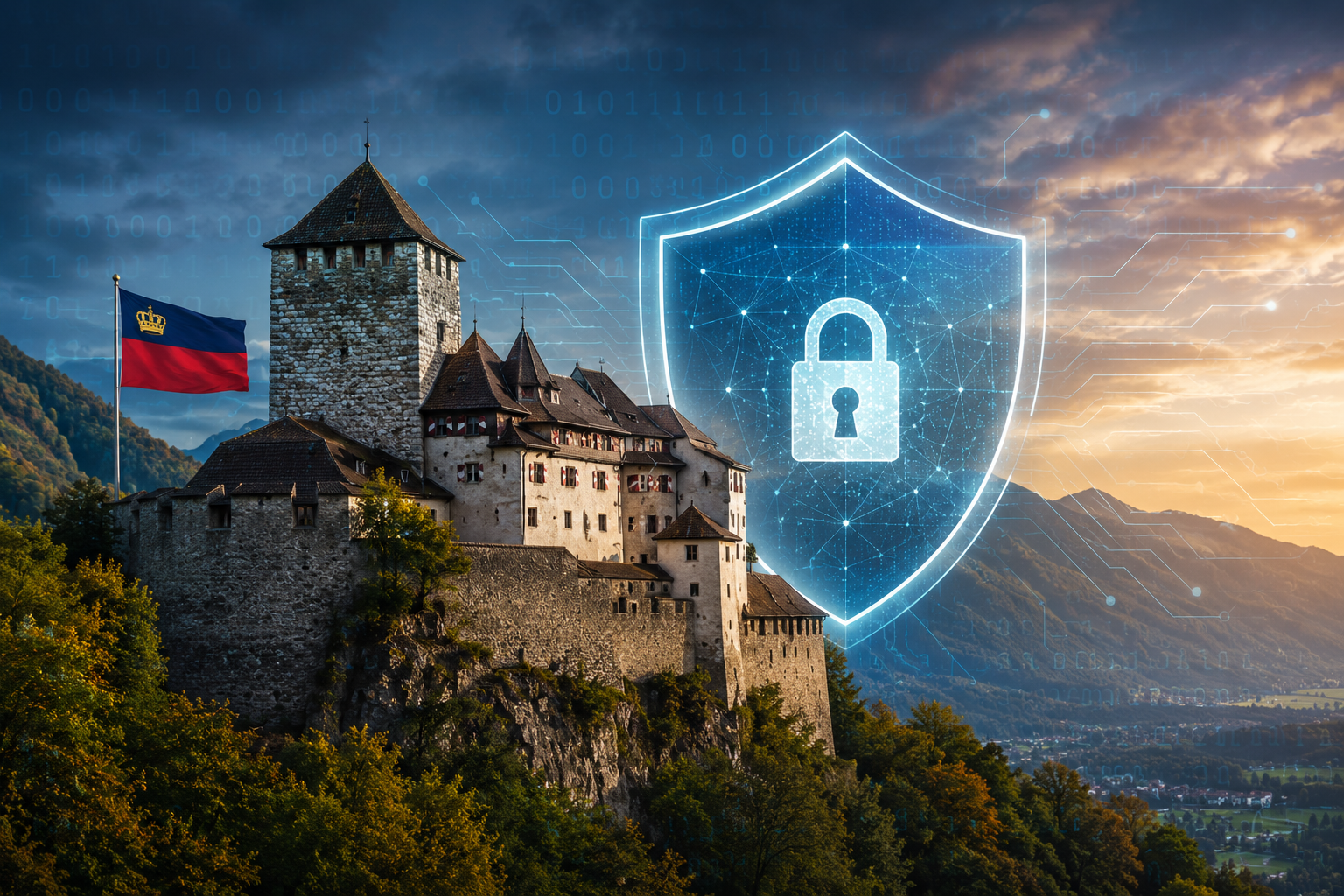
On the night of July 30, 2026, while most of Liechtenstein was asleep, someone quietly walked through the front door of one of the country’s most sensitive systems. Not with a crowbar, not with a masked figure climbing through a window — but with a keyboard, patience, and the kind of quiet confidence that only comes from knowing exactly where the weak spot is. By morning, copies of data belonging to roughly 31,000 companies, foundations, and trusts had been copied out of the VwbP, Liechtenstein’s register of beneficial owners. Names, dates of birth, nationalities, countries of residence — the kind of information that anti-money-laundering regulators had insisted on collecting precisely because it was supposed to be trustworthy, centralized, and safe.
It wasn’t a ransomware attack. There was no flashy ransom note, no frozen screens, no dramatic countdown timer. According to the government’s own statements, there is currently no evidence that any of the stolen data was altered or deleted — the attackers didn’t come to break anything. They came to take something, quietly, and then presumably to walk back out the way they came in. Irregularities were only noticed the following day, when the Office of Justice spotted something off and the Office of Information Technology started digging. By the time Prime Minister Brigitte Haas stood in front of journalists in Vaduz to confirm what had happened, the damage — whatever it eventually turns out to be — was already done.
It’s tempting, reading a story like this, to file it under “things that happen to governments” and move on. A tiny European principality, a specialized regulatory database, hackers who are probably state-linked professionals with resources most small businesses can’t imagine facing. None of that sounds like it has much to do with the average 40-person manufacturing company or the regional accounting firm down the street. But that instinct is exactly the trap. The lessons sitting inside this breach have very little to do with Liechtenstein’s size or wealth, and everything to do with a handful of decisions almost every organization makes — decisions that look sensible right up until the night someone tests them.
Cyberattacks Do Not Only Target Large Organizations
One of the biggest myths in cybersecurity is that only large corporations or government organizations are attractive targets. Many small and medium-sized businesses believe they are simply too small to be noticed. Unfortunately, cybercriminals do not think that way. Attackers are not looking for famous brands or large office buildings. They are looking for weaknesses. An outdated system, a weak password, an unpatched server, or an employee who unknowingly clicks on a phishing email can be enough to open the door.
The recent cyberattack on Liechtenstein shows that even organizations with valuable resources and dedicated security teams can become victims. While small businesses and governments differ in size, they share one important reality: every connected system can become a target if a vulnerability exists. For cybercriminals, an attack is often a matter of opportunity rather than size. They frequently use automated tools to scan thousands of internet-connected systems every day. These tools do not care whether they find a multinational company, a family-owned business, or a public authority. They simply identify weaknesses and exploit them whenever possible.
That is why every business should view cybersecurity as a basic part of daily operations rather than something only large organizations need. Being small does not make a company invisible—it simply means it must be prepared in a practical and effective way.
The Greatest Damage Is Often Not Technical
When a cyberattack makes the headlines, the focus is usually on the technical damage. Computers stop working, servers need to be rebuilt, and IT teams work around the clock to restore systems. While these disruptions can be costly, they are often temporary. Hardware can be replaced, software can be reinstalled, and backups can help recover lost data.
The consequences that are much harder to repair are often invisible. A data breach can weaken the trust that customers, business partners, and employees have built over many years. Once confidence is lost, rebuilding it takes time, transparency, and consistent action. Some customers may hesitate to share sensitive information again, while business partners may question whether their data is adequately protected.
The recent cyberattack on Liechtenstein demonstrates that the true impact of an attack is not always measured by the number of affected systems. It is also measured by the confidence people place in an organization. Cybersecurity is therefore about more than protecting computers and networks. It is about protecting the reputation, credibility, and trust that every business depends on to succeed.
The comfort of centralization is also its danger
The VwbP existed for a good reason. Before it, tracking who really stood behind a company, a foundation, or a trust in Liechtenstein was scattered, slow, and inconsistent. Centralizing that information into one well-maintained register made compliance easier, audits faster, and money laundering harder to hide behind layers of paperwork. It was, by every normal measure, a sensible piece of digital infrastructure.
That’s precisely what made it worth attacking. A single, well-organized, high-value target beats a hundred scattered, messy ones — from an attacker’s perspective, centralization is a gift. Most small and mid-sized businesses go through the exact same evolution without ever framing it this way. Customer records move out of a dozen sales reps’ notebooks and into a CRM. HR files move out of filing cabinets and into a single cloud folder. Financial data gets consolidated into one accounting platform that “everyone” can access for convenience. Each step feels like progress, because it is progress — until the day it also becomes a single point of failure that somebody else notices before you do.
This doesn’t mean the answer is to avoid centralizing systems; fragmentation creates its own chaos and its own security gaps. It means that every time a business consolidates sensitive data into one place, that consolidation deserves a matching increase in how carefully that one place is protected. The more valuable and complete a single system becomes, the more it needs to be treated like a vault rather than a filing cabinet.
What Businesses Can Learn from the Liechtenstein Cyberattack
1. No Business Is Too Important or Too Small
One of the biggest lessons from the Liechtenstein cyberattack is that no organization is immune to cybercrime. Whether it is a government institution, a multinational corporation, or a family-owned business, every organization that stores valuable information can become a target.
Cybercriminals rarely choose their victims based on size or reputation. Instead, they look for opportunities. A vulnerable system, a weak password, or an employee who unknowingly clicks on a phishing email may be all they need to gain access.
For business owners, the message is simple: cybersecurity should never be based on the assumption that “it won’t happen to us.” Regular security reviews, software updates, and employee awareness are essential for organizations of every size.
2. Cyberattacks Are About More Than Money
When people think about cybercrime, they often imagine criminals stealing money from bank accounts. In reality, information is often more valuable than cash.
Customer records, employee information, contracts, intellectual property, financial documents, and confidential business plans can all be attractive targets. Stolen information may be sold on criminal marketplaces, used for identity theft, or exploited to blackmail organizations and individuals.
For many businesses, their data is one of their most valuable assets. Protecting that information is not only a technical responsibility but also a business responsibility. Every piece of sensitive data deserves the same level of care as financial assets.
3. Early Detection Can Make All the Difference
No security system can guarantee that an attack will never happen. However, organizations can significantly reduce the impact of an incident by detecting suspicious activity as early as possible.
According to current reports, the attackers remained inside the affected systems for several hours before the unauthorized access was identified and stopped. Every additional minute an attacker remains undetected increases the opportunity to copy data, move through the network, or compromise additional systems.
Businesses should therefore invest not only in prevention but also in monitoring and detection. Security alerts, log monitoring, endpoint protection, and well-trained employees can help identify unusual activity before a small incident becomes a major crisis.
4. Preparation Is More Important Than Perfection
Many business owners believe cybersecurity means preventing every possible attack. In reality, absolute security does not exist. Even organizations with experienced security teams and significant resources can become victims of cybercrime.
The goal should not be perfection but preparedness. Companies that regularly back up their data, use multi-factor authentication, keep their software up to date, train employees to recognize cyber threats, and maintain a well-tested incident response plan are far better equipped to recover from an attack.
Preparation turns a potential disaster into a manageable incident. The organizations that recover most successfully are usually not those that never experience an attack—they are the ones that have planned for it long before it happens.
Detection speed is the real story, not the breach itself
What stands out about the Liechtenstein incident isn’t just that it happened — breaches happen to well-run organizations all the time — but how the timeline unfolded afterward. The intrusion occurred overnight on July 30. Irregularities were flagged the same day by the Office of Justice. Preliminary investigation results reached the government within roughly 48 hours, a crisis task force was assembled, and the system was taken offline before the scope of what had happened was even fully understood. Whatever criticism the government may eventually face over how the attack happened in the first place, the response afterward moved with real urgency.
Compare that to how many smaller businesses discover they’ve been breached — often not through their own monitoring, but through a customer complaint, a bank fraud alert, or in some cases months later when stolen data shows up for sale somewhere online. The gap between “an attacker gets in” and “someone notices” is, in cybersecurity circles, often called dwell time, and for smaller organizations without dedicated security monitoring, that gap can stretch for weeks or months rather than hours. Liechtenstein’s team caught the intrusion within roughly a day. That speed is precisely why the damage could plausibly be limited to data theft rather than data manipulation — the attackers were pushed out before they had time to do anything worse.
For a small business owner, the practical question isn’t “could we survive being hacked by a sophisticated, possibly state-linked actor.” Most attackers targeting SMEs aren’t operating at that level, and the honest answer to that specific question is often no — nobody fully survives a determined nation-state actor. The more useful question is: if something unusual happened in our systems tonight, would anyone notice tomorrow, or would we find out from someone else three months from now?
Trust is the actual asset that gets stolen
The most quietly devastating part of this story has nothing to do with encryption standards or firewall configurations. It’s that the register existed specifically to build institutional trust — to reassure regulators, banks, and international partners that Liechtenstein’s financial sector wasn’t a black box for hidden money. That trust was the entire point of the system, and it’s exactly what took the hit. Data can eventually be secured again, systems can be patched, but the credibility of “we protect what you gave us” is much harder to restore once it’s been publicly punctured.
Small businesses tend to underestimate how much of their own value is built on an identical, unspoken promise. A client hands over financial details assuming they’ll stay private. A patient shares medical history trusting it won’t leak. An employee submits a home address and bank details believing HR software is handled with care. None of these people are thinking about servers or backups when they hand that information over — they’re extending trust, the same way businesses and individuals extended trust to Liechtenstein’s beneficial ownership register. A breach doesn’t just cost money in remediation and notification; it spends down a reserve of goodwill that took years to build and can evaporate in a single news cycle.
What actually changes on Monday morning
None of this requires a small business to build a government-grade security operations center. It requires something more modest and more achievable: an honest inventory of where the most sensitive data lives, a real answer to how quickly anyone would notice if that data moved somewhere it shouldn’t, and a plan — written down, not just assumed — for the first 48 hours after something goes wrong. Liechtenstein didn’t avoid the breach, but its prepared crisis structure meant that when the moment came, people knew who was in charge, what needed to happen first, and how to communicate honestly with the people affected. That preparation is the part that’s genuinely available to any organization, regardless of size or budget.
The uncomfortable truth in stories like this one is that sophistication on the attacker’s side often matters less than people expect. What consistently makes the difference is whether the people on the defending side had already thought through what happens on the worst night, long before it arrived.
Conclusion: What Businesses Can Learn from the Liechtenstein Cyberattack
The cyberattack on Liechtenstein is more than a news story about a security breach. It is a powerful reminder that cybersecurity is no longer a challenge only for governments or large enterprises. Every organization that relies on digital systems and stores valuable information shares the same responsibility: protecting its data, its operations, and the trust of the people it serves.
One of the most important lessons is that cybercriminals do not measure the size of their targets—they measure their opportunities. A single vulnerability, an unpatched system, or a successful phishing email can be enough to open the door to an attack. This is why businesses should never assume they are too small, too local, or too insignificant to become a victim.
The incident also highlights that the greatest consequences of a cyberattack are often not technical. Systems can be restored, hardware can be replaced, and backups can recover data. Rebuilding trust, however, is far more difficult. Customers, employees, and business partners expect organizations to protect the information they have been entrusted with. Once that confidence is damaged, it can take years to earn it back.
Fortunately, there is a positive message. Businesses do not need unlimited budgets or large IT departments to improve their cybersecurity. Practical measures such as using strong passwords, enabling multi-factor authentication, keeping software up to date, creating regular backups, training employees to recognize cyber threats, and maintaining a well-tested incident response plan can significantly reduce both the likelihood and the impact of an attack.
Cybersecurity is not about creating an impenetrable fortress. It is about building resilience—the ability to prevent common attacks, detect suspicious activity quickly, respond effectively, and recover with minimal disruption. Organizations that prepare today will be far better equipped to face the cyber threats of tomorrow.
As the cyberattack on Liechtenstein demonstrates, no organization can guarantee that it will never be targeted. The real difference lies in how well prepared it is when that day comes. Before closing this article, take a moment to ask yourself one simple but important question: If a cyberattack happened tomorrow, would your business be ready?
I aslo recommend to read the following articels
8 Real Cyberattack Stories from Germany That Almost Destroyed Businesses
How Hackers Stole £9 Billion — and What Your Company can learn from It
Inside Germany’s Ransomware Struggle: Lessons from Real Incidents