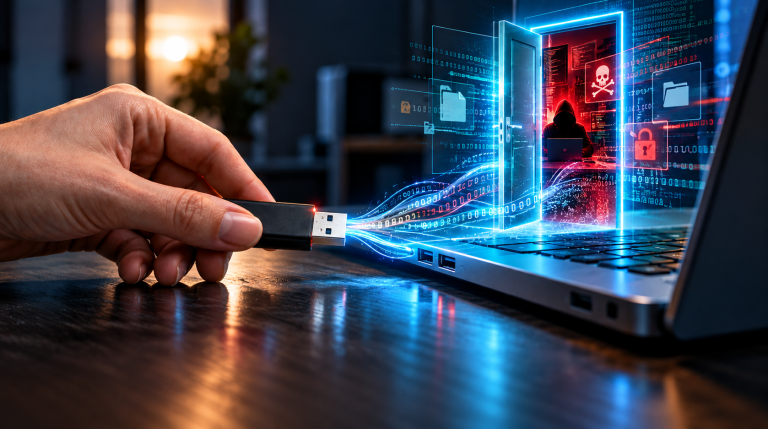

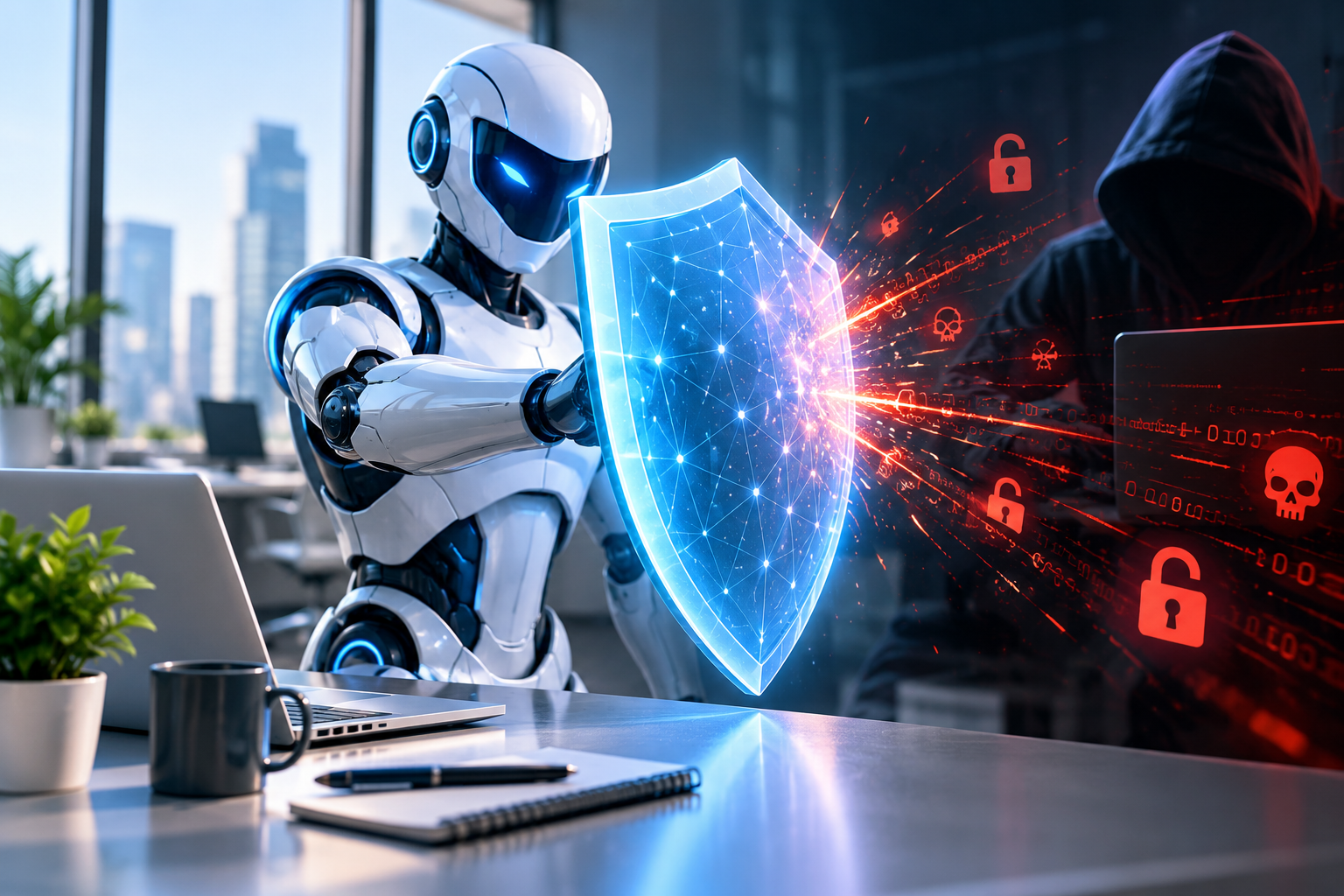
Cyberattacks are no longer a problem reserved for large corporations. Small and medium-sized businesses are increasingly being targeted by hackers because they often have fewer security resources, smaller IT teams, and less time to deal with cyber threats. From an attacker’s point of view, this can make a smaller business an attractive target. The impact of a successful attack can be serious. A business may lose important data, face days or weeks of downtime, deal with financial losses, or damage the trust of its customers. In some cases, a major cyberattack can put the future of the entire business at risk.
At the same time, cyber threats are changing quickly. Attackers are using artificial intelligence to find weaknesses, create more convincing phishing messages, automate attacks, and adapt their methods faster than before. This creates a new challenge for businesses that still rely mainly on traditional security tools and fixed rules. So, if hackers are using AI to improve their attacks, could businesses use AI to improve their defense? The answer is yes — but AI is not a magic shield. Used correctly, AI-powered cybersecurity can help businesses detect unusual activity, identify threats faster, analyze large amounts of security data, and respond to suspicious behavior in real time.
For small and medium-sized businesses, this could make a real difference. AI cannot replace good security practices, trained employees, or a clear cybersecurity strategy. But it can give businesses another powerful tool to detect attacks earlier and reduce the damage when something goes wrong.
What You’ll learn in this Video:
- What kind of questions you can ask ChatGPT to protect your devices and data
- How AI can help you detect phishing, weak passwords, and fake websites
- How to use ChatGPT for cybersecurity training and better digital habits
- Real examples of prompts you can try right now
1. Threat Detection in Real Time
One of AI’s biggest strengths in cybersecurity is its ability to analyze huge amounts of data in real time. This is a task that neither traditional software nor human security teams can handle well. Older security systems work with fixed rules: they block known viruses, flag blacklisted IP addresses, or send alerts when certain conditions are met. This method can work, but it has one big problem. Hackers know exactly how these systems function, and they change their methods faster than the rule databases can be updated. The result is a constant game of catch-up – by the time a new threat is found and added to the system, the attack has often already succeeded.
AI breaks this pattern by focusing on behavior instead of known threats. Instead of asking “does this match a known attack?”, AI systems ask a better question: “does this look normal?” By learning what normal behavior looks like in a company – when employees log in, where they log in from, which systems they use, how much data they usually send – AI builds a picture of what is typical. Anything that looks different from this pattern gets flagged as suspicious.
This approach can catch attacks that no rule-based system would ever notice. Imagine an employee who always logs in from Germany during office hours. If that same account suddenly logs in from another continent at three in the morning, an AI system will notice this within seconds – long before the attacker can explore the network or steal data. The same applies if a server that normally sends only small amounts of data suddenly starts sending huge files to an unknown address. The AI recognizes this as a likely data breach. It can even notice small details, like unusual typing patterns during login or small changes in network traffic. On their own, these signals may seem unimportant. Together, they create a reliable early-warning system.
The amount of data AI can process is hard to imagine. Modern company networks produce thousands of events every second – logins, file transfers, emails, and more. No human team, however skilled, could watch all of this around the clock. AI can do this without getting tired or missing anything. This changes detection speed completely: instead of finding a breach days or weeks later, once the damage is already done, companies can be warned the moment something suspicious happens.
This has a big real-world impact. Speed is one of the most important factors in limiting damage from an attack. Every minute a hacker stays undetected is another minute they can encrypt files, steal data, or install backdoors for later use. When AI detects threats in real time, the response can start immediately – either through automatic actions that isolate affected systems within seconds, or through instant alerts that call the IT team into action while the attack is still happening. Companies using AI-based detection often report that attackers are found faster, and that each incident ends up costing less.
In short, real-time AI detection is changing cybersecurity. It turns defense from something reactive – fixing damage after it happens – into something proactive, where threats are stopped as they appear. And since attackers are now using AI too, this shift is no longer just an advantage. It is becoming necessary for survival.
2. Predicting Future Attacks
If real-time detection is AI’s first big strength, prediction is its second – and maybe the most valuable one. Traditional security tools only react: they respond when a known threat appears, but stay silent as long as nothing matches their database. AI-driven systems work differently. By constantly analyzing millions of past attacks, system logs, vulnerability reports, and global threat data, they learn to recognize how cybercrime typically works. Small patterns in hacker behavior – patterns that human analysts would likely miss in all that data – become the basis for predicting attacks before they even reach a company.
This predictive ability matters because hackers, despite what many people think, rarely attack completely out of nowhere. Most attacks follow a recognizable path and leave early warning signs: scans that test a network’s defenses, attempts to guess weak passwords, or waves of phishing emails aimed at a specific industry. What once took a team of expert analysts to piece together by hand, AI can now detect automatically – often weeks before the real attack starts.
Here’s how this works in practice. When AI notices a sudden rise in phishing attempts against companies in a certain industry, it can warn an organization before those same emails reach its own inboxes. IT teams then have time to inform employees, tighten email filters, and run test simulations – turning possible victims into a prepared, alert first line of defense. In the same way, if a system shows early signs of a brute-force attack – like repeated failed logins from different IP addresses – AI can predict what’s coming, slow down suspicious requests, and temporarily lock at-risk accounts, all before any password is actually cracked.
AI’s predictive power also reaches deep into a company’s own systems. Machine learning models constantly check which servers, outdated plugins, or badly configured applications are the most likely targets. Instead of fixing systems on a fixed schedule or by rough priority scores, IT teams can focus on exactly the weaknesses hackers are most likely to attack next. This turns security maintenance from random guesswork into a focused effort – closing the most dangerous gaps before criminals even find them.
This foresight doesn’t stop at the company’s own walls. Modern businesses rely on complex networks of software vendors, cloud providers, and outside partners – and attackers know this well. If AI notices that one of these partners is being tested by hackers or has shown up in threat reports, it can flag the risk right away. Companies can then react by watching access more closely, limiting connections to that partner, or asking them to fix the problem – protecting themselves from the kind of attack that has hurt even large corporations in recent years.
Perhaps the most impressive part is how AI learns what “normal” looks like inside a company. By studying typical work hours, data use, and access habits, it builds a detailed profile for every user and system. When an account starts behaving differently from its usual pattern – logging in from a strange location, accessing unfamiliar systems, or showing unusual activity – AI can flag it as a possible takeover, sometimes before the attacker has done anything serious yet.
Together, these abilities change cybersecurity from a job of constantly putting out fires into a more organized form of risk management. Security budgets go further when resources are used strategically instead of reactively. Employees become harder to trick when training happens exactly when and where it’s needed. And dangerous gaps get closed before criminals ever find them.
In short, AI gives companies something attackers have always hoped to deny them: the ability to see what’s coming. It replaces guessing with foresight, giving defenders one advantage hackers never expect them to have – time.
3. Automated Incident Response
Even the best prevention and prediction tools cannot guarantee complete safety – and honest cybersecurity strategies admit this. Sooner or later, a smart and determined attacker will find a way in. In these critical moments, when prevention has failed and an intruder is already inside the network, AI shows its real value. Once a breach has happened, one thing matters more than anything else: how fast the response is. The difference between a small, controlled incident and a full crisis that stops business operations for days often comes down to just a few minutes.
Traditional incident response was never built for this speed. In most companies, it follows a slow process: an alert appears, an IT employee has to notice it and check its importance, logs are checked by hand, the incident is passed to the right team, and only then – often hours after the breach began – are the affected systems shut down. In serious cases, this can take days. Meanwhile, the attacker doesn’t wait. Every minute of delay gives them more time to steal customer data, spread ransomware across file servers, or move through the network and install backdoors for future access.
AI-based automation removes this dangerous delay. Instead of waiting for a person to act, AI systems can carry out the first response steps within seconds of detecting something unusual. There are many types of automated actions available today. If malware is found on a device, the system can immediately cut its network connection, stopping the attacker before they can move further into the network. AI-powered firewalls constantly check traffic and block harmful IP addresses in real time, so attackers can’t gain a foothold. If login details seem compromised, the affected accounts can be locked automatically, stopping the attacker from gaining more access and giving the security team time to investigate. And most importantly, if ransomware tries to encrypt files, AI can immediately start restoring backups or switch to backup systems – keeping the business running even during an attack.
Endpoint detection and response tools are a good example of this in action. When such a system notices the unusual file-encryption activity that is typical of ransomware, it doesn’t just send an alert and wait. It immediately stops the suspicious process, isolates the affected files, and informs the IT team – all within seconds of the first sign of attack. In many documented cases, this kind of automatic action has stopped ransomware completely, before any important files were lost. What once meant waking an engineer at 3 a.m. to handle an emergency now happens automatically, day and night, all year round.
Still, it would be a mistake to see automation as a replacement for human skills. Experienced security experts are still essential – for investigating what really caused the incident, understanding how the attacker got in, and making the changes needed to prevent it from happening again. AI is best at the first, most urgent minutes of a response; humans are best at everything that comes after. The real strength of this system lies in how the work is divided: AI handles the instant containment that no human could react to fast enough, while IT teams get the time to respond thoughtfully instead of in a panic.
The business impact of this is clear and real. Faster response times mean less downtime, less financial damage, and quicker recovery. They also protect something no insurance can fully replace: customer trust. In a time when news of a data breach can damage a company’s reputation within hours, being able to stop an incident before it grows is not just a technical achievement – it’s a key part of keeping the business running.
4. Continuous Training and Improvement
Maybe the biggest challenge in cybersecurity is that it never stays the same. The threat landscape is always changing. Every day, new malware is created, phishing methods get better, and new ransomware appears with tricks that older versions didn’t have. Protection that was considered strong last year – or even last month – can already be outdated today. This constant change shows the biggest weakness of traditional, rule-based security systems: they don’t change on their own. Once their rules are written, they start becoming outdated right away, and every update leaves a gap where the system is vulnerable.
AI-based systems work in a completely different way – they keep learning all the time. Every security event that the system sees, whether it’s an unusual login, a suspicious email, or even a failed attack that never worked, becomes useful training data. Nothing is wasted. Instead, AI models constantly study this growing information to spot new patterns, better understand what counts as a threat, and steadily get better at detecting them. The result is powerful: defenses don’t just keep up with new threats – they get smarter with every attack they see.
This learning ability shows up in several areas of cybersecurity at once. In the fight against malware, AI has made the older method of matching known virus patterns look outdated. Instead of asking whether a file matches something already in a virus database, AI looks at what the program actually does. If an app suddenly starts encrypting large numbers of files or connecting to suspicious outside servers, the system flags it as dangerous – even if that exact code has never been seen anywhere before. Whole groups of unknown threats can be caught, not because they were already known, but because they act like threats.
Phishing protection works the same way. Hackers keep improving their tricks, testing which methods get past spam filters and writing more convincing messages – sometimes using AI themselves. AI-based email security fights back by learning from every fake email it sees, slowly getting better at spotting fake domains, unnatural writing, small differences in sender behavior, and other small signs of phishing. Every new trick used by attackers becomes a lesson for the defense system.
This learning effect becomes even stronger because many AI systems share data across companies. Many platforms share anonymous attack data across their whole network of customers, creating a large shared pool of threat information. When a new type of attack is found at one company anywhere in the world, every other company using the same platform benefits right away – their AI systems get updated against the new threat, often within hours. No single security team could ever gain that much experience alone – but together, it gives defenders a real advantage for once.
One of the most underrated benefits is how this constant learning improves the quality of alerts. In the beginning, AI systems – just like human analysts – can make mistakes and flag normal activity as suspicious. But as more data comes in, the system adjusts and becomes more accurate. Over time, there are fewer false alarms and more correct ones. For IT teams, this means something very valuable: less alert fatigue. Instead of dealing with hundreds of low-quality warnings and possibly missing the one that really matters, security teams get a smaller number of alerts that actually matter – and can focus where it counts.
The result of all this learning is a defense system that behaves less like a fixed wall and more like a living shield – one that senses, adapts, and gets stronger with every attack it survives. Instead of staying the same while attackers keep improving, AI-based defenses grow along with the threat landscape, and in the best cases, stay one step ahead.
For companies, the message is clear. Using AI in cybersecurity isn’t just about stopping today’s attacks – it’s an investment in being ready for whatever comes next. Every attempted break-in, every blocked attack, every quarantined file makes the system better prepared for the future. In a race where standing still means falling behind, continuous learning isn’t just nice to have. It’s the key advantage.
Conclusion – Can artificial intelligence protect companies from hackers
So, can artificial intelligence protect companies from hackers? The honest answer is: it helps a lot – but it’s not a magic solution. AI can detect threats in real time, notice unusual patterns faster than any human team, and automate parts of the response. These are real strengths, not just marketing talk.
But no technology can close every gap. Hackers keep adapting, AI systems can be tricked or badly set up, and no algorithm can replace good judgment, a solid security strategy, or well-trained employees who don’t click the wrong link. The companies that stay protected are the ones that use AI as one part of their defense – not as a replacement for the basics: patching software, keeping backups, controlling access, and training employees.
For SMEs especially, this means being realistic about what AI tools can and can’t do before investing in them. Used the right way, as part of a bigger security plan, AI is genuinely useful. Used instead of the basics, it’s just a more expensive way to feel safe.
I also recommend to read the following article:
Anthropic’s Most Capable AI Model that is not intended for public consumption
How AI-Powered Firewalls Outsmart Hackers Before They Strike
Smarter Security: Are AI-Powered Firewalls the Future of Cyber Defense
The Silent Threat Inside Your Company: How Shadow AI Is changing Cybersecurity in 2026
Why Blind Faith in AI Answers Is an Existential Threat to SMEs