
It was 8:47 on a Tuesday morning. Coffee in one hand, badge in the other, an employee crossed the company parking lot, already thinking about the first meeting of the day. Then something small and silver caught her eye: a USB stick, lying on the asphalt near the entrance. She hesitated for a moment. Maybe someone had lost it. Maybe it held important files. Maybe it belonged to a colleague who would be grateful to get it back. She picked it up, walked inside, and plugged it into her computer to find out whose it was.
The whole decision took less than three seconds. By the time she had finished her coffee, the attacker was already inside the network. Cybersecurity incidents rarely begin with a dramatic attack. There is no explosion inside the system, no visible intrusion, no alarm. Most of the time, they start quietly, in an entirely ordinary moment that nobody recognises as a threat.
Most companies protect themselves against the obvious: phishing emails, network intrusions, malware. That is the right thing to do. But it is also precisely where the problem lies. While attention is focused on digital infrastructure, attackers exploit something else entirely: human curiosity, common sense, and the desire to do the right thing. This story shows how far a single moment can reach. No complex tools. No technical expertise required. Just a USB stick on the ground.
The Discovery
The parking lot outside Nordic Media’s headquarters was still wet from the night’s rain when Sarah stepped out of her car that Monday morning. The sky was a flat, heavy grey. The air was cool and smelled of asphalt and damp leaves. Somewhere in the distance, a delivery van reversed with a faint, rhythmic beep, but the building itself felt unusually quiet, almost asleep. Most of her colleagues would not arrive for another half hour.
She locked the car, shifted her bag onto her shoulder, and was already running through her to-do list when something near the curb caught her attention. A small glint of metal against the dark, wet pavement. She slowed down, then stopped. A USB stick lay on the ground.
It did not look broken, and it was not dirty. That was the first strange thing. After a night of rain, it should have been soaked, smeared with mud, or at least scuffed. Instead it looked almost deliberately placed, as if someone had set it down only moments ago. Sarah crouched and picked it up. It was heavier than she expected. Brushed metal, solid, and cold in her palm. Clearly not a cheap conference giveaway, but something expensive, something chosen with care. Then she noticed the engraving on its surface, small and precise: “Board of Directors – Strategy 2026 – Confidential.”
Her heart began to beat faster. For a moment she stood completely still, the quiet of the parking lot suddenly pressing in around her. She turned the stick over in her fingers, then looked up and scanned the lot. No one was there. No car door closing, no footsteps, no one searching the ground in a panic.
Maybe the CEO had dropped it on his way in. Maybe it was one of the investors who had visited the week before: someone in a hurry, distracted, juggling phone calls and pressure. She could picture it so easily. A coat pocket, a rushed step, a small object slipping out unnoticed. The thought made her uneasy. Sensitive company information, lying out in the open, unprotected, available to anyone who happened to walk by. It was not curiosity that held her there, or at least not only curiosity. It was something closer to responsibility. This was not the kind of thing you simply left on the ground and walked away from. And somewhere beneath that feeling, quiet and almost unnoticeable, a smaller voice asked what was on it.
The Decision
She looked around once more. The parking lot was still empty. No colleagues arriving, no security guard at the gate, no one she could simply hand the stick to and walk away from. The only sound was the wind moving through the wet leaves along the fence.
So she slipped the USB stick into her coat pocket. It felt strangely present there, a small, cold weight against her hip. She told herself this was only temporary. She would deal with it properly in a moment, as soon as she reached her desk. Of course she would take it to IT, or to the CEO’s office, or wherever it needed to go.
But as she crossed the lot toward the glass entrance, the thought returned, and this time it came dressed in reason. Perhaps it would help to quickly check what was on it. Not to snoop, just to understand how serious this was. If it really contained the board’s strategy, someone needed to know immediately. And if she could see whose files they were, she could make sure the stick reached exactly the right person. That was not curiosity, she told herself. That was diligence. By the time the elevator doors closed behind her, the question had quietly turned into a plan.
This is the moment worth pausing on. Sarah was not being reckless. She was not ignoring her instincts, and she was not careless about security. She was doing exactly what most people would do: trying to act responsibly with the information available to her. Every step she took could be justified, and every justification sounded perfectly sensible.
That sense of responsibility, that instinctive impulse to help, is precisely what the attacker had designed for. The engraving, the expensive finish, the careful placement near the entrance: none of it was accidental. Every detail had been chosen to make one particular decision feel not just acceptable, but right.
The Moment
Later, in her office, Sarah hung her coat on the back of the chair, set her bag aside, and took the USB stick out of her pocket. Under the cold light of the desk lamp, the engraving looked even more official than before, almost authoritative. Board of Directors – Strategy 2026 – Confidential. She hesitated for a heartbeat. Then she pressed the power button and waited while the system hummed to life, the login screen giving way to the familiar desktop.
Outside her glass door, the first colleagues were trickling in, coffee cups in hand, voices low. Nobody looked her way. She turned the stick over once more, found the port, and pushed it in. A soft click. A brief flicker on the screen, so quick she might have imagined it. Then nothing. Sarah frowned. She opened the file explorer, refreshed the view, and clicked through the drives one by one. No files, no folders, no message, not even an error. She removed the stick, waited a few seconds, and tried again. Still nothing. The drive appeared, and yet it was empty, as if it had never held anything at all. “Strange,” she said quietly.
Maybe it was defective. Maybe it was encrypted and needed a special key. Maybe it only worked on specific company devices. Each explanation was reasonable, and each one made it easier to let go. She felt a small flicker of disappointment, and, underneath it, something very close to relief. Whatever this was, it was no longer her problem.
She slid the USB stick into her desk drawer, closed it, and turned back to her screen. There were emails to answer, a meeting at ten, a report due by the end of the day. The ordinary rhythm of work closed over the morning like water over a stone, and within an hour the stick had faded into the background. But what Sarah did not know was that the decisive moment had already passed.
The flicker she had barely noticed had been no malfunction. In those few seconds, while she frowned at an empty folder, the stick had done exactly what it was built to do. And the quiet, uneventful nothing she had seen was not a sign that nothing had happened. It was the sign that the attack had worked.
What Really Happened: The Technical Side
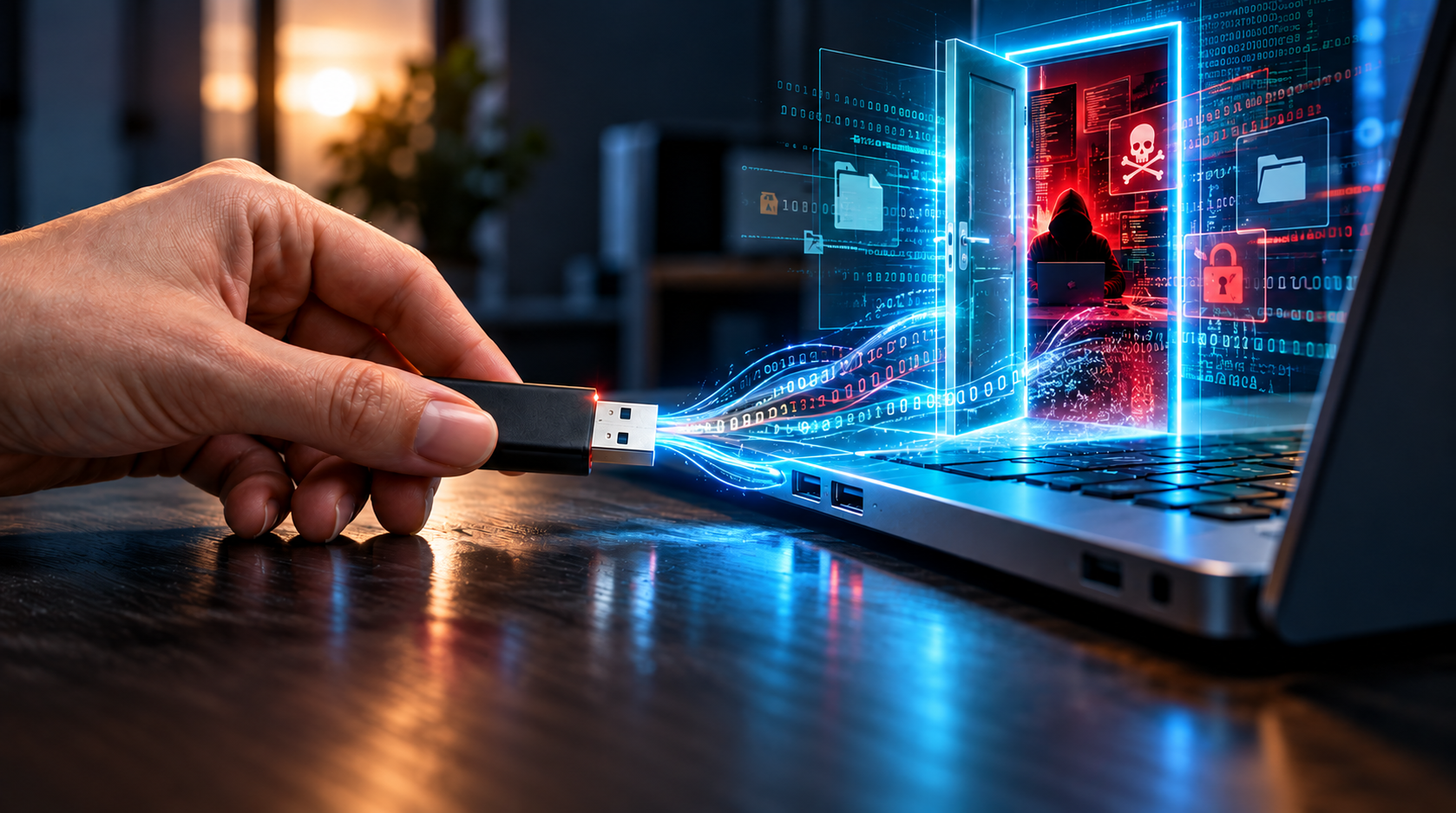
The USB stick had never been designed to store data. It was not a storage device at all. It was a human interface device — a disguised keyboard. In the security world, this technique is known as a BadUSB or Rubber Ducky attack, and it exploits a fundamental trust built into every operating system.
The moment Sarah plugged it in, the device began sending commands to her computer at machine speed — far faster than any human could type. In the background, a terminal window opened and closed in a fraction of a second. A script was downloaded from an external server. A persistent backdoor was installed, one that would survive restarts and remain dormant until the attacker chose to use it. There was no warning. No confirmation prompt. No visible sign of anything unusual.
The reason is simple: operating systems are designed to trust keyboards unconditionally. A keyboard is an input device, not a threat. When the system detected the USB stick, it did not ask who had made it, where it came from, or what it intended to do. It simply recognised a keyboard — and trusted it. That trust, built into the architecture of every modern computer, was the only vulnerability the attacker needed.
The Consequences: Silent Access
While Sarah was writing her first email of the day, someone else was already inside her system — and they were in no hurry. They did not rush. They did not make noise. They simply observed, moved carefully, and waited for the right moment. Within minutes, they had access to her local files: documents, reports, emails she had downloaded and considered private. Through her workstation, they could move laterally into the company network — shared drives, internal servers, other endpoints. One compromised device became a stepping stone into a much larger environment.
And then there is the part that most people find hardest to accept. Her microphone and camera could be activated silently, without any visible indicator. No light. No notification. Sarah could be on a call with a client, reviewing a contract, or discussing a sensitive business decision — and someone else was already in the room with her. Everything her workstation was authorised to access was now available to someone she would never see. Everything looked completely normal. Her computer ran as usual. No popups. No slowdowns. No warning signs. That is what makes this type of attack so difficult to detect — not its technical sophistication, but its silence.
Why This Still Works: The Human Factor
Attacks like this may seem simple, or even outdated. That reaction is understandable — and it is exactly why they remain effective. This attack does not depend on complex technology. It depends on human behaviour. And human behaviour is remarkably consistent. A person who finds a USB stick does not, as a rule, feel fear. They feel curious. They feel responsible. When the label reads “Confidential,” they may even feel a quiet sense of importance — as if they have stumbled onto something that matters. That single word creates a perception of legitimacy. Legitimacy reduces suspicion. And without suspicion, the decision to plug it in feels not only harmless, but correct.
We have learned to treat digital threats with caution. Suspicious links, unexpected attachments, unusual sender addresses — these trigger a certain wariness that has been trained into us over years of security awareness campaigns. But a physical object is different. Something we can hold in our hands feels real, tangible, and fundamentally harmless. Inserting it into a computer does not feel like a risk. It feels like a neutral action. The computer, however, does not share that intuition. It does not evaluate intent. It does not pause to consider context. It simply executes.
The Broader Lesson: Security Is a Human Problem
From a technical perspective, this attack is straightforward. From a psychological perspective, it is remarkably powerful — and that gap is exactly where organisations remain vulnerable. Companies invest heavily in the right places: firewalls, endpoint protection, network monitoring, security audits. All of that is necessary. But a USB stick costing less than five euros can bypass every single one of those defences, not because the technology failed, but because a person made a very reasonable decision in a moment of uncertainty.
Sarah did nothing wrong by the standards of everyday judgement. She found something that looked important, she tried to handle it responsibly, and she moved on with her day. Most people in her position would have done exactly the same. That is not a failure of character. It is a failure of awareness — and awareness is something that can be taught.
The right response is straightforward: never plug in a USB device you did not purchase yourself. Hand it to your IT or security team, without connecting it to any device. Report it as a potential security incident. These steps require no technical knowledge, no special tools, and no more than a few minutes. What they do require is knowing that the risk exists in the first place.
Final Thought to this Story
Security does not start on your computer. It starts outside: in the parking lot, in the elevator, in the small everyday moments where no one expects an attack and nothing appears to be at risk. Sarah did not fail because she was careless. She failed because the situation was built to feel safe.
The USB trap is not a relic of the past. It is still relevant today, and it will remain relevant for as long as three things are true. People are curious. Physical objects feel harmless in a way that a suspicious email never does. And computers, by default, trust whatever presents itself as a keyboard. That last point is worth remembering. A USB stick does not need to look like a threat, and it does not need to show you anything on the screen. It only needs to be plugged in. The rest happens in the time it takes to frown at an empty folder.
This is why awareness is not paranoia. Nobody is asking you to distrust every object you find or to treat every colleague as a suspect. The point is much smaller, and much more practical. Before you plug something in, stop for a second and ask yourself: Should I really do this? If you are unsure, hand it to IT and let them decide. It is the simplest and most cost-effective security measure that exists. No software required. No budget needed. Just one moment of pause before a decision that takes less than three seconds. That pause is the difference.

Behind the Backdoor reveals the true methods of modern hackers – quiet, inconspicuous, and frighteningly skillful. Based on real cases, including well-known German ransomware attacks, this book tells gripping stories from the world of cybercrime: social engineering, fake loans, weak passwords, USB spoofing, compromised browsers, and overwhelmed IT teams.
It reads like a captivating novel – yet delivers clear, immediately applicable security measures for everyday life. Each story illustrates how attacks actually begin and which small decisions can cause major damage.
This is not a technical manual—and not a fictional thriller in the classic sense. It is a guided descent into the grey zone where everyday business life meets modern cybercrime. The book connects human psychology, organizational blind spots, and real attack patterns into a coherent picture that explains why so many incidents succeed despite security tools, policies, and awareness training. For entrepreneurs, freelancers, and anyone who wants to understand how hackers think – and how to effectively protect themselves in just a few steps. Payment processing via Stripe, automatic delivery via Payhip.
What is a USB drop attack and how does it work
Security is not only about systems, it is about decisions. You can invest in tools, firewalls, and policies, but one small action can still create a serious risk. The USB trap shows something important. Most attacks do not start with complex technology. They start with trust, curiosity, and everyday behavior. In many cases, people believe they are doing the right thing, and that is exactly where the risk begins. That is why cybersecurity must go beyond technical protection. It must be present in real situations, in simple moments, and in daily routines. What you pick up matters, what you connect matters, and what you trust matters.Because sometimes, a small and almost invisible moment is enough to open a door no one knew existed.
You can find another story from a book here
The Hidden Risk Behind a Trusted Website – A Reading from My Book Behind the Backdoor
The Trojan Game: How a Helpful Tool Can Open the Door to Hackers — An Excerpt from My Book