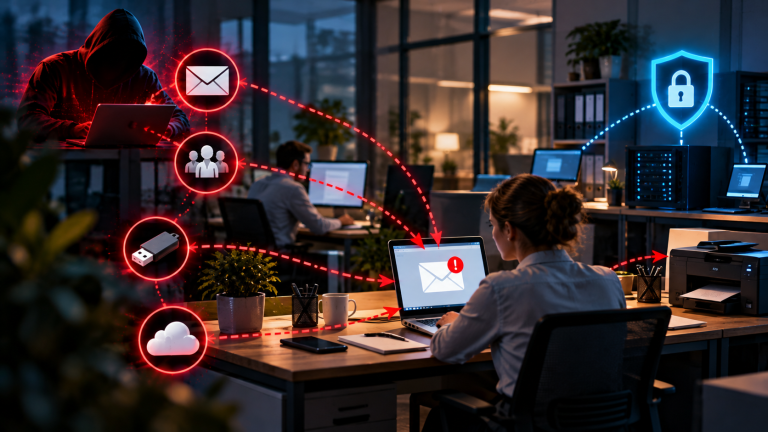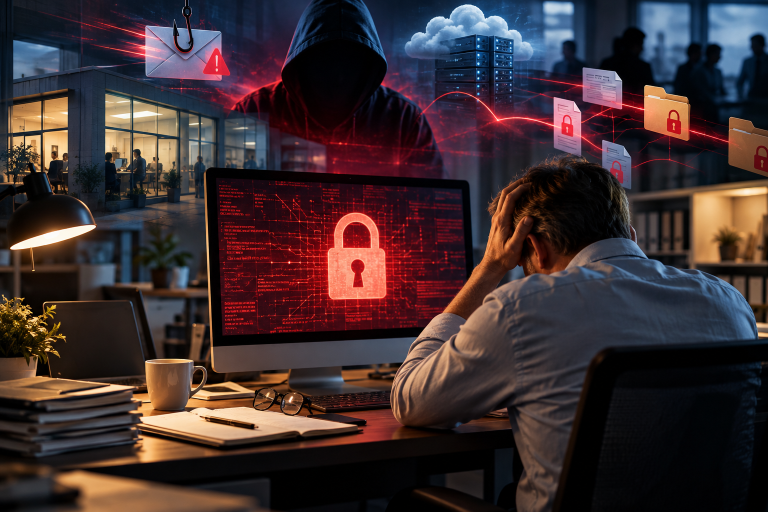

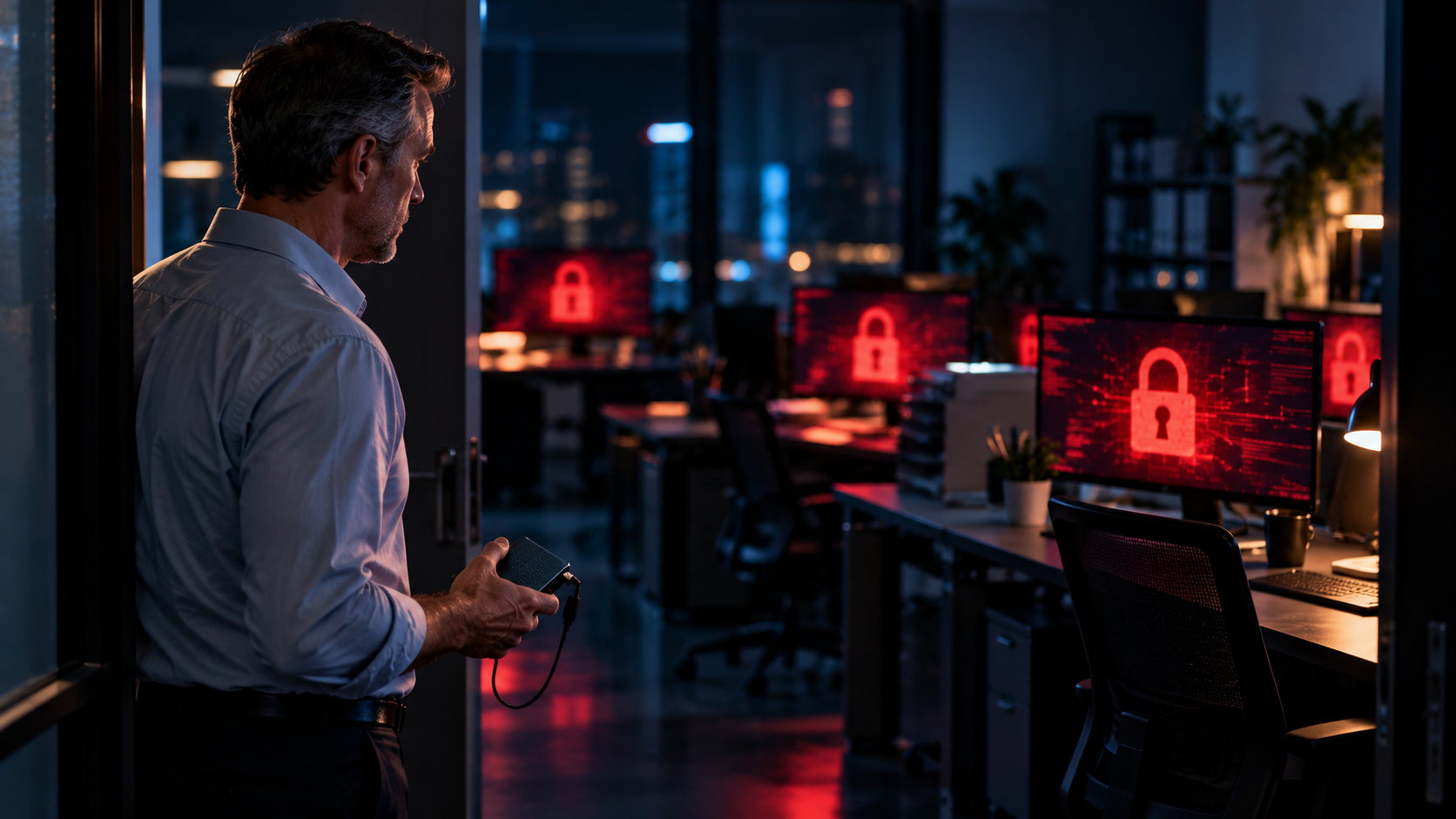
Ransomware remains one of the biggest cybersecurity risks for small and mid-sized businesses. Although the threat has been around for years, many companies still underestimate how easily an attack can disrupt their business. A single infected computer can lead to locked files, lost access to important systems, and days or even weeks of downtime. The financial impact can be severe, especially for smaller companies that cannot afford long interruptions. The problem is not always a highly advanced attack. In many cases, cybercriminals exploit weaknesses that could have been prevented: a stolen password, an outdated system, or a backup that fails when it is needed most.
The good news is that SMEs do not need a large IT department or an unlimited budget to reduce the risk. The right security measures can make a real difference. This article explains how ransomware attacks work in 2026, why they remain so effective, and which practical steps help small businesses protect their data and keep their operations running.
Ransomware Has Become a Professional Industry
Ransomware is no longer the work of single hackers. Today it is a business with its own services, partners, and rules for sharing money. Many attacks use a model called Ransomware-as-a-Service. One group builds the ransomware and offers it as a ready-made tool. Other criminals, called affiliates, use this tool to attack companies. When a victim pays, the developers and the affiliates share the money, and the affiliates usually keep the larger part. This makes it easy to start. An attacker does not need to write his own software or have strong technical skills. He only needs to find a way into a company, and a small business is as easy a target as a large one.
This system is hard to stop. When the police shut down a large group, the people behind it do not disappear. Members and affiliates join other groups or start again under a new name. The case of LockBit showed how fast this can happen. For a business, this means that one shutdown does not remove the danger, because new groups appear as long as ransomware brings in money. SMEs should not hope that a certain group goes away. They need protection that works against any attacker.
What Ransomware Looks Like Today
The classic idea is simple. Criminals lock your files and demand money for the key. Modern attacks are more planned. The attackers usually enter quietly and spend days or even weeks exploring the network. They look for the most valuable data and for your backups, and they copy sensitive files to their own servers. Only then do they start the encryption, often at night, on a weekend, or during a holiday period when few people are watching. The victim receives two threats at the same time: pay to get the data back, and pay to stop the criminals from publishing the stolen files. This is called double extortion. It means that a good backup alone no longer solves the whole problem, because the stolen data can still be sold or published.
Behind these attacks there is often a well-organised business model. Some criminal groups develop the ransomware and rent it to others, who only need to find a way into a company. Automated tools scan the internet around the clock for weak systems, and they do not care whether a company has twenty or twenty thousand employees. For the attacker, a small business with weak protection is simply a good opportunity. Being small does not make you invisible. Often it makes you easier to reach.
Why Ransomware Attacks Still Succeed
Most ransomware attacks do not begin with a clever technical trick. They begin with a stolen password. Criminals get these login details from phishing emails, from other criminals, or simply by trying passwords that employees reuse on other websites. Once they have one, nothing stops them from logging in — the login looks completely normal, and without multi-factor authentication, a single password may be all an attacker needs. From there, they can move quietly through the network, looking for valuable systems to encrypt. This is why stolen accounts remain such a serious risk, even for companies that believe their technical protection is strong.
Attackers rarely need to invent new methods. They wait for known weaknesses in software that connects a company to the internet — firewalls, VPNs, remote access services, mail servers — and pounce as soon as a security gap becomes public. Updates often get delayed in SMEs, sometimes because owners fear business interruptions, sometimes because no one is clearly responsible for them. The result is predictable: a weakness that could have been fixed months ago is still open when an attacker comes looking. Phishing feeds directly into this problem. With AI tools, criminals now write convincing emails in any language, so the old warning signs — spelling mistakes and poor grammar — are disappearing.
Even a well-prepared company can be brought down by the part nobody tests: recovery. Backups only help if they work when needed, and many businesses discover too late that they don’t. If the backup system is still connected to the main network, attackers can delete or encrypt it along with everything else. Other failures are quieter: a critical system that was never included in the backups, or a restore process that turns out to take days rather than hours. Regular recovery tests catch these problems early — while they are still cheap to fix.
What makes ransomware so dangerous, in the end, is not the encryption itself but the pressure it creates. Production stops, invoices go unsent, customers wait. Every hour costs money and trust. Criminals deliberately intensify this pressure with deadlines and threats to publish stolen data, hoping the owner will pay quickly. But payment guarantees nothing: files may stay locked, stolen data may still be leaked, and the company may be attacked again. Law enforcement agencies therefore recommend a different path — contact the authorities and bring in professional incident response support. A clear response plan, tested backups, and agreed responsibilities are what let a business owner make sound decisions when every minute counts.
What SMEs Can Do
The good news is that you don’t need a perfect security system to stop most of these attacks. You need to close the most common doors — and to be ready when something still goes wrong. Most attacks begin at the login, so that’s where defence begins too. Switch on multi-factor authentication for everything that matters: email, remote access, cloud services, and every administrator account.
An authenticator app or a security key is better than a text message, because text messages are easier for criminals to intercept. A password manager makes it realistic for your team to use a different strong password for every service. While you’re at it, clear out what shouldn’t be there at all — accounts of former employees, old test users, forgotten logins that nobody watches anymore. Administrators should work with two accounts: a normal one for emails and web browsing, a separate one for administrative tasks. That way, a single click on a bad link never comes with full power over the whole network.
Whoever gets in anyway usually comes through software that was left unpatched. So write down which of your systems can be reached from the internet, give one person clear responsibility for them, and agree on a fixed routine. Critical security updates belong on those systems within days, not months. Anything the manufacturer no longer updates should be replaced or cut off from the network, because it will never be safe again — it’s just a question of when someone finds it.
When an attacker does get through, everything depends on one question: can you get your data back? Backups answer that question — but only if they are treated as part of security, not as a side task. Keep at least one copy that attackers cannot reach, offline or in a form that cannot be changed or deleted for a defined period. Test a full restore at least once a year and measure how long it takes, because that number decides how long your business stands still. Write down the order in which your systems must come back. It surprises most companies — and it’s far better to learn it during a quiet test than during an attack.
Recovery, however, is the worst case. Ideally, one mistake never gets that far, and that is a question of distance. If one infected laptop can reach every server and every file, one wrong click can stop the whole company. Divide your network into smaller areas, and give people access only to the data they actually need. Traditional antivirus is no match for modern ransomware, so use protection that detects suspicious behaviour — and make sure someone actually looks at the alerts, including nights and weekends. For many small companies, that level of monitoring is only realistic with an external service, which is a reasonable choice. On the email side, proper security settings for your own domain (SPF, DKIM, and DMARC) keep a large share of fake messages from ever reaching your team.
Almost every attack still needs one thing from the outside: a person who clicks. Your Team are therefore part of the defence, not the weak link. Short, regular training with up-to-date examples works far better than one long course per year. But the real key is culture. An employee who says “I clicked something and I’m not sure it was safe” gives you the chance to react early — and an early report is often the difference between one infected computer and a company-wide standstill. Make sure nobody fears blame, and answer every report quickly and with thanks.
Prepare Before It Happens
A simple plan on one page is enough for a small company, as long as everyone can find it. It should say who must be called first, who makes the decisions, how infected devices are separated from the network, and who to contact at your IT partner, your insurer, and the police. Keep a printed copy, because your systems and your email may not be available during an attack. If personal data is affected, data protection law usually requires you to report the incident to the authority within 72 hours, so it helps to know the process in advance. Decide before an attack how your company will handle a ransom demand, and talk about it with your management while the situation is calm. Once a year, take thirty minutes to play through a short example with your team, because a plan that has never been practised often fails in the first hour.
Conclusion – Ransomware prevention for SMEs 2026
Ransomware remains a serious threat in 2026, but successful attacks are not inevitable. Cybercriminals often take advantage of weaknesses that businesses can address: stolen passwords, outdated software, unprotected backups, and a lack of preparation. Small and mid-sized businesses do not need a large IT department or expensive security tools to reduce these risks. Strong account protection, regular updates, secure backups, and a tested recovery plan can make a real difference.
Being prepared also means knowing what to do when an attack happens. Employees should know how to report suspicious emails and unusual activity. Everyone involved should understand their role, and business owners should have a clear plan for responding to an incident. These preparations help limit damage and avoid rushed decisions when time is critical.
Start with the security measures that matter most to your business. Check whether multi-factor authentication is enabled, whether your systems are up to date, and whether your backups can restore your data. Each improvement closes another gap that attackers could exploit.
I also recommend to read the following articles
Backup Exists – But Data Cannot Be Restored When It Matters Most
Ransomware Attacks Explained: How They Spread and How to Protect Your Business
Ransomware in Small Businesses: 5 Steps You Can Take Right Away
The 10 Biggest Cybersecurity Mistakes Small Businesses Are Making in 2026
The Hacker Groups Behind Today’s Biggest Cyber Threats – And How They Attack Businesses
The Ransomware Wake-Up Call: Lessons from Germany’s Biggest Attacks