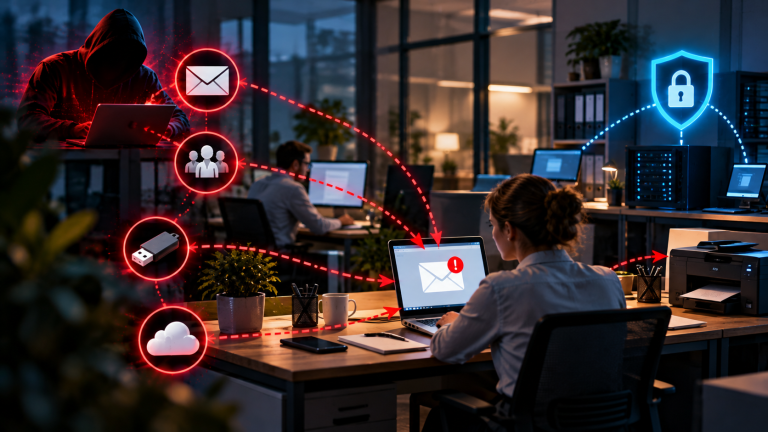

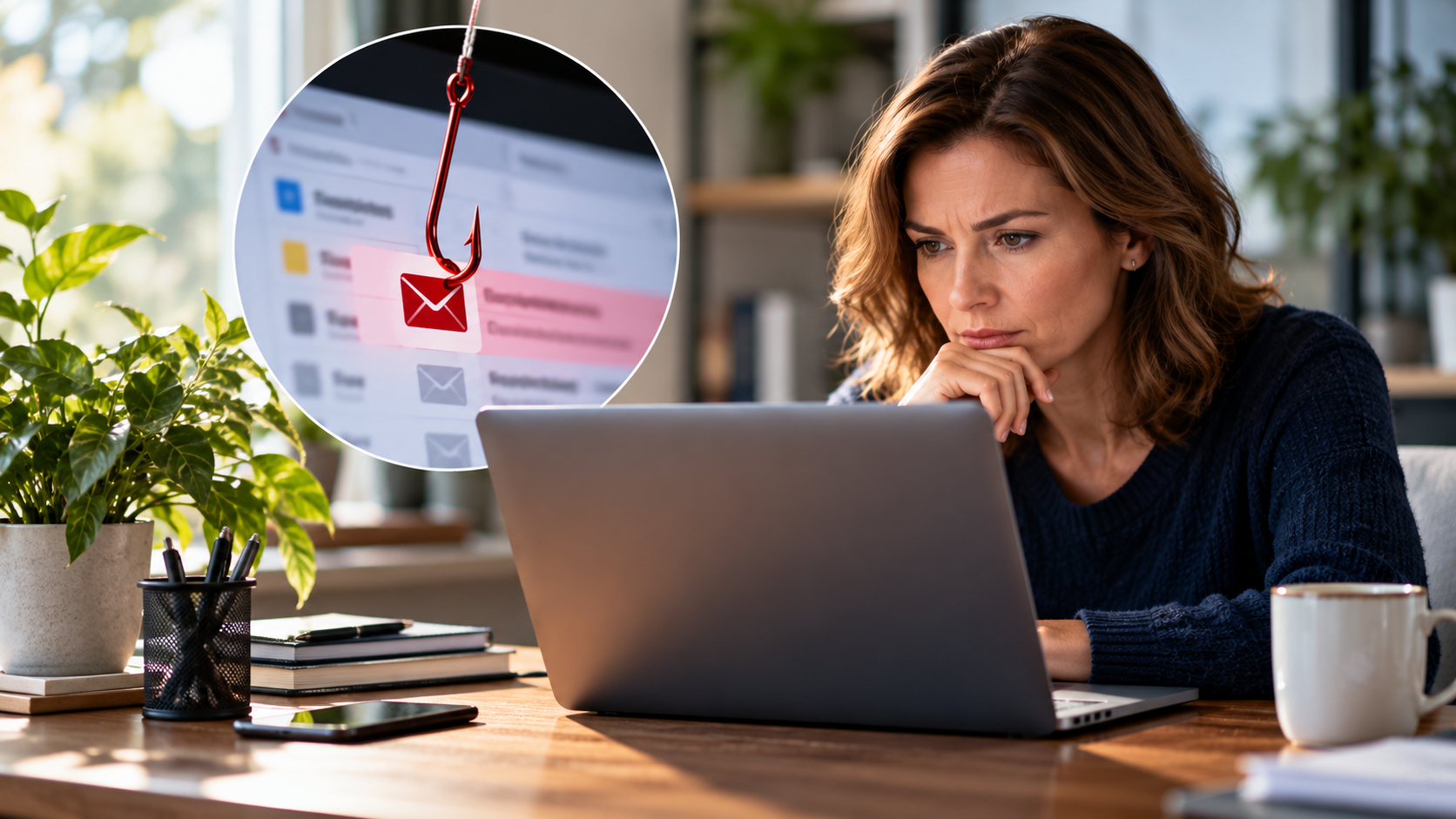
Phishing emails are becoming harder to recognise. In the past, spelling mistakes, strange email addresses, and suspicious links often gave them away. AI has made this much harder. Criminals can now write convincing emails in different languages, copy familiar voices, and create fake videos that look real. Even an email that sounds professional and comes from a familiar name can be part of a scam.
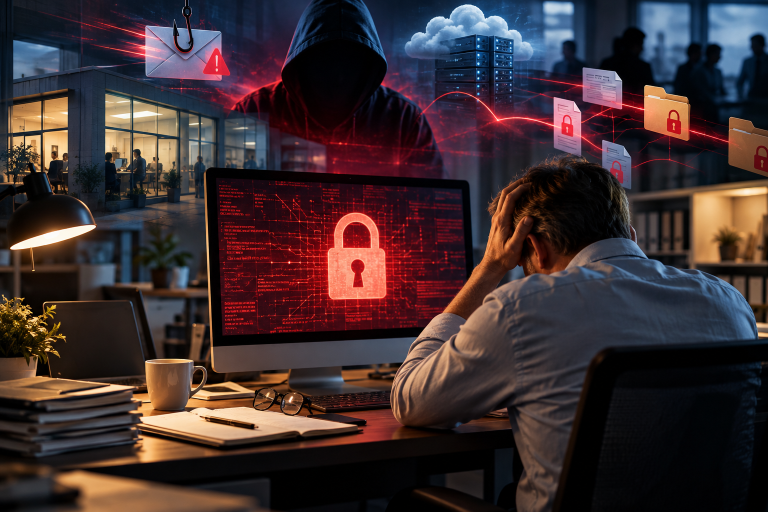
For small businesses, this creates a real challenge. There may be no dedicated security team to check every email or investigate every suspicious request. A single mistake can lead to stolen data, fraudulent payments, or a costly business disruption.
The good news is that you do not need an expensive security system to reduce these risks. You need to know what to look for and how to check unusual requests before taking action. This guide explains how to detect AI-generated phishing emails, recognise common warning signs, and protect your business with practical security measures that fit a limited budget.
How AI Has Transformed Phishing Attacks
In the past, many phishing attacks came from people who did not speak the language of their victims well. This was a weakness, because the mistakes gave the attack away. Modern AI language tools have removed this weakness. A criminal can now write a message in perfect German or English within seconds, in any tone he wants. The email can sound like your bank, your supplier, or your managing director, and it is polite, well structured, and free of errors. One of the most useful warning signs has quietly disappeared.
Personalisation has also become much easier. Before, an attacker had to spend hours researching each victim on company websites, social media, and business networks, so he could only target a few people. Today, AI tools can collect this information in minutes and turn it into a unique message for every person. The email may mention your manager by name, refer to a real project, or copy the writing style of a colleague. This kind of targeted attack is called spear phishing. It used to be rare and expensive, but now it is fast and cheap, and many more criminals can use it.
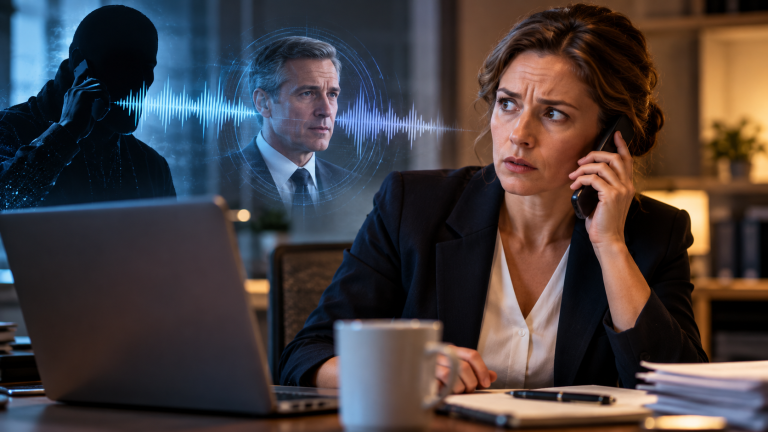
The problem is not limited to email. With only a few seconds of audio, for example from a video on a website or a social media clip, criminals can clone a voice so well that colleagues may not notice the difference. They use it in phone calls, often called vishing, where a fake manager asks for an urgent payment. In more advanced cases, attackers use fake video during a live call, so that the person on the screen looks and sounds like someone you know. This means that a familiar voice or face is no longer proof of identity. Attackers can also test many versions of a message and learn which one works best, so their attacks improve over time. Classic spam filters have more difficulty with these messages, because they often look for known phrases or patterns, and AI can create a new text every time.
Why These Attacks Are So Dangerous for Small Business
Many owners believe that their company is too small to be interesting for criminals. This belief is one of the biggest risks. Attackers rarely choose their targets by size. They look for the easiest way to get money or access, and smaller companies often offer exactly that. A small accounting firm may handle payments for larger clients, and a local supplier may become the entry point to attack its own customers. Being small does not make you invisible. Because AI makes attacks cheaper, criminals can now afford to target thousands of small companies at the same time.
The way small teams work also helps the attackers. In a small company, people know each other personally and trust each other. They help each other quickly, without forms and without long approval processes. This is a great strength for teamwork, but it is also a weakness. When a message seems to come from a colleague or a boss of many years, the natural reaction is to help, not to question. In many small businesses, one person may answer the phone, process invoices, and approve payments, which means there is no second person who can stop a mistake. Under time pressure, this employee has to decide alone.
This is why the psychology of the attack matters more than the technology. Criminals use urgency, fear, curiosity, and authority, and these tricks are as old as fraud itself. A message that says the managing director needs an invoice paid within thirty minutes creates strong pressure, because nobody wants to be the person who delayed an important payment. AI does not change this trick. It only removes the last doubts by adding perfect language and a familiar voice.
How to Detect AI-Powered Attacks
The most important rule is simple: do not judge a message by how it looks, but by what it asks you to do. A perfectly written email is not a safe email. Ask yourself whether the request makes sense. Would your manager really ask you to buy gift cards? Would your bank really send you a link and ask for your password? Would a supplier change their bank details in a short message without any explanation? Most attacks fail at this logical level, even when the language is perfect. If a request is unusual, it deserves a second look, no matter how professional the message sounds.
Pay special attention to pressure and to unusual channels. If a colleague suddenly writes to you on a private messaging app instead of the normal company email, ask yourself why. If someone demands immediate action, asks you to keep the matter secret, or wants you to skip the normal process, you should stop and check. Real emergencies inside a company rarely require you to break all the rules within a few minutes, and a genuine request from a real manager will survive a short delay for verification. Attackers know that people make mistakes when they feel stressed, which is why they create time pressure on purpose.
Voice and video are no longer proof of identity. If a call or video message asks for money, sensitive data, or access to a system, always confirm the request through a second, independent channel. Call the person back on a phone number that you already know, or write to their official company account. Do not use the contact details that the caller or the message gives you, because they can be part of the scam. This habit feels strange at first, especially when the voice sounds exactly like your boss, but it becomes normal quickly once it is a company rule. A real manager will never be angry because you checked a financial request.
Technical details still matter, even though they are no longer enough on their own. Look closely at the sender address, because fake addresses are often almost correct, with one small difference that is easy to miss. Move your mouse over a link before you click it, so you can see the real destination. Be careful with unexpected attachments, especially file types such as HTML files or documents that ask you to enable macros. QR codes in emails can also lead to fake login pages, so treat them with the same caution as links. These checks take only a few seconds, and they can still expose many attacks.
Simple Rules That Make a Big Difference
The strongest protection for a small business is often a clear process. The most important one is the second-channel rule. Every request that involves money, bank details, passwords, or access to systems must be confirmed through a different channel before anyone acts. This rule should be mandatory for everyone, including the owner, and employees must know that they will never be blamed for double-checking. It works against AI attacks because it does not depend on the quality of the fake message. Even a perfect email or a perfect voice cannot pass a callback to a known number.
A second useful rule is the four-eyes principle for payments. Decide that no transfer above a certain amount, and no change of bank details, can be done by one person alone. Write down who is allowed to approve what, and make sure that substitutes are also clear for holidays and sick days. Some companies also agree on a secret code word with managers and key partners, which can be used to confirm identity during an urgent phone call. These rules are easy to introduce, and they remove the attacker’s greatest weapon, which is the chance to make one person act alone under pressure.
Simple Technical Protection That Works
Technical measures support these rules, and many of them are already included in the tools you use today. Multi-factor authentication is the most important one. Even if an employee enters a password on a fake page, the criminal still cannot log in without the second factor. Wherever possible, use an authenticator app or a hardware security key instead of text messages, because they are harder to steal. A password manager is another helpful tool, because it fills in passwords only on the correct website, which protects against fake login pages.
You should also check the security settings of your email provider, for example Microsoft 365 or Google Workspace, because strong protection features are often included but not switched on by default. For your own domain, make sure that the email standards SPF, DKIM, and DMARC are set up correctly. They make it much harder for criminals to send emails that pretend to come from your company. Finally, keep your devices and software updated, and keep regular backups that are stored separately from your main network, so that you can recover quickly if something goes wrong. Setting all of this up correctly can take time, especially when nobody in your team has a security background. An experienced partner can check your settings, close the gaps, and explain everything in plain language, so that you can focus on running your business.
Training That Fits a Small Team
Short and regular training works better than one long course per year. A fifteen-minute talk every month or two, where you show a real example of a modern phishing email, a fake invoice, or a voice scam, keeps the topic alive without disturbing daily work. Make sure that your examples are up to date. Employees need to see well-written attacks, not only the old ones with obvious mistakes, and they should hear what a cloned voice can sound like. Simulated phishing tests can also help, but they should be used to learn and not to punish.
The most important part of training is the culture behind it. If employees are afraid of being blamed, they will hide their mistakes, and this is exactly what you do not want. A person who says “I clicked something and I am not sure it was safe” gives you a chance to act early. Respond to every report quickly and positively, even if the message turns out to be harmless. This builds trust, and the next warning will come faster. Also make sure everyone knows who to contact when something looks wrong, and that this is one clear person or phone number, not a long chain of emails.
When It Makes Sense to Get Support
You can do a lot yourself, but you do not have to do everything alone. Many owners have no time to check email settings, review payment processes, or prepare training for their team, and this is normal. A short security check by a specialist can show you which risks matter most for your business and which steps you should take first. At Cybersecureguard, I help small and mid-sized businesses with exactly this, in clear language and without unnecessary technical jargon.
Conclusion – How to detect AI-powered phishing attacks
AI has made phishing attacks harder to recognise. Emails can sound professional, voices can be copied, and fake videos can look real. Spelling mistakes and strange wording are no longer reliable warning signs. Still, small businesses can protect themselves without spending a fortune on security tools. The most important step is to check what a message asks you to do rather than trusting how it looks or sounds. Be careful with urgent payment requests, unexpected password changes, and emails asking for sensitive information. If something seems unusual, verify the request using a trusted phone number or another separate communication channel.
Simple security measures also make a difference. Use multi-factor authentication, keep software up to date, and make sure employees know how to report suspicious messages. Clear rules for payments and changes to bank details can prevent costly mistakes.
You do not need to recognise every AI-generated phishing email to protect your business. You need a reliable process for checking suspicious requests before taking action. Technology will continue to change, but careful checks and clear procedures can help you stay one step ahead of many common attacks.
I also recommend to read the following article
Email Security Guide 2026: Find Your Risks Before Attackers Do
First Steps After Falling for a Phishing Email: A Quick Guide for Small Businesses
How Safe Is Your Business Email? 7 Things You Should Check Today
How to recognize phishing and Trojans – 7 warning signs you need to know