
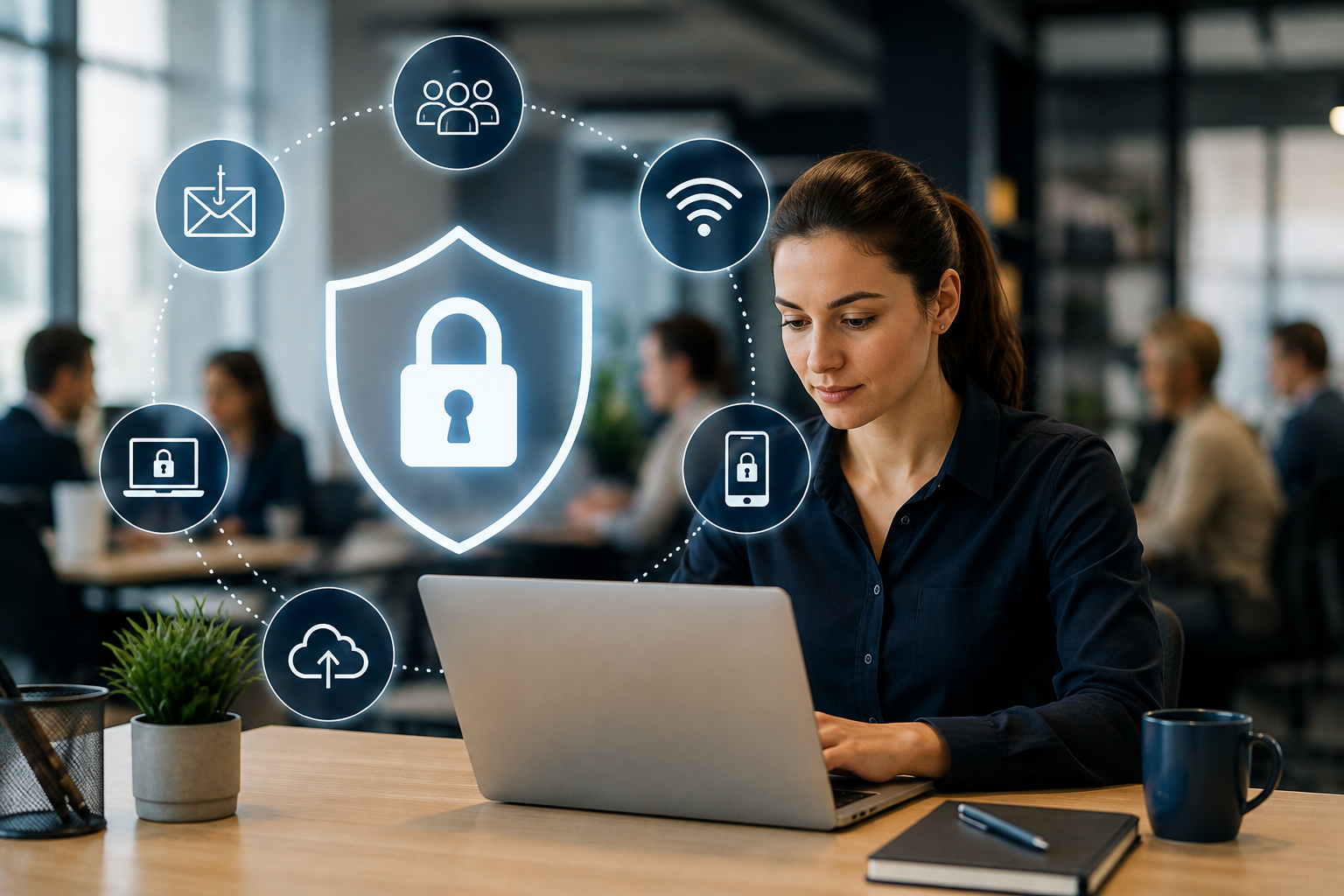
It’s your first week at a new job. Your inbox is full, your calendar is packed with introductions, and everything feels a little overwhelming — in a good way. Somewhere between meeting your new team and setting up your laptop, you’ll also make a decision that most new employees never think twice about: whether to click that link, trust that email, or reuse that old password.
That decision matters more than you might expect. Cybersecurity is not only the responsibility of the IT department — every employee plays a role in protecting the company’s systems and data, starting from day one. In fact, most cyberattacks don’t rely on breaking through firewalls. They rely on someone, somewhere, making one small mistake: clicking a phishing link, choosing a weak password, or sharing sensitive information with the wrong person.
That’s exactly why cybersecurity awareness is one of the most valuable skills you can bring into a new role — no technical background required. The good news? Staying safe doesn’t have to be complicated. In this article, you’ll learn the essential cybersecurity habits every new employee should know before getting started — simple, practical steps that protect you, your colleagues, and your customers from day one.
Understanding the Basics of Workplace Security
When new employees first arrive, they often assume that cybersecurity is entirely the responsibility of the IT department. It’s an understandable assumption — IT teams are the ones installing firewalls, managing software updates, and monitoring for threats behind the scenes, so it’s easy to picture them as the sole line of defense. But this is one of the most dangerous misconceptions in any organization, and it’s one that cybercriminals count on.
While IT teams certainly build and maintain the technical systems that keep a company protected, they cannot control every action that employees take at their desks — or on their phones, in a coffee shop, or while working from home. They can’t decide which email you open, which link you click, or which password you choose. That responsibility sits with you. New staff members need to understand that security is a shared responsibility that involves everyone who uses a computer, a smartphone, or an email account, regardless of their job title or department. Marketing, sales, finance, customer service — every role touches company systems and data in some way, which means every role carries some level of security responsibility.
This means that every click, every download, and every password choice matters, even the ones that feel routine or insignificant. Opening an unexpected attachment, saving a document to a personal device, or reusing a password across multiple accounts might seem like small, harmless actions in the moment — but each one is a potential entry point for an attacker. Employees should learn that company data is valuable not only to the business but also to criminals who may try to steal, encrypt, or sell it. Customer records, financial information, internal communications, and login credentials can all be turned into profit on the black market, which is exactly why attackers actively target businesses of every size, not just large corporations.
Once new team members accept that they play an active role in protecting this data, something important shifts: security stops feeling like someone else’s job and starts feeling like a normal part of doing good work. They are far more likely to pause before clicking a suspicious link, think twice before sharing sensitive information, and take security seriously in their daily work — not because they were told to, but because they understand why it matters.
Password Management and Authentication
One of the first practical skills every new employee should develop is the ability to create and manage strong passwords. It sounds like a small thing — until you consider how often it’s the reason a company ends up in the headlines for a data breach. Many people still use simple passwords or reuse the same password across multiple accounts because it feels convenient. Remembering one password for everything is easier than remembering a dozen, and after a long day, “Company123!” can feel like a perfectly reasonable choice.
In a workplace setting, this habit can have serious consequences. Passwords are rarely just protecting a single account — they’re often the first link in a much longer chain. If a criminal discovers one weak password, they may gain access to company emails, customer databases, or internal systems, and from there, quietly move through the network, gathering more information or planting malware before anyone even notices something is wrong. A single reused password, stolen from an unrelated, unsecured website, can be enough to unlock an employee’s entire professional life.
New employees should be taught to use long and complex passwords that combine letters, numbers, and symbols in unpredictable ways — ideally passphrases of at least twelve to sixteen characters that don’t rely on obvious words, names, or dates that could be guessed or found on social media. A password like “Summer2024” might feel secure, but it’s exactly the kind of pattern attackers test first. Even better, they should learn to use a password manager, which can generate and store secure, unique passwords for every account without requiring the employee to remember every single one. This removes the temptation to reuse passwords out of convenience and takes the mental burden of password management off the employee entirely — all they need to remember is one strong master password.
Additionally, every new staff member should understand the importance of multi-factor authentication (MFA). This extra layer of security requires a second form of verification — such as a one-time code sent to a mobile phone, a prompt in an authentication app, or a fingerprint scan — before granting access to an account. Even if a password is stolen or guessed, MFA acts as a locked second door that a criminal typically cannot get through. It is a simple step, often taking just a few extra seconds during login, but it blocks the vast majority of unauthorized login attempts and is one of the single most effective defenses a new employee can enable from day one.
Password managers promise simplicity, and to a large extent, they deliver on it. But as we’ve seen throughout this article, that convenience comes bundled with a set of hidden risks that many users never stop to consider. Read in this Articel: The Risks You Should Know
Recognizing Common Threats
New employees are often targeted by cybercriminals precisely because they are unfamiliar with company procedures and communication styles. In the first few weeks, everything is new — you don’t yet know who typically emails you, how your manager usually phrases a request, or what a normal internal process looks like. Attackers know this too, and they exploit it deliberately. They may send fake emails that appear to come from a manager or the human resources department, asking the new employee to click a link, confirm login details, or provide personal information such as a bank account number for “payroll setup.” Because everything about the job still feels unfamiliar, these requests can seem entirely plausible, even when something about them is off.
This is why it is essential that every newcomer learns to recognize the most common threats they will face before they encounter them for real. Phishing emails remain the most widespread attack method, and they are becoming increasingly difficult to spot. Early phishing attempts were often full of spelling mistakes and obviously fake logos, but today’s attacks can look nearly identical to genuine company communications, right down to the branding, tone, and email signature. Employees should be trained to look carefully at sender addresses rather than just the display name, since a message that appears to be from “IT Support” may actually come from an address that only loosely resembles the real one. They should be suspicious of unexpected attachments, especially ones they weren’t expecting or that arrive with vague file names, and they should avoid clicking links in emails that create a sense of urgency or fear — messages warning that an account will be suspended, a payment is overdue, or immediate action is required are classic pressure tactics designed to make people act before they think.
They should also learn about other threats such as malware, which can hide in downloaded files, fake software updates, or infected USB drives, quietly installing itself and giving attackers access to a device without the employee ever realizing it happened. And they should become familiar with social engineering, where attackers manipulate people into revealing confidential information not through technical hacking, but through phone calls, text messages, or even in-person conversations — posing as a vendor, a colleague from another office, or an IT technician who “just needs to verify a password.” These attacks work by exploiting trust and helpfulness, not technical vulnerabilities, which is exactly what makes them so effective.
The more familiar new employees become with these tactics, the less likely they are to fall victim to them. Recognizing a threat is often the difference between a near-miss and a serious incident — and that recognition only comes from knowing what to look for in the first place.
Safe Use of Company Devices and Networks
Most new employees receive access to company laptops, phones, or tablets during their first days on the job, often as part of a welcome package that also includes a badge, a login, and a stack of onboarding paperwork. It’s easy to start treating that shiny new laptop like any other personal gadget — installing a few favorite apps, browsing freely during a lunch break, or letting a family member borrow it “just for a minute.” But new employees need to understand that these devices are not personal property. They contain business data and connect to internal networks, which means they must be treated with a level of care that goes well beyond how someone might use their own personal computer.
New staff members should know that installing unauthorized software or visiting unsafe websites on company devices can introduce malware that spreads across the entire organization. A single infected download — even something as seemingly harmless as a free PDF converter or a browser extension — can give an attacker a foothold on the device, which can then be used to reach shared drives, internal systems, or other employees’ accounts. What starts as one careless click on one laptop can end up affecting the entire company.
They should also understand the risks of using public Wi-Fi networks for work purposes. A coffee shop or airport network may seem harmless, especially when it’s password-protected and full of other people quietly working on their own laptops. But attackers can easily intercept data transmitted over unsecured connections, sometimes by setting up fake networks with names like “Free_Airport_WiFi” designed to trick people into connecting directly to them. Once connected, everything from login credentials to internal documents can potentially be captured without the employee ever noticing.
If remote work is part of the job, employees should learn to use virtual private networks (VPNs), which encrypt internet traffic and protect sensitive information from prying eyes, essentially creating a secure, private tunnel between the employee’s device and the company’s systems, even when working from an untrusted network. Using a VPN should become as automatic as logging in each morning.
Beyond networks and software, simple physical habits matter just as much. Locking screens when stepping away from the desk — even for a quick coffee refill or a two-minute conversation with a colleague — and never leaving devices unattended in public places, such as on a café table or in a parked car, also go a long way in preventing physical and digital theft. A stolen laptop is a security risk even if it never connects to the internet again, simply because of what it might contain. These small, everyday habits take only seconds, but together they close off many of the easiest opportunities an attacker could otherwise exploit.
The Importance of Reporting Incidents
Perhaps the most important lesson for any new employee is that mistakes happen — and that reporting them quickly is far better than hiding them. No amount of training completely eliminates human error. Even the most careful, security-conscious employee can have a moment of distraction and click the wrong link, or open an attachment before fully registering that something about it felt off. What separates a minor incident from a major breach is often not whether the mistake happened, but how quickly someone spoke up about it.
Many people fear punishment or embarrassment if they accidentally click a suspicious link or download a questionable file. It’s a natural reaction — nobody wants to be “the person who caused the breach,” especially in their first few weeks at a new job, when making a good impression still feels important. This fear causes delays: an employee might quietly hope the issue resolves itself, or wait to see if anything actually goes wrong before mentioning it to anyone. But that hesitation, even just a few hours of it, gives attackers valuable time to move through systems, access additional accounts, or install further malware, causing damage that grows more serious with every minute it goes unreported.
New employees must be told from their very first day that the IT department would rather hear about a potential problem immediately than discover it days later when the damage is already done. A false alarm costs a few minutes of someone’s time to check; a hidden incident can cost a company its data, its money, or its customers’ trust. That difference is worth repeating clearly and often during onboarding.
They should know exactly who to contact and how to report suspicious emails, unusual system behavior, or lost devices, ideally with a clear, simple process — a dedicated email address, a phone extension, or a button built directly into the email system — so that reporting never feels complicated or intimidating. When organizations build a culture where reporting is encouraged and supported, rather than met with blame, they create an environment where small incidents can be stopped before they become major security breaches. In that kind of culture, speaking up quickly isn’t seen as admitting a failure — it’s recognized as exactly the right thing to do.
Social Media and Information Sharing
Many employees use social media today regularly, sharing a quick photo of their new desk, a celebratory post about landing the job, or an update about an exciting project — often without thinking about how these seemingly harmless posts might affect workplace security. Social media feels personal, almost private, even though it’s often visible to hundreds or thousands of people, including some who have no good intentions at all.
New staff members should be aware that cybercriminals actively monitor social platforms to gather information about companies and their employees, a practice sometimes called open-source intelligence gathering, or OSINT. Attackers don’t need to hack into a system to learn valuable details — they can often just scroll through public profiles. A simple post about a new job title, a project name, or an upcoming business trip can provide attackers with valuable details they can use to craft convincing phishing messages or impersonate colleagues. For example, knowing that an employee is starting a new role in finance, or that a manager will be traveling and hard to reach next week, gives an attacker exactly the kind of believable detail needed to make a fake email or phone call sound legitimate.
Employees should think carefully before sharing work-related information online and should understand the boundaries between personal social media use and professional confidentiality. This doesn’t mean employees can’t celebrate a new job or share career milestones — it means pausing to consider what a stranger, including one with bad intentions, could do with that piece of information. A congratulatory LinkedIn post is very different from a post that names specific clients, reveals internal project details, or shares screenshots of internal tools.
Even photos taken in the office can accidentally reveal sensitive information such as whiteboard contents, computer screens, or visitor badges, often without the person even realizing it. A cheerful “first day at the new office” photo might unintentionally capture a login screen in the background, a strategy document on a whiteboard, or an access badge with a photo and employee ID clearly visible — small details that can be pieced together by someone looking to impersonate an employee or gain physical access to a building.
Teaching new employees to be mindful of what they share helps protect both their personal privacy and the company’s security. A quick habit worth building early on: before posting anything work-related, take a second look — not just at the caption, but at everything visible in the background of the photo, and everything the post might reveal to someone who’s paying closer attention than expected.
Conclusion: What should new employees know about cybersecurity
Cybersecurity is not just an IT issue—it is everyone’s responsibility. Every employee plays an important role in protecting company data, systems, and customers from cyber threats. By using strong passwords, recognizing phishing emails, protecting company devices, handling sensitive information carefully, and reporting suspicious activity quickly, new employees can help prevent many common cyberattacks.
Building good cybersecurity habits from the very first day creates a safer workplace for everyone. Technology can provide strong protection, but informed and aware employees remain a company’s best defense against cybercriminals. Remember, cybersecurity is not about being perfect. It is about making smart decisions every day and staying alert to potential risks. Small actions can make a big difference in keeping your business secure.
I also recommend to read the following articels
Do we really need a Cybersecurity Strategy for our Business?
How to Identify Phishing Emails in 2026 – A Practical Step-by-Step Guide
How to Use ChatGPT Safely at Work Without Risking Customer Data