
Cybersecurity is no longer a technical issue that only concerns IT teams. It is a business issue. For a small company, a cyberattack can stop operations, expose sensitive data, damage customer trust, and create costs that are difficult to recover from. Whether you have five employees or five thousand, your company can become a target. Phishing, ransomware, stolen passwords, supply chain attacks, and other threats are no longer rare events. They are part of the everyday threat landscape. Attackers do not always need sophisticated tools to get into a company. Sometimes, one stolen password or one successful phishing email is enough.
For decades, antivirus software was the standard answer. It was simple: install the software, keep it updated, and let it detect and remove malicious files. That approach made sense when most malware was known, predictable, and easier to identify through signatures. But cybersecurity has changed dramatically.
Modern attacks are more difficult to detect. Malware can change its appearance, use legitimate system tools, steal valid credentials, or avoid traditional detection methods altogether. At the same time, Windows, macOS, and other operating systems now include security features that can detect and block many common threats without requiring a separate antivirus product.
And then there is the marketing problem. Some security vendors still use dramatic claims, fear-based advertising, and promises that sound almost too good to be true. Statements such as “100% protection” should make every business owner stop and ask a simple question: What am I actually paying for? So, do companies still need antivirus software in 2026? The answer is not simply yes or no.
The real question is whether your current security setup gives your business the protection it actually needs — and whether your antivirus software is an important part of that protection or simply an expensive layer that makes you feel safer than you really are.
Antivirus in Transition: From Signatures to AI
The original idea of antivirus software was simple: every piece of malware had a kind of “fingerprint,” a signature. Security vendors collected these signatures in databases, and scanners compared files on your system against them. If there was a match, the software raised an alarm.
The problem is that cybercrime never sleeps. Today, thousands of new malware variants appear every single day. Attackers use tricks like code obfuscation and fileless techniques to hide their malicious code, so it slips past scanners undetected. This means traditional signature-based detection becomes outdated almost as soon as it’s deployed.
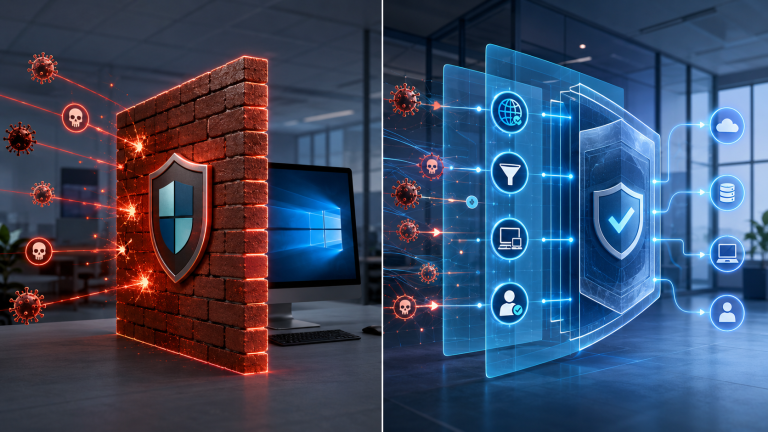
To keep up, antivirus solutions have changed a lot over the years. Instead of only looking for known viruses, modern tools watch how programs actually behave. If a file suddenly starts hundreds of processes, quietly encrypts documents in the background, or tries to send data out without permission, the software raises a red flag – even if it has never seen that exact threat before. On top of this behavior analysis, many vendors now train AI models on millions of data points to catch suspicious patterns at an early stage. These systems don’t just recognize known attack methods; they also learn to spot behavior that looks similar to malware, even when it’s a brand-new variant. And antivirus itself has changed its role: it’s rarely a standalone program anymore. Instead, it usually forms part of a larger security platform, such as Endpoint Detection and Response (EDR), which makes protection more connected, more adaptive, and more proactive overall.
A good example of this shift is Windows Defender. Ten years ago, it was seen as a joke in the security industry. By 2026, it has turned into a serious competitor to many paid products. Thanks to cloud integration and AI-driven updates, it now offers strong protection – and it comes for free. For many companies, this raises an uncomfortable question: why pay for expensive licenses if the operating system already delivers solid built-in protection?
In short, antivirus has grown from a simple virus scanner into a multi-layered security tool. But this evolution fuels an important debate: do companies still need third-party solutions in 2026, or is antivirus becoming more of a “nice to have” than a genuine must-have?
Snake Oil – What’s Really Behind It?
The term “snake oil” goes back to the 19th century. Traveling salesmen in the United States used to sell miracle cures – supposedly made from snake oil – that claimed to heal everything from headaches to rheumatism. In reality, these products were useless but brilliantly marketed.
In cybersecurity, the term has stuck around to describe products that promise a lot but deliver very little. Antivirus vendors have often been accused of exactly that, and a few warning signs tend to repeat themselves. The clearest one is unrealistic promises: claims like “100% protection against all threats” or “guaranteed absolute security” are immediate red flags, because there’s no such thing as 100% safety in cybersecurity – new attack methods emerge every day. Closely related is an overload of buzzwords. Terms like “Next-Gen,” “Military-Grade Encryption,” or “Quantum-Safe AI” sound impressive, but they’re often just marketing fluff with little real innovation behind them. Another common trick is charging for features that already exist in the operating system, such as selling a separate “firewall module” when Windows and macOS have shipped with solid firewalls for years. And finally, there’s fear-based marketing: instead of being transparent, many vendors push panic, warning that “without our product, your business will face total shutdown.” If a company sells fear instead of facts, that’s rarely a good sign.
A good example of this is a mid-sized company that pays thousands of dollars a year for a flashy “AI-powered” security suite. In practice, it doesn’t block more threats than Microsoft Defender – and it regularly produces false alarms that frustrate employees. The result is high costs, wasted time, and no real improvement in security.
So why do companies still fall for it? Often it comes down to uncertainty: cybersecurity is complex, and decision-makers want to play it safe rather than risk being blamed later. Many smaller businesses also lack in-house security experts, so they simply trust the sales pitch instead of questioning it. And in some cases, regulatory pressure plays a role too, since certain compliance frameworks still explicitly require “antivirus software,” even though modern defenses go far beyond that single tool.
In short, snake-oil vendors exploit the fear of cyberattacks and sell expensive licenses that rarely provide any measurable extra protection.
Where Antivirus Still Makes Sense in 2026
Conclusion: Does my company still need antivirus software in 2026
So, do you still need antivirus software in 2026? Maybe. But “Do I have antivirus?” is no longer the right question. The better question is: “What happens if someone clicks a malicious link tomorrow?”
Can your systems detect suspicious activity? Can they stop an attacker after the first compromise? Are stolen passwords protected by stronger controls? Will someone notice if an attacker moves through your network? And, just as importantly, can your business recover quickly if prevention fails?
That is where the old antivirus mindset falls short. Installing a security product and seeing a green check mark does not mean your company is secure. A tool can block thousands of malicious files and still fail to protect you from a stolen password, a convincing phishing attack, a compromised account, or an attacker using legitimate software already installed on your systems.
For some companies, the security built into their operating systems, combined with strong identity protection, regular updates, employee awareness, backups, and good security practices, may already provide enough protection without paying extra for traditional third-party antivirus.
For others, a professionally managed endpoint security solution can still be extremely valuable. The difference is that you are no longer buying antivirus simply because “every computer needs antivirus.” You are buying visibility, detection, response, and protection that fits your actual risk. And that is the real point in 2026:
Don’t buy antivirus because you are afraid of viruses. Don’t avoid it because someone says antivirus is dead.
First understand what your business needs to protect, where your real weaknesses are, and what your existing security controls already cover. Then decide whether another security product solves a real problem — or simply adds another subscription to your monthly expenses. Because the goal of cybersecurity is not to own more security tools.
The goal is to make it harder for attackers to succeed — and easier for your business to recover when something goes wrong.
Don’t miss out on important content anymore: Follow CybersecureGuard on Facebook now and get additional tips and updates on IT security for your business.
I also recommend to read the following article
Enterprise Antivirus Doesn’t Stop Every Cyber Attack — Here’s Why
Is Windows Defender 2025 still the best protection?
Phishing 2026: How Attackers Are Becoming Increasingly Professional
The truth about virus protection on your smartphone
Why Weak Firewall Configurations Still Allow Ransomware Attacks
Why Virus Protection Alone Is Rarely Enough – and Why Knowledge Is the Key